A library of books with a purpose.
The Bible is a library of books, not a single book. The Bible includes 66 books that were written over about 1,600 years (from about 1500 BC to AD 100), by more than 40 authors. The Old Testament has 39 books (written about 1500 to 400 BC) and was written mainly in Hebrew and some in Aramaic. The New Testament has 27 books (written about AD 45-100) and was written in Greek. Christianity is a special revealed religion of truths about God. This sets it apart from naturalistic religions like Hinduism or Buddhism, and other New Age religions based on the subjective insight and feelings of gurus, prophets, and leaders who claim to have more enlightenment and insight than the rest of us. The Bible is a unique library of books from the mind of God that tells us that God loves the world and wants to have a relationship with us through Jesus Christ. Erwin W. Lutzer, Seven Reasons Why You Can Trust the Bible (Chicago, IL: Moody Press, 1998), 16.

God inspired the words of the Bible.
Inspired by God or God-Breathed.
The language or text of the Bible was inspired by God or God-breathed, meaning the authors were writing God’s own words (Exodus 17:14; Jeremiah 1:9; Ezekiel 1:2; Hosea 1:1) as divinely authoritative for Christian faith and practice. Inspiration is “verbal” in that it applied to the words, not the authors or just the ideas or general concepts. Inspiration is “plenary” in that it applies to everything in the Bible as God intended, not just the spiritual teachings of God. Inspiration is “confluent” in that God spoke through and used humans to communicate, but the words were God’s words. The Bible claims to be written by God over 1,500 times. Jesus agreed that the words of the Old Testament came from God (Matthew 19:4-5; Mark 12:36). The apostle Paul wrote, “All Scripture is breathed out by God and profitable for teaching, for reproof, for correction
and for training in righteousness, that the man of God may be competent, equipped for every good work” (2 Timothy 3:16-17 ESV). Paul also included Jesus’ words as Scripture as recorded in the Gospel of Luke (1 Timothy 5:18; Luke 10:7). The apostle Peter also referred to Paul’s letters as Scripture (2 Peter 3:16). Paul considered his own writing as scripture (1 Timothy 4:11-13). The apostle John also claimed that God gave him authority to reveal end times prophecy (Revelation 22:18-19). Because God breathed out the words, the Bible is the full and final authority for Christians. Timothy Paul Jones, PhD, How We Got the Bible (Peabody, MA: Rose Publishing, 2015), 11-12. It is important to clarify that God’s words are inspired and not the authors, the inspiration applies only to the original writings/autographs, and we don’t know fully understand how God actually inspired the authors. Sometimes God wrote or dictated word for word. For example, God gave Moses the 10 Commandments and Moses wrote them down a second time and taught them (Exodus 20:1-17; Deuteronomy 4:13-14, 5:1-22). Sometimes God gave the authors ideas that they were allowed to write in their own words and style. For example, Paul wrote his letters in his words and style. Sometimes the authors just wrote what they had investigated and seen. For example, Luke wrote his account of the life and ministry of Jesus (Luke 1:3-4). Lutzer, Seven Reasons Why You Can Trust the Bible, 21-23, 39-53, 64.
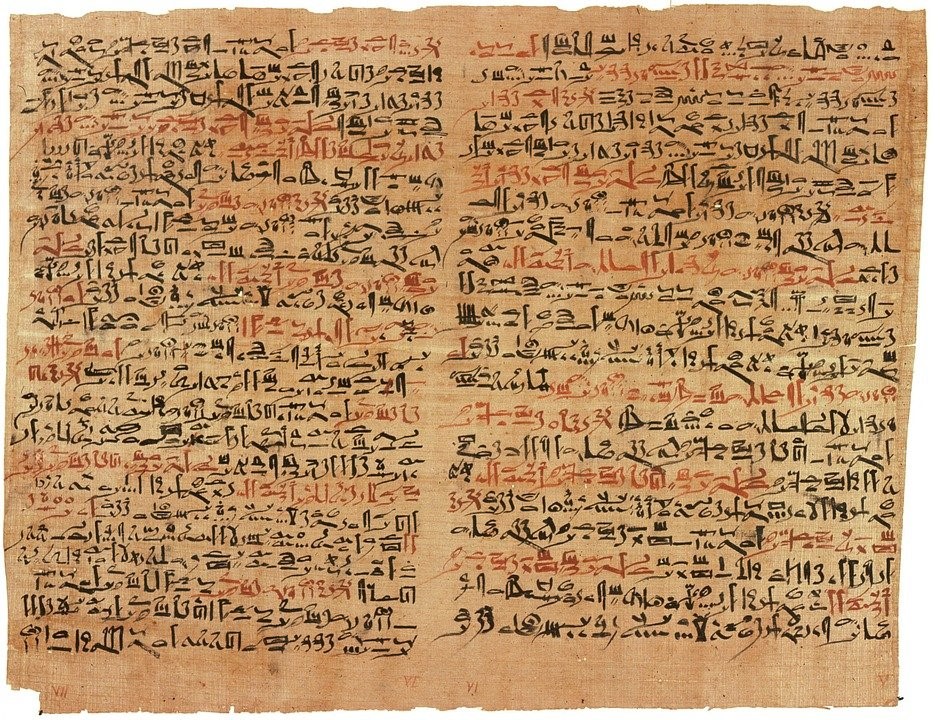
Papyrus with cuneiform script.
What materials was the Bible text written on?
Papyrus is a plant reed that grows in marshy areas (Job 8:11) and each reed can grow to about 15 feet tall and be as thick as a human wrist. Paper was made from papyrus by using needles to separate the pith of the plant into broad, thin strips. Then these strips were placed in two layers that were perpendicular to each other. The layers were pressed together, dried, and rubbed smooth. The Egyptians produced and wrote on papyrus paper for more than a thousand years before Moses was born. The original autographs of the Old Testament and New Testament texts deteriorated and decayed into dust, or were burned when Israel was conquered on multiple occasions or were destroyed when the original autographs became too worn for use.
Originally, the papyrus paper was rolled into scrolls up to about a maximum length of about 35 feet. In about the early 100s AD, the papyrus paper was cut in sheets and bound like a book in a papyrus codex. Finer and smoother writing surfaces were bleached and stretched animal skins from calves (vellum) and sheep, goats, or calves (parchment), and were used for more than 1,000 years (AD 300 to 1400) to make codices. Two of the oldest codex copies that exist today are the Codex Vaticanus (AD 325-350) and the Codex Sinaiticus (AD 350). Jones, How We Got the Bible, 34-38; Dr. Craig Evans, Dr. Dan Wallace, narrated by John Rhys-Davies, Can We Trust the Bible? Fragments of Truth (Faithlife Films, 2018); Corie Bobechko Bible Discovery Program Video Segment on Papyrus Plant and Paper for Psalm 9-14, May 5, 2021. https://www.youtube.com/watch?v=ZuAqtsmc2G0

A papyrus plant reed.
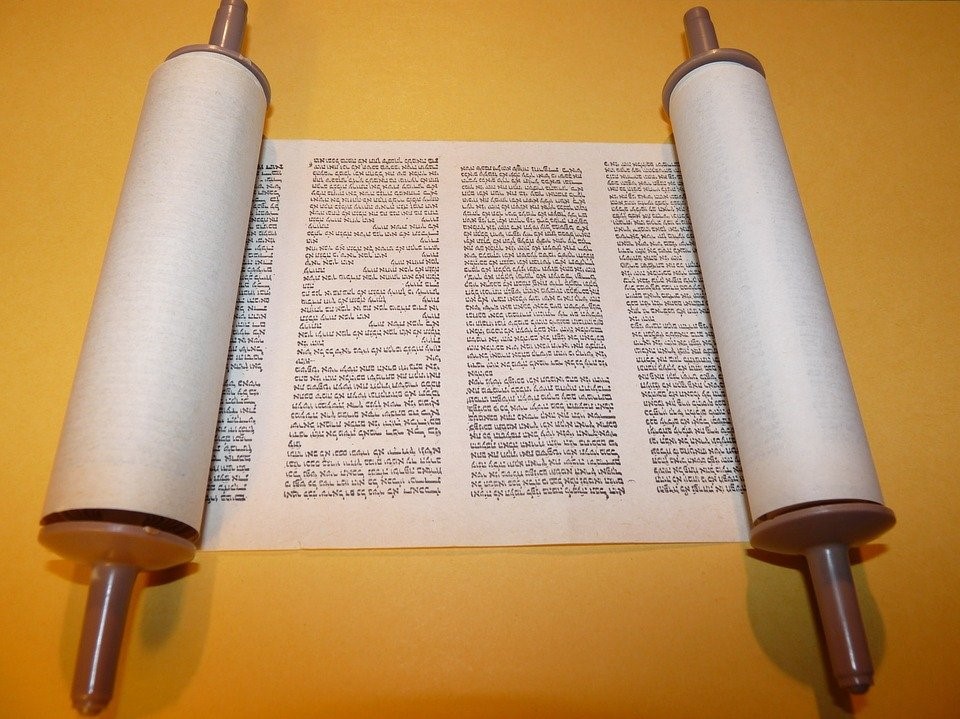
A scroll of the Old Testament Torah.
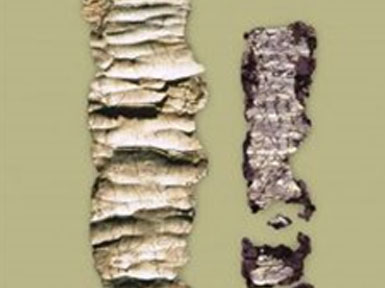
Dating approximately seven centuries before Jesus (700-600 BC), one of the oldest of all extant Hebrew manuscript fragments is Aaron’s priestly benediction or blessing at Numbers 6:24-26 on silver amulets (tiny, rolled-up silver sheets) uncovered in 1979 in a burial chamber outside the Old City of Jerusalem at Ketef Hinnom. Paul D. Wegner, A Student’s Guide to Texual Criticism of the Bible (Downers Grove, IL: IVP Academic, 2006), 140-142 cited by Hank Hanegraaff, Has God Spoken? Memorable Proofs of the Bible’s Divine Inspiration (Nashville, TN: Thomas Nelson, 2011), 10; Corie Bobechko Bible Discovery Program Video Segment on Ancient Silver Amulets for Psalm 9-14, May 13, 2021 and reference to Psalm 12:6-7 as general prophecy that the LORD’s word is like silver that he will preserve, “The words of the LORD are pure words, like silver refined in furnace on the ground, purified seven times. You, O Lord, will keep them, you will guard us from this generation forever” (ESV). https://www.youtube.com/watch?v=ZeMn4d8Y6z0
Ancient silver amulets from Ketef Hinnom
inscribed with the blessing of Numbers
6:24-26. Image from the Israel Museum,
Jerusalem by Nahum Slapak.