

The definition of the Trinity.
The doctrine of the Trinity is one of the fundamental doctrines of the Christian faith. The Trinity may be defined as, “God eternally exists as three persons, Father, Son, and Holy Spirit, and each person is fully God, and there is one God.” Trinity also means “tri-unity” or “three-in-oneness” and demonstrates the interpersonal relationship within the being of God. God the Father directs and has authority over Jesus the Son (John 8:18-19, 50, 54), Jesus the Son obeys and is responsive to the directions of God the Father (John 12:49-50), and the Holy Spirit is obedient to the directives of both God the Father and Jesus the Son (John 14:16, 26). In these relationships, the persons carry out the roles that are appropriate to each person while still being equal in person. Grudem, Systematic Theology, 226-227, 634; Grudem and Purswell, Bible Doctrine, 104, 116-117.
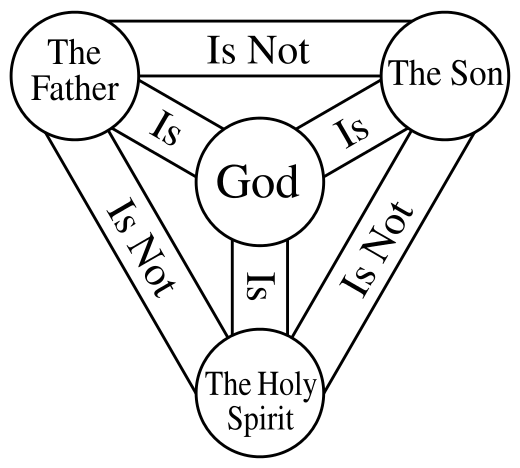
“Shield of the Trinity” diagram from Wikimedia Commons.
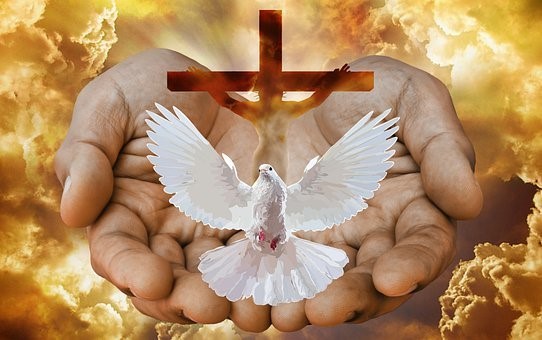
God’s hands, Jesus on the cross, and the Holy Spirit as a dove.
Where the Trinity is taught in the Bible.
The word “Trinity” is not found in the Bible, but the concept or doctrine of the Trinity is taught in many places. In the Old Testament, God reveals the Trinity in a sampling of verses as follows: “Let us make man in our image, after our likeness” (Genesis 1:26 RSV). “Behold, the man has become like one of us, knowing good and evil” (Genesis 3:22 RSV). “Come let us go down, and there confuse their language” Genesis (11:7 RSV). “Then I heard the voice of the Lord saying, ‘Whom shall I send? And who will go for us?” And I said, “Here I am. Send me!’” (Isaiah 6:8 NIV).
In the New Testament, God reveals a more complete description of the Trinity in a sampling of verses as follows: “As soon as Jesus was baptized, he went up out of the water. At that moment heaven was opened, and he saw the Spirit of God descending like a dove and alighting on him. And a voice from heaven said, ‘This is my Son, whom I love; with him I am well pleased.’” (Matthew 3:16-17 NIV).
At the end of Jesus’ ministry on earth, he told the disciples that they should go “and make disciples of all nations, baptizing them in the name of the Father and of the Son and of the Holy Spirit” (Matthew 28:19 RSV). “Now there are varieties of gifts, but the same Spirit; and there are varieties of service, but the same Lord (Jesus); and there are varieties of working, but it is the same God who inspires them all in every one” (1 Corinthians 12:4-6 RSV). “The grace of the Lord Jesus Christ and the love of God and the fellowship of the Holy Spirit be with you all” (2 Corinthians 13:14 RSV). “There is one body and one Spirit, just as you were called to the one hope that belongs to your call, one Lord (Jesus), one faith, one baptism, one God and Father of us all, who is above all and through all and in all” (Ephesians 4:4-6 RSV). “According to the foreknowledge of God the Father, by the sanctifying work of the Spirit, that you may obey Jesus Christ and be sprinkled with his blood” (1 Peter NASB). “But you, dear friends, by building yourselves up in your most holy faith and praying in the Holy Spirit, keep yourselves in God’s love as you wait for the mercy of our Lord Jesus Christ to bring you to eternal life” (Jude 20-21 NIV). Grudem, Systematic Theology, 227-231; Grudem and Purswell, Bible Doctrine, 104-106.
.
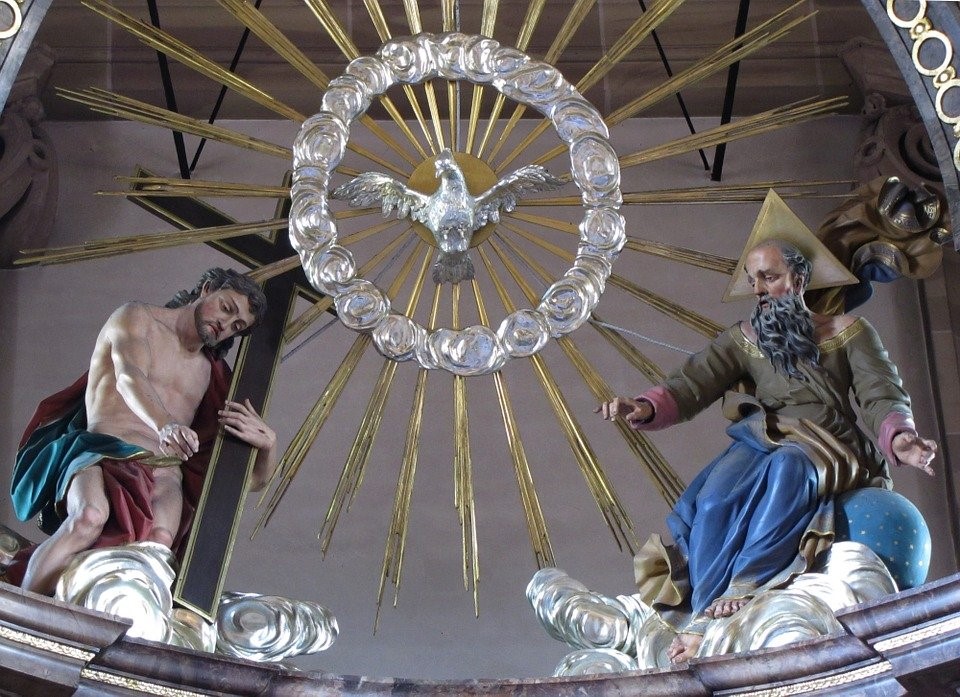
France St. Michel Church Trinity Display.
Why the Trinity is fundamental to Christianity.
The teaching of the Holy Spirit has implications at the very heart of Christianity. First, it is necessary for Jesus to be fully God and not a created being because he has to bear the full wrath of God in order to atone for all of our sins. A finite created being could not spiritually save us. Second, if Jesus is not fully God, we may doubt whether we can trust Jesus to justify us by faith so we can have a relationship with God (Ephesians 2:8-9). Third, God’s commands to pray to and worship Jesus (Philipians 2:9-11; Revelation 5:12-14) would be a command to commit idolatry if Jesus is not fully God. Fourth, since only God can spiritually save us and God tells us that Jesus saves us, Jesus must be God. Fifth, the Trinity demonstrates the independence and personal nature of God. God does not need humans, but he created them so that he could have a relationship with them just like the persons of the Trinity have a relationship with each other. Sixth, the Trinity demonstrates God’s perfect plurality and perfect unity when God created the universe by unifying and fine tuning the diverse elements of the universe so that the universe and life can exist. Grudem, Systematic Theology, 226-227, 247; Grudem and Purswell, Bible Doctrine, 114-116.
Analogies for the Trinity.
Analogies can be helpful to understand the Trinity, but they all are not fully adequate for a full understanding of the Trinity. For example, God is like a three-leaf clover, which has three parts yet one clover, is not fully accurate because each leaf is only part of the clover, and any one leaf cannot be the whole clover. But each of the three persons of the Trinity is fully God, not just a separate part of God. The analogy of three forms of water (steam, water, and ice) is not fully accurate because water is not ever all three of these forms at the same time and these forms have different properties and or characteristics. The most accurate analogy is describing a person as a son/daughter, husband/wife, and father/mother, because these titles speak of distinct persons and the close relationship that exists between them in a human family. But a person has not been all of these titles his or her entire life and they do not become separate persons when they get married or have children. Therefore, although analogies may be helpful to understand certain aspects of the Trinity, the analogies are limited and do not fully explain all aspects of the Trinity. Grudem, Systematic Theology, 240-241; Grudem and Purswell, Bible Doctrine, 110-111.

The three-leaf clover as an analogy of the Trinity.