

- Anything that begins to exist must have a cause.
- The universe began to exist.
- Therefore, the universe must have a cause.
- This cause must be eternal, meaning it is uncaused.
- This cause must be timeless.
- This cause must be nonmaterial.
- This cause must be powerful.
- This cause must be intentional.
- This cause has the attributes of what we normally call God.
- IF THERE IS A BEGINNING, THERE MUST BE A BEGINNER.
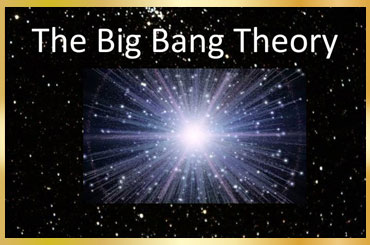
EVIDENCE IN SUPPORT OF THE COSMOLOGICAL ARGUMENT
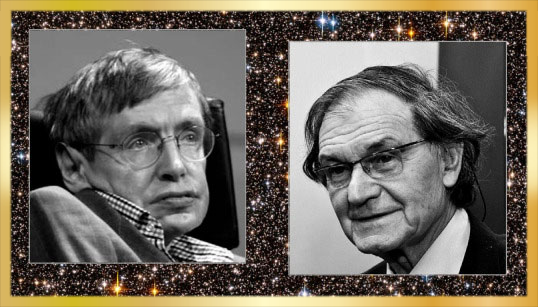
Stephen Hawking
Roger Penrose
“[A]lmost everyone now believes that the universe, and time itself, has a beginning at the big bang.” Theoretical physicists, Stephen Hawking and Roger Penrose, The Nature of Space and Time (Princeton, NJ: Princeton University Press, 1996), 20. According to the Big Bang Theory, the universe is finite in size and age, and all space and time originated with a single powerful explosive expansion event about 13.7 billion years ago, and is still expanding. The solar system formed about 4.5 billion years ago and the Earth became habitable about 3.8 billion years ago. Clear & Convincing Christianity endorses the Big Bang Theory and the (Old Earth Christian) standard cosmological timeline. The creation account in the Bible and reference to the 6 days of creation may refer to longer periods or ages of time. Old Earth Christians also contend that God created humans about 10,000 to 130,000 years ago. Evolutionists contend that humans first appeared on the Earth about 1 million years ago. Hugh Ross, The Creator and the Cosmos: How the Latest Scientific Discoveries Reveal God, (Covina, CA: RTB Press, 4th ed., 2018), chapters 3 and 17; Stephen C. Meyer, Return of The God Hypothesis: Three Scientific Discoveries That Reveal the Mind Behind the Universe, (New York, NY: Harper Collins Publishers, 2021), chapters 5 and 12.
Some Christians (Young Earth Christians) do not believe in the Big Bang Theory and the above referenced ages of the universe, solar system, and Earth. Young Earth Christians believe the Bible and the scientific evidence indicate that God created the universe, solar system, and Earth about 6,000 to 10,000 years ago and that God also created humans about 6,000 to 10,000 years ago, according to a more literal interpretation of the Bible. Young Earth Christians oppose the Old Earth scientific claims because they think they are based solely on the examination of the scientific evidence. Of course, Old Earth Christians could be wrong. The age of the universe, Earth, and life is one of those “in-house debates” that Christians can agree to disagree on in good faith. It is Clear & Convincing Christianity’s position that some of the most convincing scientific evidence for the creation, age, and design of the universe, Earth, and life comes from modern physics, cosmology, genetics, and chemistry. David G. Hagopian-Editor, The Genesis Debate: Three Views on the Days of Creation, (Mission Viejo, CA: Crux Press, Inc., 2001).
There is other scientific evidence for the beginning of the universe and time. In 1915, Albert Einstein proposed his General Theory of Relatively which described gravity and its relation to the interdependent nature of time, space, and matter. It predicted an expanding universe, thus implying a beginning of time, space, and matter. At first, Einstein did not accept the implications of his theory because it conflicted with the common view of his scientific peers that the universe was eternal and static. He developed the cosmological constant in his equations to preserve belief in an eternal, static universe. He was later convinced that the universe was not eternal, and referred to his cosmological constant as “the greatest blunder of my life.” Donald Goldsmith, Einstein’s Greatest Blunder? The Cosmological Constant and Other Fudge Factors in the Physics of the Universe (Cambridge MA: Harvard University Press, 1995), 7. The evidence that convinced Einstein follows.
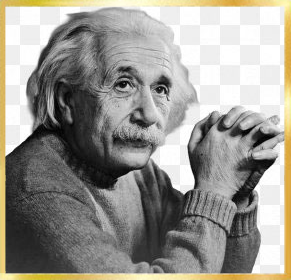
Albert Einstein
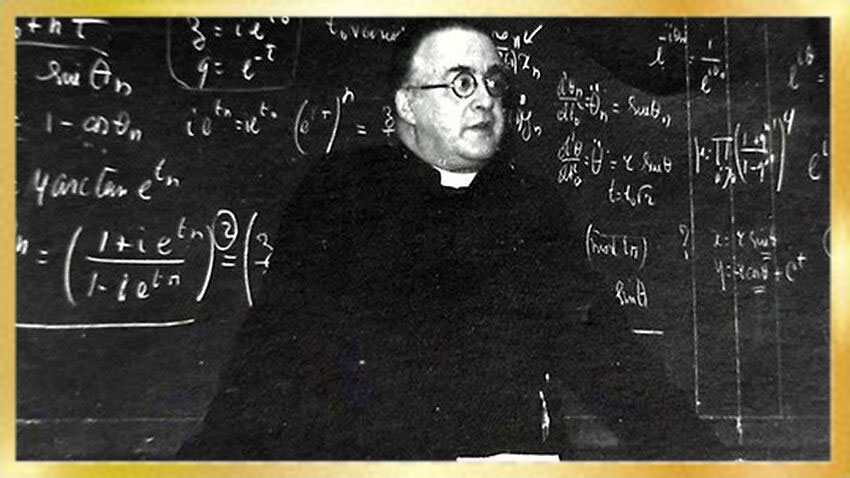
In 1927, Belgian astronomer Georges Lamaitre developed the theory that the universe began with a single explosion from a densely compacted state, which became known as the Big Bang Theory as discussed above. Georges Lemaitre, Annales de la Societe Scientifique de Bruxelles Tomme XLVII, Series A, Premiere Partie (April 1927).
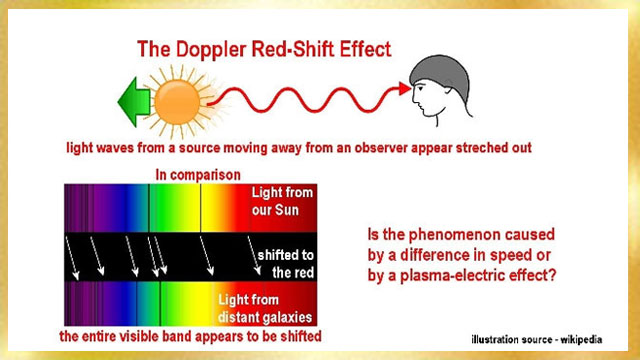
In 1929, astronomer Edwin Hubble published a study supporting the Big Bang Theory indicating that all galaxies are receding from one another and that the universe is expanding. Hubble’s research involved the Doppler effect in light waves. The light waves that come from an approaching object shift toward the higher blue end of the spectrum of visible light, whereas light waves coming from a receding object shift down toward the lower red end of the spectrum of visible light. Hubble confirmed that galaxies are receding from one another by discovering a disproportionately high level of red light coming from virtually every galaxy. If every observable galaxy is moving away from every other galaxy, the universe is expanding. Guillermo Gonzalez and Jay W. Richards, The Privileged Planet: How Our Place in the Cosmos is Designed for Discovery (Washington, D.C.: Regnery, 2004), chapter 9.
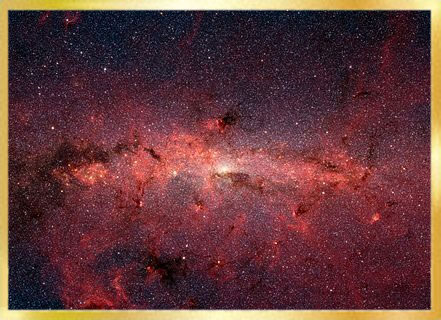
Cosmic Background Radiation view of the Milky Way taken by the
Spitzer Space Telescope – afterglow of the Big Bang
In 1965, two Bell Lab scientists, Arno Penzias and Robert Wilson, detected on their antenna, cosmic background radiation afterglow that was light and heat from the initial explosion from the Big Bang. As early as 1948, scientists predicted that this radiation would still be present if the Big Bang really did occur. Penzias and Wilson received Nobel Prizes for this discovery. Robert Jastrow, God and the Astronomers (New York: Norton, 1978), 15-16.
If the Big Bang occurred, scientists also believed that they would see slight ripple variations in the temperature of the cosmic background radiation. In 1989, NASA launched a $200 million satellite called COBE for Cosmic Background Explorer with equipment to detect and measure any temperature ripple variations in the background radiation. In 1992, the project leader, astronomer George Smoot, announced COBE’s findings that they detected ripples that were so precise, that the explosion and expansion of the universe were precisely tweaked to cause just enough matter to congregate to allow galaxy formation, but not enough to cause the universe to collapse back on itself. Smoot called the ripples “machining marks from the creation of the universe” and the “fingerprints of the maker. “ Fred Heeren, Show Me God, (Wheeling, IL: Daystar 2000) 168. The infrared pictures taken by COBE point to the existence of matter from the very early universe that would ultimately form into galaxies and clusters of galaxies. Smoot called this matter “seeds” of the galaxies as they exist today. Michael D. Lemonick, “Echoes of the Big Bang,” Time, May 4, 1992, 62.
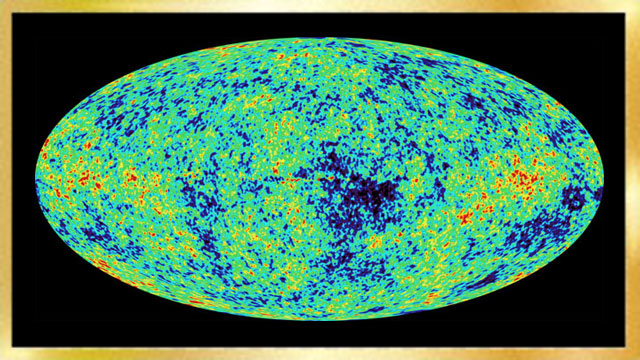
NASA image of the infant universe
Like a running car will run out of gas, the universe will eventually run out of useable energy.
Thermodynamics is the study of matter and energy. The First Law of Thermodynamics states that the total amount of energy in the universe is constant. The Second Law of Thermodynamics states, in part, that the universe is running out of usable energy. This causes scientists to conclude that one day the energy in the universe will be gone and the universe will die. Like a running car will eventually run out of gas, the universe will eventually run out of useable energy. Also, the universe must have had a beginning because there is not an infinite amount of usable energy. The universe currently is still in existence because it has not used all the energy yet.
The car also must have had a time when the gas tank was full because the car does not have an infinite amount of gas in the tank. The car still runs as long as it has gas. The Second Law of Thermodynamics is also known as the Law of Entropy, which states that nature tends to bring things to disorder. In other words, with time, things naturally fall apart. Your body, house, and car all fall apart or deteriorate. The universe is also becoming less ordered or deteriorating. Just like your car may not be completely rusted out yet, the universe has not become completely disordered yet. Therefore, there must have been a time when your car was brand new, just like there was a point of time when the universe was originally ordered. Norman Geisler and Frank Turek, I Don’t Have Enough Faith to Be an Atheist, (Wheaton, IL: Crossway Books 2004), 76-77.
OBJECTIONS TO THE COSMOLOGICAL ARGUMENT
Answer: Nothing. Only anything that begins to exist must have a cause. God is eternal, meaning God had no beginning. God is the uncaused first cause.
Answer: No. Even if there were multiverses, we would still need to determine what created the multiverses. Each multiverse would have a beginning.
Answer: The quantum vacuum itself is something, not nothing. Quantum theory predicts that quantum events will occur within range of well-defined statistical parameters that each require a highly ordered set of circumstances. It is highly unlikely that there is no underlying cause.
Answer: The first cause need not exist before time. This cause is timeless and unchanging because it exists outside of time. The first moment of time is identical to the first act of bringing the universe into existence.