

SPIRITUAL WARFARE, SATAN, AND DEMONS
Today Christians question whether Satan and demons still exist and whether they engage in spiritual warfare against Christians.
Satan and Demons.
Demons are “evil angels who sinned against God and who now continually work evil in the world. … “Satan” is the personal name of the head of the demons” Wayne Grudem, Systematic Theology: An Introduction to Biblical Doctrine (Grand Rapids, MI: Zondervan, 1994, Appendix 6 and glossary copyright 2000), 412, 414.
Satan.
The name “Satan” also means adversary. In the Bible, Satan is the adversary or the great opposer of God and human kind. Satan is also the personal name of the devil. Youngblood, R. F., Bruce, F. F., & Harrison, R. K., Nelson’s New Illustrated Bible Dictionary (Nashville, TN: Thomas Nelson, 1995).
The Old Testament Hebrew word for Satan sometimes refers to human enemies (1 Samuel 29:4; Psalm 109:6). One time it refers to the angel of the Lord who opposed Balaam (Numbers 22:22). But whenever Satan is used as a proper name in the Old Testament, it refers to the great superhuman enemy of God, people, and good (1 Chronicles 21:1; Job 1-2). Satan is also referred to as “the serpent” (Genesis 3:1, 14).
The word Satan also occurs frequently in the New Testament. Another common name for Satan in the New Testament is “the devil,” meaning “slanderer” or “false accuser.” The New Testament also identifies Satan as “the tempter” (1 Thessalonians 3:5); “Beelzebub” (Matthew 12:24); “the wicked one” (Matt. 13:19, 38); “the ruler of this world” (John 12:31); “the god of this age” (2 Cor. 4:4); “Belial” (2 Cor. 6:15); “the prince of the power of the air” (Eph. 2:2); and “the accuser of our brethren” (Rev. 12:10), and “the serpent” (2 Corinthians 11:3; Revelation 12:9, 20:2).
The origin and history of Satan.
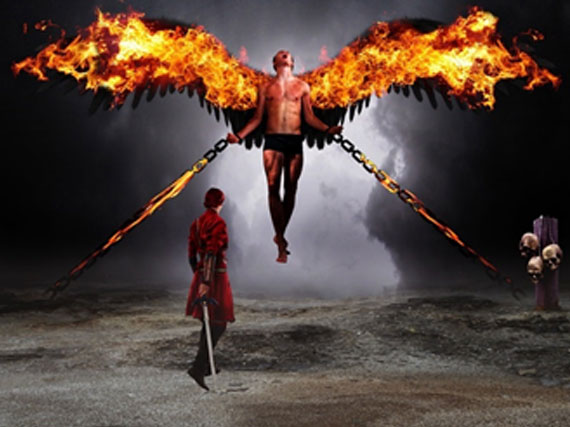
Satan the original fallen angel.
Genesis 3 describes a serpent, who apparently sinned before any humans sinned, and thereafter tempted Adam and Eve to sin. That serpent was Satan himself (Revelation 12:9; 20:2). The two Old Testament passages of Isaiah 14:12-15 and Ezekiel 28:11-19 furnish a picture of Satan’s original condition as a perfect anointed angel from heaven, and the reasons for his loss of that position: sinning and exalting himself above God. These passages were addressed originally to the kings of Babylon and Tyre, but most scholars believe that their long-range implications refer to Satan himself. Revelation 12 provides additional background on stages in Satan’s work of evil. In his fall from God’s favor, Satan persuaded one third of the angels to join him in his rebellion (Revelation 12:3-4). Throughout the Old Testament period, Satan sought to destroy the messianic line. When God became fully man as the Messiah Jesus, Satan tried to eliminate Jesus (Revelation 12:4-5). During the future period of tribulation before the Messiah’s second coming, Satan will
be cast out of God’s presence (Revelation 12:7-12). Then he will direct his animosity toward the Messiah’s people on earth (Revelation 12:13-17). Revelation 20 describes the final phases of Satan’s work. He will be bound for a thousand years and then finally cast into hell which is the lake of fire (Revelation 20:2, 10).
Satan’s characteristics.
As a result of his original status and authority as a great angel, Satan has great power and dignity. Satan’s strength is so great that Michael the archangel viewed him as a foe too powerful to argue with, so Michael deferred to and asked God to rebuke Satan (Jude 9). Satan has great influence in the world. His various titles emphasize his control of the world system: “the ruler of this world” (John 12:31), “the god of this age” (2 Corinthians 4:4), and “the prince of the power of the air” (Ephesians 2:2). The apostle John wrote, “The whole world lies under the sway of the wicked one” (1 John 5:19 NKJV). Satan exercises his evil influence in the world through demons (Matthew 12:24; 25:41; Revelation 12:7, 9). An upsurge of demonic activity occurred when Jesus came to earth the first time because of Jesus’ threat to and attack against Satan’s kingdom (Matthew 12:28-29; Acts 10:38). Another demonic upsurge is expected just before the second coming of Jesus, because this will bring about the downfall of Satan and his angels (Rev. 9:3-17; 12:12; 18:2).
Satan is also highly intelligent and deceptive. For example, he cleverly deceived Adam and Eve and took over their rule of the world for himself (Genesis 1:26; 3:1-7; 2 Corinthians 11:3). However, Satan’s impressive attributes are not limitless. God is able to restrict Satan’s power (Job 1:12; Luke 4:6; 2 Thessalonians 2:7-8). For example, Satan had to request God’s permission to afflict Job (Job 1:7-12).
God also permits Satan to afflict God’s people (Luke 13:16; 1 Thessalonians 2:18; Hebrews 2:14), but God never permits Satan to ultimately overcome them and the world (John 14:30-31; 16:33).
Satan aspires to replace God and have others worship him (Matthew 4:8-9; Revelation 13:4, 12). Since God has frustrated Satan’s aspirations and quelled Satan’s rebellion, he has become God’s exact opposite. He is “the wicked one” (Matthew 13:19, 38), while God is “the Holy One” (Isaiah 1:4). Satan is malicious and constantly opposes God, God’s people, and God’s truth (Job 1:7; 2:2; Matthew 13:28). Satan is always opposed to the best interests of God’s people (1 Chronicles 21:1; Zechariah 3:1-2). By tempting and persuading Adam and Eve to sin (Genesis 3), Satan gained the power of death, but Jesus broke Satan’s power over death through Jesus’ crucifixion and resurrection (Hebrews 2:14-15).
Satan’s Methods.
Satan uses various methods to carry out his work. His main method is temptation (Mathew 4:3; 1 Thessalonians 3:5). Sometimes Satan tempts people to sin by direct suggestion, as in the case of Judas Iscariot (John 13:2, 27); sometimes through his demons who disguise themselves as messengers of God (2 Thessalonians 2:9; 1 John 4:1); and sometimes through a person’s own weaknesses (1 Cor. 7:5). Satan tempted Jesus directly and tried to lead Jesus into compromise by promising Jesus worldly authority and power, but Jesus withstood the temptation by exposing Satan’s misstatements of God’s words (Luke 4:5-13).
Satan’s second main method is deception (1 Timothy 3:6-7; 2 Timothy 2:26). Satan is the father of lies whereas Jesus is the truth (John 8:32, 44, 14:6). Satan’s great and most frequent deception is that good can be attained by doing wrong. This lie is present in practically all his temptations (Gen. 3:4-5). As the great deceiver, Satan is an expert at falsifying truth (2 Corinthians 11:13-15).
Satan’s other methods are doubt (Genesis 3:1), persecution (Matthew 13:21; Mark 4:17, 10:30; Romans 8:35; 2 Timothy 3:12), and self-reliance (1 Chronicles 21:1-2; Psalm 147:10-11; Jeremiah 9:23-24; 1 Corinthians 10:12;
Satan uses his methods to attempt to silence the gospel and stop the spread of God’s message to the world (Matthew 13:19; 1 Thessalonians 2:17-18). When the gospel is preached, Satan tries to blind people’s understanding so they cannot grasp the meaning of the message (2 Corinthians 4:3-4; 2 Thessalonians 2:9-10). Sometimes Satan opposes the work of God by violence (John 13:2, 27; 1 Peter 5:8; Revelation 12:13-17). He also brings disorder and chaos into the physical world by afflicting human beings (Job 1-2; 2 Corinthians 12:7; Hebrews 2:14). Sometimes God allows Satan to afflict people to correct them (1 Timothy 1:20).
Satan’s defeat and destiny.
Satan is destined to be defeated in his continuing rebellion against God. His final defeat is predicted and described in the New Testament (Luke 10:18; John 12:31; Revelation 12:9, 20:10). Jesus’ death started the defeat and destruction of Satan and his power over the death and the world (Hebrews 2:14–15; 1 Peter 3:18, 22). Jesus’ death and resurrection followed Jesus’ sinless life during which Jesus triumphed over the enemy Satan repeatedly (Matthew 4:1-11; Luke 4:1-13). The final defeat of Satan and his destiny will occur when Jesus returns and Satan is cast into the lake of fire (Revelation 20:1-15).
How Christians can defeat Satan’s temptation to sin.
Strength and power for your victory over Satan’s temptation to sin has also been provided through the death and resurrection of Jesus. You have assurance that “the God of peace will crush Satan under your feet” (Romans 16:20 NKJV). But such personal victory depends on your will to offer resistance to Satan’s temptations (Ephesians 4:25-27; 1 Peter 5:8-9). To help you win this battle against Satan, God has provided the power of Jesus’ blood (Revelation 12:11), the continuing prayer of Jesus in heaven for believers (Hebrews 7:25), the leading of the Holy Spirit (Galatians 5:16), and various weapons and armor for spiritual warfare (Ephesians 6:13–18).
The reality of Satan.
Some people deny the existence of Satan as their spiritual enemy. But Satan’s existence and activity partially explain the problems of evil and suffering in the world. God makes it clear through the Bible that Satan exists and that his main work is to oppose the rule of God and the best spiritual interests of humankind. Why would God allow Satan to exist in God’s creation? God does not directly answer this question in the Bible. Most likely, God allows Satan to exist to show that evil and wrongdoing do not provide the key to the ultimate meaning of life. Also, God will ultimately defeat evil and put an end to suffering (Revelation 20-21).
Demons.
Demons are “the fallen angels who joined the kingdom of Satan in rebellion against God” Youngblood, Bruce, Harrison, Nelson’s New Illustrated Bible Dictionary.
The origin and history of Demons.
The origin of demons is not explicitly discussed in the Bible, but the New Testament describes the fall and later imprisonment of a group of angels (1 Peter 3:19-20; 2 Peter 2:4; Jude 6). God removed the angels from God’s presence and restrained them until the final judgment, but the angels still continue their activities in the world until the final judgement. Wayne Grudem, Systematic Theology, 412-413. These angels that participated in the fall followed the original fallen angel, Satan. The fall left Satan and his angels free to contaminate and oppress the human race with wickedness (Genesis 3; Matthew 25:41; Revelation 12:9). A symbolic view of this “initial” fall appears in Revelation 12:3-4 where the dragon (a symbol for Satan) “drew a third of the stars of heaven” (a symbol for angels) and “threw them to the earth.” Therefore, Satan has his own angel followers that are demons (Matthew 25:41; Revelation 12:9).
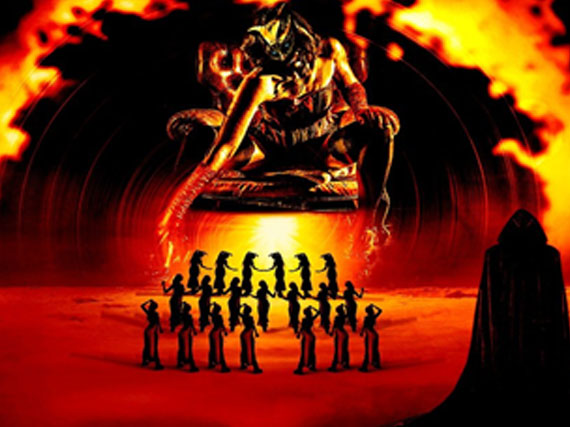
Demons are fallen angels that follow Satan.
Demons in the Old Testament.
The Old Testament contains little information about demons because the Israelites believed in God’s power over all spirits. For example, a fallen angel may have been a “distressing (or evil) spirit from God” (1 Samuel 16:15–16, 23) that brought great distress to King Saul. The prophet Micaiah spoke about a “lying spirit” from the Lord that may have been a demon (1 Kings 22:21-23). Pagan and idol worship were also related to demon activity (Leviticus 17:7; Psalm 106:37).
Demons in the New Testament.
The New Testament accepts and expands the Old Testament teaching about demons. Demons are designated in a number of different ways. Demons are called “unclean spirits” (Matthew 10:1; Mark 6:7), “wicked (or evil) spirits” (Luke 7:21; Acts 19:12–13), “deceiving spirits” (1 Timothy 4:1), “spirits of demons” (Revelation 16:14), and a “spirit of divination” (Acts 16:16).
Satan himself is not specifically referred to as a demon in the Bible. The only demon named in the New Testament is “Abaddon” in Hebrew and “Apollyon” in Greek (Revelation 9:11). Some scholars believe this demon is another name for Satan or a fallen angel. Other scholars contend that there is more biblical evidence that indicates this demon was a fallen angelic leader who is subject to the kingly rule of Satan. Legion (Mark 5:9; Luke 8:30) is probably a collective name for a group of demons instead of the name of a single demon.
One of the main purposes of Jesus’ ministry was to overcome the power of Satan over death and the world. This included Jesus’ conquest of the demonic realm (Matthew 12:25-29; Luke 11:17-22; John 12:31; 1 John 3:8). This purpose explains the fierce conflict between Jesus and these evil spirits while Jesus was on earth. At the same time, Jesus’ enemies accused Jesus of being in alliance with Satan’s kingdom, including his demons (Mark 3:22; John 8:48). This same accusation was made against Jesus’ forerunner, John the Baptist (Matthew 11:18; Luke 7:33). But Jesus’ works of goodness and righteousness showed that these claims were not true (Matthew 12:25-29; Luke 11:17-22).
Since the resurrection of Jesus and his return to heaven, these demons have continued their constant spiritual warfare against Christians (Romans 8:38-39; Ephesians 6:12). However, God will finally defeat and banish Satan and his demons to hell. After Jesus returns to the earth, the devil and his angels will be defeated and thrown into the lake of fire and brimstone (Matthew 25:41; Revelation 20:10). The demons are familiar with and predicted this torment and defeat (Matthew 8:29). God will achieve the ultimate victory in this spiritual conflict, which has been going on since the beginning of time.
Demon possession.
Demon possession in the Bible is defined as: “an affliction of persons in the New Testament who were possessed or controlled by demons (Matthew 4:24, 8:33; demoniac, NASB)” Youngblood, Bruce, Harrison, Nelson’s New Illustrated Bible Dictionary.
The New Testament graphically describes of the effects of demon possession. Some of the diseases which demons caused included muteness (Matthew 12:22; Mark 9:17, 25), deafness (Mark 9:25), blindness (Matthew 12:22), and bodily deformity (Luke 13:10-17). But demons were not responsible for all physical ailments. The gospel writers frequently distinguished between sickness and demon possession (Matthew 4:24; Mark 1:32; Luke 6:17-18). Demons also caused some mental problems (Matthew 8:28; Acts 19:13-16), ranting and raving (Mark 1:23-24; John 10:20), uncontrolled fits (Luke 9:37-42; Mark 1:26) and antisocial manner (Luke 8:27, 35).
Jesus and his disciples did not cast out demons by using the magical methods that were so often used by others at that time in history. Instead, Jesus expelled demons by his simple command (Mark 1:25; 5:8; 9:25). His disciples simply added the authority of Jesus’ name to the command (Luke 10:17; Acts 16:18). Even some people who were not Jesus’ followers invoked his power (Luke 9:49; Acts 19:13). In some instances, prayer was necessary before they could cast out a demon (Mark 9:29). By casting out demons, Jesus showed that the God’s rule over the world was a present reality. Casting out demons also demonstrated Jesus’ power over Satan and the demonic forces of sin and evil in the world.
Christians cannot be possessed by demons.
Although demons may influence, tempt, attack, and oppress Christians (Luke 4:2; 2 Corinthians 12:7, Ephesians 6:12; James 4:7; 1 Peter 5:8), demons cannot possess Christians because demons cannot completely dominate and control a Christian to the extent that the Christian has no power to resist the demon, choose to do right, and obey God. First, Jesus taught through the illustration of a house divided cannot stand, that a Christian could not be possessed by a demon. The Pharisees accused Jesus of casting out a demon as the ruler of the demons. Jesus responded that he cast out demons by the Spirit of God and asked, “How can one enter a strong man’s house and plunder his goods, unless he first binds the strong man? (Matthew 12:22-29). Jesus explained that in order for demons to possess Christians, the demons would have to bind God the Holy Spirit who indwells Christians. But the demons could not do so because the God-man Jesus could actually expel and bind demons. Second, Jesus also denied that he was possessed by a demon because he honored God the Father (John 8:49). Third, the Holy Spirit that indwells Christians can never cohabit with demons (2 Corinthians 6:15-16). Fourth, Christian salvation brings true victory over Satan (Romans 8:37; 1 Corinthians 15:57, 2 Corinthians 2:14), and deliverance and protection from Satan (Colossians 1:13). Fifth, the apostle John instructed Christians to test all spirits to see if they were from God. They were to reject all spirits that did not confess that Jesus Christ was God. John assured the Christians, “He (Jesus or the Holy Spirit) is in you is greater than he who is in the world (Satan, demons, and unbelievers)” (1 John 4:1-4). Sixth, there are no examples in the New Testament of a Christian that was possessed by a demon. John MacArthur, How to Meet the Enemy (Wheaton, IL: Victor Books, 1992), 21-22, Hank Hanegraaff, The Complete Bible Answer Book Collector’s Edition (Nashville, TN: Thomas Nelson, 2008), 336-337; Grudem, Systematic Theology, 423-425.
God’s provision to win spiritual war against Satan.
To help you win the spiritual war against Satan, God has provided the power of Jesus’ blood (Revelation 12:11), the continuing prayer of Jesus in heaven for believers (Hebrews 7:25), the leading of the Holy Spirit (Galatians 5:16), and various weapons and armor for spiritual warfare (Ephesians 6:13-18).
Spiritual warfare.

Spiritual warfare is between God/Truth against Satan/lies.
What is spiritual warfare? Answer: “A war of universal proportions pitting God and His truth against Satan and his lies. It’s a battle of wills between God and Satan. It’s a cosmic conflict that involves God and the highest creature He ever made and it filters down to every human being. Satan and his army of demons are fighting Christ, His holy angels, the nation of Israel, and believers. The battle lines are clearly drawn.” MacArthur, How to Meet the Enemy, 19.
God wants you as a Christian to resist Satan and to remain firm in your faith (James 4:7; 1 Peter 5:8–9).
You are to endure hardship that Satan may inflict (2 Timothy 2-4), fight the good fight by keeping faith in sound Christian doctrine while living a Godly life in good conscience (1 Timothy 1:18-19, 6:12), and stand firm in battle by resisting Satan (1 Corinthians 10:12; 1 Peter 5:8-9). MacArthur, How to Meet the Enemy, 60-68. In other words,
shun evil and draw near to God. When Satan or your own desires tempt you, resist. If you do that, God guarantees that the devil will flee (James 4:7). MacArthur, How to Meet the Enemy, 68.
Armor of God. Resisting Satan and demons is not a matter of speaking to them or rebuking them. God clearly describes the spiritual armor you are to use in spiritual warfare, “Put on the whole armor of God, that you may be able to stand against the schemes of the devil. …. Therefore take up the whole armor of God, that you may be able to withstand in the evil day, and having done all, to stand firm” (Ephesians 6:11, 13 ESV). “Full armor” means every armor piece is essential. God then provides a list of the spiritual combat equipment that the Holy Spirit issues to every believer at the moment of salvation (Ephesians 6:14-17):
The belt of truth.
The breastplate of righteousness.
The shoes of the gospel of peace.
The shield of faith.
The helmet of salvation.
The sword of the Spirit.
The belt of truth. Paul described the first piece of the armor of God as, “Stand therefore, having fastened on the belt of truth” (Ephesians 6:14 ESV). The belt of truth was a leather belt with an apron with small brass plates attached to provide protection that hung in front of the soldier’s groin and lower abdomen. When a Roman soldier prepared for battle, the belt would have been the first piece of protective equipment that he would put on. It clung closely to the soldier and shielded some of the most vulnerable areas of his body. The belt of truth is a reference to preparation, readiness, and commitment to God and the truth. This includes being ready to explain why you have hope, believe, and trust in Jesus (John 3:16; 1 Peter 3:15) and living as a person of Christian integrity that is honest and trustworthy (1 Peter 2:12). Then you will leave no room for Satan to gain an advantage in the spiritual battlefield and God will be glorified in you. MacArthur, How to Meet the Enemy, 77, 85; Timothy Paul Jones, The Armor of God: Put on the Full Armor Pamphlet (Peabody, MA: Rose 2005).
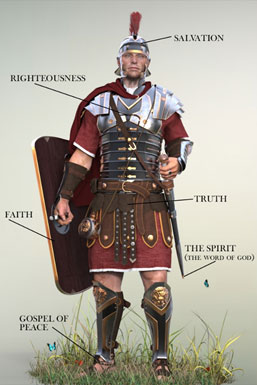
Armor of God image by Hallie Liening.
The breastplate of righteousness. The next piece of the armor of God to put on is the “breastplate of righteousness” (Ephesians 6:14 ESV). The Roman soldier fastened the breastplate around his chest to protect the soldier’s heart, lungs, and other vital organs. There were two types of breastplates. The first type of breastplate was made by joining several broad, curved metal bands together using leather thongs. The other breastplate was a chain link type breastplate that was constructed by linking small metal rings together until they formed a vest. God puts on “righteousness as a breastplate,” battles injustice and corruption, and restores peace and order to the land (Isaiah 59:17 ESV). God offers his own righteousness to every believer in Jesus Christ. Righteousness is not something that you can gain by doing good deeds. Satan’s ultimate goal is to spiritually destroy you, preventing you from becoming a citizen of heaven by getting you to believe you are going to heaven because of your good deeds. But all your best efforts apart from God will not help you get into heaven. As Isaiah said, “All our righteous acts are like filthy rags” to God (Isaiah 64:6 NIV). That is the best you can offer to God. Jesus addressed this issue in the parable of the good Pharisee who went to hell because he exalted himself, and the bad tax collector who went to heaven because he admitted he was a sinner (Luke 18:10-14). The apostle Paul said this about the human race: “There is no one righteous, not even one; there is no one who understands, there is no one who seeks for God. All have turned away, they have together become worthless; there is no one who does good, not even one” (Romans 3:10-12 NIV). The Greek word for “worthless” means going sour like milk. The whole human race has gone sour because “all have sinned and fall short of the glory of God” (Romans 3:23). Instead, your righteousness or rightness with God comes from faith and trust in Jesus Christ (2 Corinthians 5:21; Titus 3:5; Philippians 3:9). In summary, putting on the breastplate of righteousness means believing and trusting in Jesus and his righteousness, not your own (Romans 1:17; Galatians 2:20-21); standing firm against injustice and corruption (Leviticus 19:15; Hebrews 1:9); and knowing that God promises his protection against the forces of evil for those who have faith and trust in Jesus (2 Thessalonians 3:3). MacArthur, How to Meet the Enemy, 92-98; Jones, The Armor of God.

Roman soldier footwear. Image by Bible Lands Museum.
The shoes of the gospel of peace. The next pieces of the armor of God to put on are the shoes of “the preparation of the gospel of peace” (Ephesians 6:15 NASB) or the shoes of the “readiness given by the gospel of peace” (Ephesians 6:15 ESV). The Greek word “preparation” or “readiness” can also be translated “prepared foundation”, or in other words, a firm basis for a soldier’s feet. The footwear of the Roman soldier was a thick-soled, hobnailed semi-boot with thick leather straps that secured it to the foot. On the bottom of the sole were little pieces of metal that protruded like spikes to give the soldier firmness of footing so he could stand in battle. The soldier’s footwear was also designed to provide foot protection for long marches covering different terrains. In addition, the enemy soldiers commonly placed razor-sharp sticks in the ground to pierce the feet of the advancing soldiers. To protect themselves, soldiers wore boots with heavy soles that couldn’t be pierced. If their feet were pierced so that they couldn’t walk and stand up, they were rendered ineffective. Even before the Roman empire, the breaking of a soldier’s shoe was a metaphor for weakness or defeat (Isaiah 5:27-28).
In spiritual warfare, it is vital for you to wear the shoes of the gospel of peace for your defense, which means you embraced the gospel and put on the shoes at salvation: “having been justified by faith, we have peace with God through our Lord Jesus Christ” (Romans 5:1 NASB). That is what enables you to spiritually stand firm. If your feet are supported and protected with the good news of peace with God, you are protected and will be able to stand your ground against the devil (Ephesians 6:13). This is an objective peace, not peace based upon your feelings. God spiritually reconciled you to God through the death of His Son Jesus on your behalf as Paul wrote, “But God demonstrates His own love toward us, in that while we were still sinners, Christ died for us. Much more then, having now been justified by His blood, we shall be saved from the wrath of God through Him” (Romans 5:8-9 NASB). God poured out His vengeance, anger, and wrath on Christ, who acted as your substitute. Christ made full payment for your sins, and God’s anger was appeased. Your new status as a Christian is peace with God. Because Christ bore all your sins, you are forever holy and faultless in God’s sight. Therefore, before you believed and trusted in Jesus, you wanted to live for yourself. You did not care about God’s plans. You were in conflict. But God loves you and made a way for you to be reconciled with God and living in peace. God maintains this peace through Christ as your High Priest, who cleanses you from all your past and future sin after you repent from your sin (1 John 1:7-10) and mediates for you at God’s right hand (Hebrews 7:25) so that you can have peace with God forever (Hebrews 10:14). It is spiritually comforting to know that God is on your side. You are one with God and fully protected in Christ. Because of that, you can stand firm in battle against Satan. MacArthur, How to Meet the Enemy, 102-104; Jones, The Armor of God.
The shield of faith. The next piece of the armor of God to use in battle is the “shield of faith” (Ephesians 6:16 NASB). The Roman shield was made out of a thick plank of wood and covered on the outside with either metal or leather. Iron rims were fitted along the top and bottom edges, and an iron circle was attached to the center of the shield. The inner wood boards curved inward and a leather strap was fastened to the shield’s back. This outer covering was also very thick. The metal cover would deflect flaming arrows, while the leather cover would be treated or drenched in water to extinguish the enemy’s fiery arrows. Soldiers could put their shields together to create a wall of protection.
In spiritual warfare, you as a Christian can protect yourself from the enemy’s fiery arrows by using the shield of faith. As long as you believe and trust God, your shield of faith protects you. When Satan lies and you believe Satan, you put your shield down. Trust God in
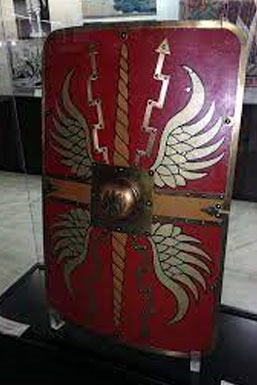
A Roman solder’s shield. Image from AncientFinances.com.
everything. The apostle John wrote, “Whatever is born of God overcomes the world; and this is the victory that has overcome the world—our faith” (1 John 5:4 NASB). You win by trusting in God. Even though Satan shoots his flaming arrows at you, you will find strength by believing in God’s Word. “Every word of God is pure; He is a shield to those who take refuge in Him. Do not add to His words or He will rebuke you, and you will be proved a liar” (Proverbs 30:5-6 NASB). Satan tries to add to God’s message, but what God says is true. God is a spiritual shield against Satan’s lies and deception.
The shield of faith is also your protection against temptation from Satan. Whenever you trust that God will provide everything you need, “the spiritual forces of evil” cannot tempt you with the lie that sin can provide a better life than God will (Ephesians 6:12 NASB). By trusting God, you can stop “all the flaming arrows of the evil one” which are the temptations and distractions that Satan may shoot at you (Ephesians 6:16 NASB). When faced with authentic faith in God, the powers of darkness are overcome. That is why the apostle John said, “whoever has been born of God overcomes the world; and this is the victory that has overcome the world: our faith” (1 John 5:4 NASB). Paul also said, “No temptation has overtaken you except something common to mankind; and God is faithful, so He will not allow you to be tempted beyond what you are able; but with the temptation will provide the way of escape also, that you may be able to endure it” (1 Corinthians 10:13 NASB).
Therefore, God’s battle plan for you is to consistently trust and apply what you know to be true about God to the issues of your life. If you don’t trust God, you don’t know God well enough. The more you know God through studying the Bible, meditating on God’s attributes, and praying to God, the more you will trust God to empower you to live how God wants you to live. MacArthur, How to Meet the Enemy, 109-119; Jones, The Armor of God.
The helmet of salvation. The next piece of the armor of God to use in battle is “the helmet of salvation” (Ephesians 6:17 NASB). The Roman soldier’s helmet was made from bronze or iron. Two hinged cheek-pieces protected the sides of the soldier’s face. The Roman soldier’s helmet protected his skull and neck from his enemy’s weapons and falling debris.
The helmet of salvation represents God’s ultimate victory over the forces of evil. Jesus’ death on the cross and his resurrection from the dead provides all Christians with freedom from the bondage of sin, and with eternal life with God in heaven. In spiritual warfare, to put on “the helmet of salvation” is to have assurance that Jesus has spiritually saved you, not because of your good deeds, but because of Jesus’ grace and mercy (Isaiah 59:17; 2 Timothy 1:9). You can also know that you are a “new creation,” no longer living for your selfish purposes, but living for God (2 Corinthians 5:17; 1 Thessalonians). You can accept that you are in a spiritual war and will be persecuted for believing and trusting in Christ. So keep your faith in your helmet of salvation and you will be blessed (Matthew 5:11-12) and you can look forward to eternal life with God (John 3:16). Finally, you can know that God will forgive you when you spiritually fail/sin and genuinely ask God for forgiveness (Romans 6:11-14; 1 John 1:9). Therefore, don’t let Satan discourage you. Don’t let him take away the hope of an eternal relationship with God in the new heaven and earth. MacArthur, How to Meet the Enemy, 121-133; Jones, The Armor of God.
The sword of the Spirit. The next piece of the armor of God to use in battle is the “sword of the spirit” (Ephesians 6:17 NASB). The Roman soldier’s sword was typically just over two feet long, and was made from iron. Blacksmiths hardened the sword blade by covering the red-hot iron with coal dust, which formed a hard carbon coating on the blade. The sword handles were crafted from either iron, ivory, bone, or wood. In battle, the sword was used in hand-to-hand combat. Also, rows of Roman soldiers pressed back their enemies one step at a time by forcing their shields forward and using their swords to advance against the enemy, with the blade held flat and parallel to the ground. The sword is the only offensive piece of armor mentioned in Ephesians 6. The belt, breastplate, shoes, shield, and helmet were defensive pieces that soldiers wore to stand their ground and protect against the enemy. The sword was designed to defeat the enemy’s plan and spiritually rescue lives. Paul defined the sword of the Spirit as “the Word of God” (Ephesians 6:17 NASB).
The “Word of God” is a spiritually effective weapon and has two main meanings. The first meaning of the Word of God is the gospel: the message of salvation through belief and trust in Jesus Christ. The gospel is the good news that Jesus came to spiritually save you and give you an eternal life with the God who loves you. Specifically, “if you confess with your mouth Jesus is Lord, and believe in your heart that God raised Him from the dead, you will be saved” (Romans 10:8-9 NASB).
When you wield your sword with understanding, people will be spiritually saved, “for it is the power of God for salvation” (Romans 1:16 NASB). God uses his Word to cut through Satan’s dominion and control over the world to liberate people who don’t have an eternal relationship with God from the kingdom of darkness separated from God. The Word is “able to judge the thoughts and intentions of the heart” (Hebrews 4:12 NASB). When you present the Word to others, God’s judgment applies to their lives. The Word opens the hearts of unbelievers, examines the evidence of their lives, and shows them their sin and guilt before God.
The second meaning of the Word of God is the Bible. “For the Word of God is living and active. Sharper than any two-edged sword, even penetrating as far as the division of soul and spirit, of both joints and marrow and able to judge the thoughts and intentions of the heart” (Hebrews 4:12 NASB).
When you become a Christian, you receive the sword in the form of the Bible. An unbeliever might read the Bible, but he doesn’t have Holy Spirit as the truth Teacher, who makes the Bible meaningful. That’s why the unbeliever doesn’t understand the teachings of God (1 Corinthians 2:14). Christ said, “The Helper, the Holy Spirit, whom the Father will send in My name, He will teach you [believers] all things” (John 14:26 NASB). The Spirit of God indwells you as a Christian and enlightens your understanding of what the Word teaches. The Bible tells you the absolute truth about life and death, time and eternity, heaven and hell, right and wrong, your relationship with God, and your relationships with others and nature. It is the truth about everything you need to live your life.
God’s Word also teaches, reproves, corrects, and trains you as a Christian to be adequately equipped to live life and work for God (2 Timothy 3:16-17). There is no other source of necessary spiritual truth. God’s Word is a divinely powerful weapon. If you don’t use it on the spiritual battlefield, you’ll quickly become disabled. Satan will find out an area where you don’t know the biblical principles, and that’s where he will start his attack. Satan will do anything he can to nullify the efforts of those who present the Gospel to spiritual seekers. That was Christ’s point in the Parable of the Sower and the Seed, which illustrates that Satan is busy twisting people’s perspective of the world, persecuting them, or snatching the Word away so they won’t remember it. He wants to stop the sowing of the seed because he knows it will produce spiritual fruit in good soil (Matthew 13:3-23). The only way you will know victory in the Christian life is by daily studying the principles of God’s Word. That way you’ll be ready to apply them whenever the world (1 John 2:15-17), your sinful flesh nature (Romans 7:15-25), and Satan the devil (1 Peter 5:8-9) attack you. That means you must saturate your mind with God’s Word. The reason so many Christians fall to temptation is they just don’t know how Scripture deals with what’s troubling them. They aren’t equipped to use the sword properly. For example, if you are tempted to be discouraged or become sorrowful or doubt, think of and apply verses that relate to that problem.
Jesus demonstrated how to use God’s Word the right way to resist temptation from Satan. When Jesus was tempted by the devil/Satan, he answered by citing what God said through the Bible to correct the devil’s lies and point out God’s true Word. Thereafter, the devil left Jesus according to Jesus’ command to go away (Matthew 4:1-11). The following are some key verses to remember and apply when you are tempted to do something wrong:
God will help you (See Isaiah 41:10).
God will always be with you (See Joshua 1:9).
Serve God only (See Matthew 4:10).
God helps you when you are tempted (See 1 Corinthians 10:13).
God has given you not only His Word, but also the Holy Spirit as your resident truth Teacher, who indwells you. God will enlighten your understanding if you submit to God’s teachings. God’s Word is effective, if you use it the right way. MacArthur, How to Meet the Enemy, 141-154; Jones, The Armor of God.
Pray in the Spirit. At all times, you should pray that the Holy Spirit will help you and other Christians when you and others go through spiritual warfare. “Pray in the Spirit at all times and on every occasion. Stay alert and be persistent in your prayers for all believers (or God’s holy people) everywhere” (Ephesians 6:18 NLT).
Resources for spiritual warfare, Satan, and demons.
This spiritual warfare, Satan, and demons website page is based upon the following resources:
Youngblood, R. F., Bruce, F. F., & Harrison, R. K., Nelson’s New Illustrated Bible Dictionary (Nashville, TN: Thomas Nelson, 1995).
Wayne Grudem, Systematic Theology: An Introduction to Biblical Doctrine (Grand Rapids, MI: Zondervan, 1994, Appendix 6 and glossary copyright 2000), 412-436.
John MacArthur, How to Meet the Enemy (Wheaton, IL: Victor Books, 1992)
Timothy Paul Jones, The Armor of God: Put on the Full Armor Pamphlet (Peabody, MA: Rose 2005)
Hank Hanegraaff, The Complete Bible Answer Book Collector’s Edition (Nashville, TN: Thomas Nelson, 2008), 336-337.
For a current resource on the authenticity and biblical view of spiritual warfare, Satan, and demons, see:
Billy Hallowell, Playing with Fire: A Modern Investigation into Demons, Exorcism, and Ghosts ( Nashville, TN: Emanate Books, 2020)