

SERVE GOD AND OTHERS
God created you for a purpose (Psalm 138:8, 139:15-16; Colossians 1:16) and decided when and where you would live (Acts 17:26). When God created you, you were the focus and expression of his love (Isaiah 44:2, 46:3-4; 1 John 4:8; Ephesians 1:4). However, “[i]ts not about you. The purpose of your life is far greater than your own personal fulfillment, your peace of mind, or even your happiness. It’s far greater than your family, your career, or even your wildest dreams and ambitions. If you want to know why you were placed on this planet, you must begin with God. You were born by his purpose and for his purpose … until you understand that, life will not make sense.” Rick Warren, The Purpose Driven Life: What on Earth Am I Here For? (Grand Rapids, MI: Zondervan, 2002), 17, 19, 25. In other words, you can discover the meaning and purpose in your life only when you make God the reference point of your life (Romans 12:3).

God created and shaped you.
God has entrusted you as a steward of the gifts God has given you.
Your time, talents, and treasures, are all gifts from God that God has entrusted to your management and care as a steward for God. Warren, The Purpose Driven Life, p. 44. Your local church fellowship is a place God designed for you to discover, develop, and use your spiritual gifts as a means of helping the entire church (1 Corinthians 12:7) and surrounding community. Warren, Purpose Driven Life, 134. God created and prepared you to serve God and others (Jeremiah 1:5; Matthew 25:34-45; Ephesians 2:10, 6:7; Colossians 3:23-24). God has assigned you a place, a purpose, a role, and a function to fulfill. This gives your life great significance and value. You should not serve God and others out of guilt, fear, or duty, but out of joy and deep gratitude that you have a loving eternal relationship with God (Romans 12:1; 1 Corinthians 6:20; 2 Timothy 1:9). Your loving service or ministry to others is proof that you have a loving relationship with God (Romans 7:4; 1 John 3:14). Warren, Purpose Driven Life, 228-229.
In the context of service at your church, you and other Christian church members are a necessary and separate part of the “Body of Christ” that all work together to serve each other and the community (Romans 12:5; 1 Corinthians 12:27). There are no insignificant ministries at church. Some church members serve in ministries that are visible to the public and some members serve behind the scenes, but all ministry service is valuable. Every ministry is valuable because they all are dependent on each other to function just like all of your physical body parts are valuable for your body to function properly. As Jesus came not to be served, but to serve and give his life for others, you should be willing to serve and give to others as they serve and give to you (Matthew 20:28). Warren, Purpose Driven Life, 230-231.
God has shaped you for serving God and others.
God has uniquely designed or “shaped” you to serve God and others. You “are God’s workmanship, created in Christ Jesus to do good works” (Ephesians 2:10 NIV). In the Old Testament, King David praised God for putting David together with incredible attention to detail: “You made all the delicate, inner parts of my body and knit me together in my mother’s womb. Thank you making me so wonderfully complex! Your workmanship is marvelous” (Psalm 139:13-14 NLT). This applies to you as well. David also pointed out that you should recognize that God plans out every day of your life to support God’s shaping process of you: “Every day of my life was recorded in your book. Every moment was laid out before a single day had passed” (Psalm 139:16 NLT). God gave you abilities, talents, interests, gifts, personality, and life experiences to use them for God’s glory. Warren, Purpose Driven Life, 234-235.
Rick Warren created a simple acrostic: SHAPE to help you discover, identify, and remember the different aspects or attributes of how God created you to serve him and others: S = Spiritual gifts, H = Heart, A = Abilities, P = Personality, and E = Experiences. Warren, Purpose Driven Life, 235-235.
Listing Of Spiritual Gifts
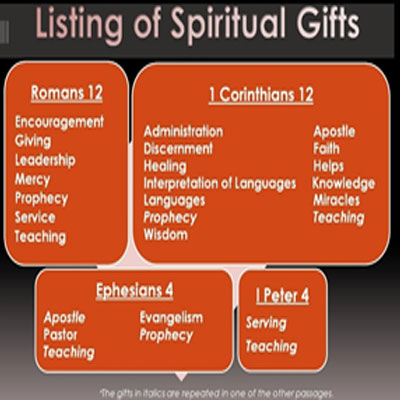
Image from Upwards Church.
S = Spiritual Gifts. Spiritual gifts are defined as ”special God-empowered abilities for serving him that are given only to believers (see 1 Corinthians 2:14)” ( Warren, Purpose Driven Life, 236) or “special gifts bestowed by the Holy Spirit upon Christians for the purpose of building up the church” Ronald F. Youngblood, F.F. Bruce, R.K. Harrison, Nelson’s New Illustrated Bible Dictionary (Nashville, TN: Thomas Nelson Publishers, 1995)(see also 1 Corinthians 12:7). You don’t deserve and can’t earn spiritual gifts. God gives them to you as an expression of his grace (Ephesians 4:7). You don’t get to choose your spiritual gifts. God in the person of the Holy Spirit distributes spiritual gifts (1 Corinthians 12:11). God does not give everyone the same spiritual gifts and no one receives all of the gifts (1 Corinthians 12:29-30). This is because God wants each of us to be special and to love and depend on each other. When we all use our spiritual gifts, we all benefit. You should take the time to discover your spiritual gifts, because an unopened gift is useless.
The first list of spiritual gifts appears in 1 Corinthians 12:7-11: administration, wisdom, knowledge, faith, healing, miracles, prophecy, discerning of spirits, speaking in tongues, and interpretation of tongues.
A second similar list appears in Ephesians 4:7-13: prophecy, evangelizing, shepherding/pastoring, and teaching. A third list appears in Romans 12:3-8: prophecy, faith, serving, teaching, encouraging, giving, leading, and showing mercy. A fourth list appears in 1 Peter 4:10-11: serving and teaching. Most Christians do not believe that the spiritual gifts of healing, speaking in tongues, and interpretation of tongues continued after the death of all of Jesus’s apostles and disciples in the first century. Today, the service of each Christian should be in proportion to the gifts that person possesses (1 Corinthians 12:1:31). Since these gifts are gifts of grace, their use must be controlled by the principle of love-the greatest of all spiritual gifts (1 Corinthians 13:1-13).
You can discover and identify your spiritual gifts by taking a spiritual gift survey, getting input from others that observe you use your gifts, and just trying to use various gifts to see which gifts that you most naturally and effectively use for God’s glory.
H = Heart. From a biblical serving perspective, your heart is what you are passionate about, most interested in, what you love to do, and what you care about the most (Psalm 34:7; Proverbs 4:23, 27:19; Matthew 12:34). God gave you those inborn passions, interests, and cares so that you can “serve the Lord with all of your heart” (Deuteronomy 11:13; 1 Samuel 12:20; Romans 1:9; Ephesians 6:6). There are two telltale signs to know when you are serving God with all your heart. First, you will serve God with enthusiasm and sheer enjoyment. Second, you will excel and be effective serving God. Your heart will determine what ministry you will serve in. When you serve using your spiritual gifts in a ministry that you have a heart and passion for, it won’t feel like you are working in the ministry. You will be self-motivated and enjoy serving in that ministry. Churches that help their members identify their spiritual gifts and heart/passion ministries to serve in are the most effective churches that serve each other and the community. Warren, Purpose Driven Life, 237-240.
A = Abilities. Your abilities are the natural talents that you were born with, such as public speaking, writing, reading, mathematics, physical coordination, music, art, crafts, mechanics, making money, administrative skills, etc. (Deuteronomy 8:18; Romans 12:6; 1 Corinthians 12:6; Hebrews 13:21; 1 Peter 4:10). Abilities or talents are similar to spiritual gifts except that everyone has abilities, whereas God gives spiritual gifts only to Christians. God may enhance your abilities or talents to make them part of your spiritual gifts to use for his glory (1 Corinthians 2:14). Warren, Purpose Driven Life, 241-244.
P = Personality. God works through different people with different personalities in different ways to achieve his purposes (1 Corinthians 12:6). There is no right or wrong personality or temperament for ministry. Your personality will affect how and in what ministry you will use your spiritual gifts and abilities. For example, two people may have the spiritual gift of evangelism, but if one person is an introvert and the other is an extrovert, that gift will be expressed in different ways. On the other hand, if someone is forced to minister in a way that is inconsistent with the person’s personality, it creates tension and discomfort, requires extra effort and energy, and produces less than the best ministry results. When you minister in a manner consistent with your God-given personality, you will feel good and experience fulfillment, satisfaction, and fruitfulness for God. Warren, Purpose Driven Life, 244-246.
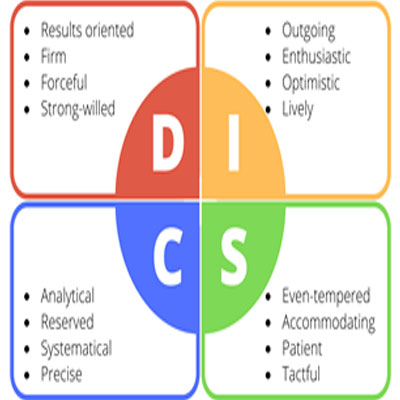
4 personality types: Dominance, Influence, Steadiness, Conscientiousness. Image from Speakout.com.
E = Experiences. Your experiences in life also partially shape you. Most of these experiences were beyond your control, but God allowed them for his purpose of molding you (Romans 8:28-29). When determining your shape for serving God and others, you should examine at least six kinds of your experiences from your past. First, your family experiences: What did you learn growing up in your family? Second, your educational experiences: What were your favorite subjects in school and what was your area of study if you went to college or trade school? Third, your vocational experiences: What jobs have you been most effective in and enjoyed the most? Fourth, your spiritual experiences: What have been your most meaningful times with God? Fifth, your ministry experiences: How have you served God in the past? Sixth, your painful experiences: What problems, hurts, physical ailments, and trials have you learned from? God allows you to go through painful experiences to equip you for ministry to others that have had similar painful experiences. God comforts you in all of your troubles so you can comfort others with the same comfort God gave you (2 Corinthians 1:4). Warren, Purpose Driven Life, 246-248.