

Interview of Craig S. Keener on the evidence for miracles outside of the Bible and in the New Testament of the Bible. Lee Strobel interviewed a leading New Testament scholar Craig S. Keener regarding his two-volume work on miracles that stands as the definitive work on the topic of miracles outside and in the New Testament of the Bible. Strobel, The Case for Miracles, chapters 4-6, 73-117.
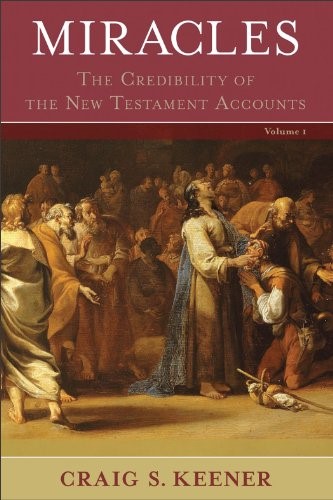
Keener responded to the modern prejudice against biblical miracle reports that depend on David Hume’s argument that uniform human experience preclude miracles. Yet current research shows that human experience is far from uniform. In fact, hundreds of millions of people today claim to have experienced miracles. Keener argues that it is time to rethink Hume’s argument in light of the contemporary evidence available to us. Keener meticulously researched and wrote the two-volume study and presented the most thorough current defense of the credibility of the miracle reports in the Gospels and Acts. Drawing on claims from a range of global cultures and taking a multidisciplinary approach to the topic, Keener suggests that many miracle accounts throughout history and from contemporary times are best explained as genuine divine acts, lending credence to the biblical miracle reports. Craig S. Keener, Miracles: The Credibility of the New Testament Accounts: Volume 1 and Volume 2, (Grand Rapids, MI: Baker Academic, 2011).
Keener is a former atheist that became a leading Christian scholar. Keenon was an adamant atheist and was skeptical of Christianity and the Bible until he became a Christian at 15 years old, based on more of a spiritual experience of God’s presence in his life. Thereafter, he systematically studied the evidence for God and Christianity and easily answered all of the questions, doubts, and potential objections that he had as an atheist and new Christian. He debated his professors and wondered why brilliant scholars who questioned the fundamentals of the faith would not develop a firm and confident faith like he did after considering the arguments and evidence. Keener concluded that they clearly had an anti-supernatural presupposition that prevented them from a full consideration of the arguments and evidence. After decades of intense study of Christianity and living his transformed life as a Christian, he decided to research and study miracles to see if he could prove to skeptics that miracles were possible. Strobel, The Case for Miracles, 78-81.
Keener researched miracles that happen today. As a historian, Keener did extensive research on modern day miracles. He critically demanded convincing sources, tried to maintain intellectual honesty, and followed the evidence wherever it led. He found a tidal wave of legitimate miracle claims that better fit the supernatural explanation than a naturalistic conclusion. Examples from the case studies he encountered included: “Cataracts and goiters (enlarged thyroid gland)-instantly and visibly healed. Paralytics suddenly able to walk. Multiple sclerosis radically cured. Broken bones suddenly mended. Hearing for the deaf. Sight for the blind. Voices restored. Burns disappearing. Massive hemorrhaging stopped. Failing kidneys cured. Rheumatoid arthritis and osteoporosis-gone. Life given back to the dead, even after several hours.” The accounts were “from around the world-China, Mozambique, the Philippines, Nigeria, Argentina, Brazil, Cuba, Ecuador, South Korea, and other countries. Multiple and independent eyewitnesses with reputations for integrity, including physicians. Names, dates, medical documentation in many cases. There’s even a peer-reviewed scientific study confirming the healing of the deaf. And the timing is usually the most dramatic element-instantaneous results right after prayers to Jesus. Lots of cancer healings too-malignant brain tumors and reticulum-cell sarcoma.” Keener then went on to discuss many specific documented cases of miracle healings after prayer verified by witnesses, medical reports, diagnostic images, and doctors. He accumulated 350 reports just of people healed of blindness. These documented miracle healings exceeded even the stringent standards required by skeptics. Strobel, The Case for Miracles, 96-113. One purpose of Kenner’s research is to determine whether it is rational to believe that supernatural miracles occur today. His research led him to conclude yes, “It looks like God is still in the miracle business!” His other purpose for his research is to show that it is not necessary to dismiss the New Testament writings as legendary, fanciful, or inaccurate, just because they report miracles. If miracles happen today, there is no reason to suppose that miracles were not possible in the ancient world. Strobel, The Case for Miracles, 114-117.
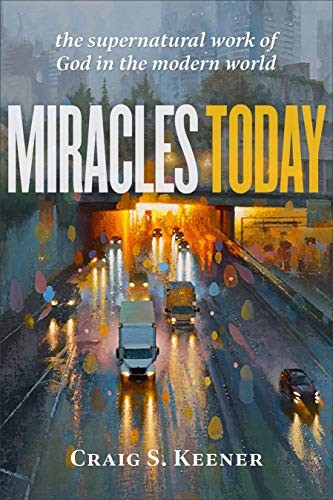
Craig S. Keener’s concise overview book, Miracles Today: The Supernatural Work of God in the Modern World. The publisher’s description of the book states as follows: “This book demonstrates that miraculous works of God have been part of the experience of the church around the world since Christianity began and that they continue into the present. Leading New Testament scholar Craig S. Keener addresses common questions about miracles and provides compelling reasons to believe in them today, including many accounts that offer evidence of verifiable miracles.
This book gives an accessible and concise overview of one of Keener’s most significant research topics. Keener’s earlier two-volume work on miracles stands as the definitive work on the topic, but its size and scope are daunting to many readers. This work summarizes Keener’s basic argument but contains substantial new material, including new accounts of the miraculous. It is suitable as a textbook but also accessible to church leaders and laypeople.” Craig S. Keener, Miracles Today: The Supernatural Work of God in the Modern World, (Grand Rapids, MI: Baker Academic, 2021).
Keener researched New Testament miracles. A member of the left-wing Jesus Seminar criticized Keener’s book, The Historical Jesus of the Gospels, because the book contained reports of Jesus’ miracles, even though Keener followed standard historiographical principles which apply to the New Testament gospel accounts as ancient biographies. Strobel, The Case for Miracles, 83.
Keener responded to skeptic Michael Shermer’s objection to the gospels that the authors told “far-fetched stories about fictional miracles in order to make a moral point.” Keener’s specific response was just because the gospels make moral points does not mean the gospel authors were not reporting on historical events. Readers of the gospels from the middle of the second century through most of the nineteenth century regarded the gospels as biographies. Today, most scholars regard the gospels like modern biographies that report historical events that occurred in the person’s life. Therefore, the gospels should not be classified as mythology. Strobel, The Case for Miracles, 84. For example, the opening words of Luke’s gospel state that Luke “carefully investigated everything from the beginning, I too decided to write an orderly account for you, most excellent Theophilus, so that you may know the certainty of the things you have been taught” (Luke 1:4). Strobel also commented, “After all, Jesus wasn’t averse to his own miracles being scrutinized. He told eyewitnesses to his miracles to report what they had personally seen (Matthew 11:4-5), and he instructed a person healed of leprosy to show himself to the priest so he could be examined (Mark 1:44). Strobel, The Case for Miracles, 123.
Jesus performed many nature, creation, and physical and spiritual healing miracles.
Keener also pointed out that the gospels attribute more than 30 miracles to Jesus such as walking on water, raising the dead, and instantly curing leprosy. But the gospels report the miracles in a sober fashion, in great detail. Jesus often performed miracles before hostile audiences. His critics did not dispute the miracles. They simply objected that he did them on the Sabbath. Also, none of the witnesses to the miracles disputed them as fraudulent miracles. Jesus’ miracles were most likely not legends because they were reported in the early gospels and New Testament epistles/letters manuscripts, some of which date to within a few years-or even months of Jesus’ death. Non-Christian early sources such as the rabbis, the Jewish historian Josephus, and the anti-Christian Greek philosopher Celsus clearly refer to Jesus as a wise man who performed startling deeds or a miracle worker. Strobel, The Case for Miracles, 84-85. Jesus performed these miracles as a sign of his authority as the God-Man, displaying God’s power and benevolent and compassionate character, and prelude to when God will make a new heaven and new earth where there will be no more sickness, pain, and suffering. Strobel, The Case for Miracles, 85-87.

God appears in dreams and visions to some people who are hostile towards God. Jesus appeared in a vision to Saul, who persecuted Christians, and transformed him into a major early Christian evangelist to the Gentiles (Acts 9:1-5, 22:6-21; 1 Corinthians 15:18). Similarly, more Muslims have become Christians since 2000 than in the previous 1,400 years since Muhammad lived. Approximately a quarter to a third of Muslims all over the world experienced a dream or vision of Jesus before their salvation experience. Strobel, The Case for Miracles, 141, citing Tim Doyle, Dreams and Visions: Is Jesus Awakening the Muslim World?, (Nashville, TN: Nelson, 2012), 127. Although each vison is unique, in many cases, Jesus tells the person something in the dream/vision that he or she could not otherwise have known, or two people having the same dream/vision on the same night. The amazing consistency of these dreams and visions in different countries suggests that they are more than the product of overactive imaginations. Muslims have no incentive to imagine these encounters with Jesus, because they may face the death sentence if they become Christians in certain countries and may be ostracized from their Muslim families and communities. Jesus may be appearing to Muslims because it is estimated that 50% of Muslims in the world cannot read and 86% of Muslims do not know a Christian. Strobel, The Case for Miracles, 139-156.