

DEATHBED & RELATED EXPERIENCES
J. Steve Miller examined the scientific research of alleged afterlife experiences that has accumulated from the late 1800s to today (2021), to determine whether the research confirms the conclusion that these experiences are evidence of the afterlife. The main types of experiences that he evaluated for evidence of the after include the following. J. Steve Miller, Deathbed Experiences as Evidence for the Afterlife, Volume 1:A Groundbreaking Scientific Apologetic, Evaluating Death-Related Visions, Terminal Lucidity and After Death Communications (Kennewaw GA: Self-published, 2021), 20.
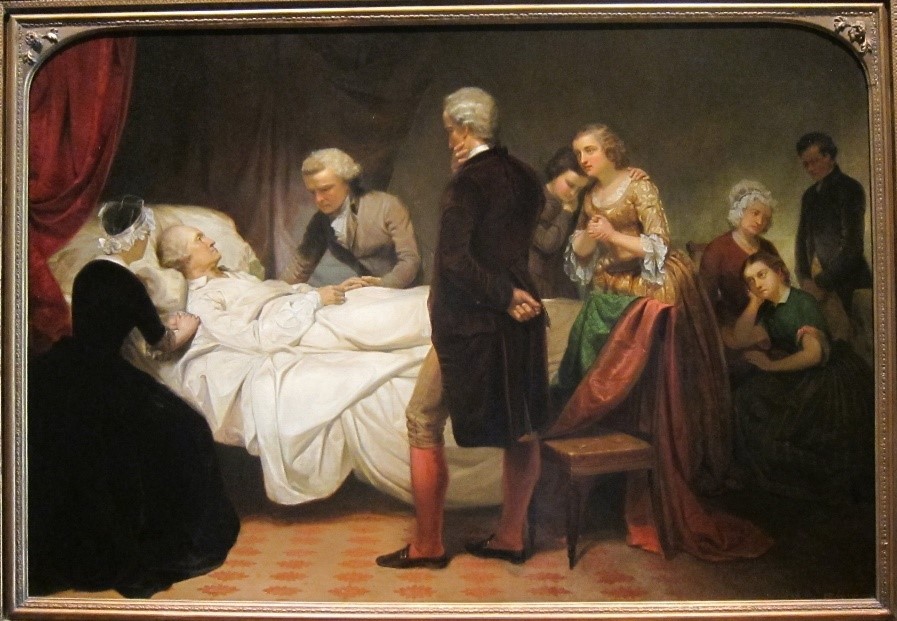
George Washington on his deathbed. Wikipedia Commons
Deathbed experiences.
Deathbed experiences (DBEs) refer to dying people “reporting seeing people/beings/places that are typically not seen by the physical people who are present. The otherworldly beings are often perceived to be there to escort the dying to their afterlife existence.”
An example of a deathbed experience is physics professor Sir William Barrett’s example of his physician/wife’s patient, Doris, who was dying after she gave birth to her healthy child. She saw “lovely brightness-wonderful beings” who told her she could not stay with her baby. One being was her father who was so glad that she was coming. Another being was Doris’ sister, Vida, who had died three weeks earlier, but Doris’ family kept the news of Vida’s death from her to not upset her. Miller, Deathbed Experiences, 20.
Evidence of DBEs.
DBEs are not rare. Much recent DBE research is found in nursing, hospice, and other medical journals. “For example, an ongoing study in a New York hospice unit interviews patients, daily, asking if they’ve had any unusual dreams/visions. Over 80 percent report realistic visions of deceased relatives/angels/visions. … if such studies are accurate, some of these experiences should be considered a normal part of the dying experience.” Miller, Deathbed Experiences, 24.
Skeptics of DBEs argue DBEs are normal dreams or hallucinations. However, an argument against DBEs being normal dreams or hallucinations is that the dying are often surprised to see people on the other side who were not known to have died. This is called the “Peak in Darien” experience based upon poem of John Keats that he published in 1817. The poem is about the presumed reaction of the Spanish explorers after they crossed the Atlantic Ocean and explored Panama. They crested a peak in the Darien Range and expected to see a vast, unexplored continent. Instead, to their shock and amazement, they saw another ocean and “Look’d at each other with a wild surmise-Silent, upon a peak in Darien.”
Researchers of near-death and DBEs distinguish three different types of “Peak in Darien” experiences. The first type is when the dying person sees a deceased person that died sometime before the dying person’s vision, although that death was unknown to the dying person. The second type is when the dying person sees a deceased person that died at the time of, or immediately before the vision, so that there is no possibility of the dying person learning of the death of the deceased person before the vision. The third type is when the dying person sees someone who the dying person had never known. In large scale survey studies in the United States and India, the visions of dying people and of near-death patients were nearly all apparitions of the dead and religious figures with a message. Until further research is done to explain Peak in the Darien experiences, these experiences are evidence of the afterlife. The dying appear to know that they are about to die and that someone will come to accompany them to the other side. The dying are surprised that it is someone that they thought was still living. Miller, Deathbed Experiences, 126-131.
The research findings of studies regarding Children’s DBEs are impressive from an evidential standpoint. First, children typically have less informed ideas about heaven, and simply tell their experiences quite literally as they experience them. When children are dying, they speak very openly of seeing things on the other side that the adults in their lives had not taught them to expect. Second, children prepare their parents before their death. The children know they are dying and are peaceful and often excited about where they are going after death. The children tell the parents that the children are going to be alright and it is okay for the parents to let go of the children. Children report seeing and communicating with angels (without wings to the children’s surprise), deceased family members, and or friends. The children see, hear, smell, and have a kinesthetic awareness of where they are going. Most children tried to time their death by either waiting for someone to arrive or to leave before they die. Some children call all the present family members and or the hospital staff to their bedside immediately before their death to announce they will die before they actually die. Third, doctors typically do not tell young children they are dying and what to expect shortly before death. Instead, children tell the doctors and families what they are experiencing shortly before death. Therefore, the DBEs of young children tend to be more credible than DBEs of adults because the children are less likely to have pre-conceived ideas and notions of what they experience shortly before death. Miller, Deathbed Experiences, 196-206.
John Adams and Thomas Jefferson both willed to live until they died within hours of each other on July 4, 1826. Photo: Painting image Ben Franklin’s World.
The “will to live” longer and premonition of imminent death.
John Adams and Thomas Jefferson died on the same day within hours of each other on the 50th anniversary of the Declaration of Independence, July 4, 1826. Miller, Deathbed Experiences, 39-47, 72-74. Co-founder of Apple, Steve Jobs, was diagnosed with pancreatic cancer, but seemed to live in denial. He eventually died, but nobody expected him to die when he did, according to his sister, Mona Simpson. He called his sister and told her to take a plane to see him before he would die and go to a better place. She did so and when she arrived, he was alert and joking with family members and friends. But then he looked over and past the shoulders of his family members and said something that amazed them. His final words were: “OH WOW. OH WOW. OH WOW!” Miller, Deathbed Experiences, 53-55.

John Adams and Thomas Jefferson
The evidence of the “will to live” longer and premonition of death.
In 1989, Stanford University School of Medicine published a clinical trial it conducted to compare the survival rates of 86 patients with metastatic breast cancer. Both groups of the study received “routine oncological care.” But the 50 patients who attended “weekly supportive group therapy with self-hypnosis for pain” survived, on average, 36.6 months, compared to only 10.8 months for those that did not attend the support group. Therefore, the treatment of their minds in the therapy group most likely helped them to survive significantly longer. They did not survive longer simply by naturalistic chance. Miller, Deathbed Experiences, 47-48. This supports the contention that the immaterial mind is separate from the physical brain, which is referred to as dualism. In addition, a study published by the British Medical Journal (one of the most respected medical journals in the world) found physicians to be extremely inaccurate about their predictions of the date and week of death in the final weeks of their patients’ lives. The doctors also overwhelmingly told the family that the dying person would live much longer than the patient actually lived. Other peer reviewed medical articles and sections of medical texts also describe as quite normal that some patients, who may or may not be dying, may experience and express to others, premonitions of their imminent deaths or the deaths of their children and other family members. Miller, Deathbed Experiences, 55-59, 78. But where do dying patients get their knowledge that they will die soon? To know something like when you are going to die is something that cannot be known by the normal function of the brain. It would seem to be evidence of a source of information outside of the brain. In addition, beyond the premonition of death, there is also the even more fascinating knowledge of the patient explaining that the patient is going to a better place, or is following a relative who has come to take the patient to a better place.
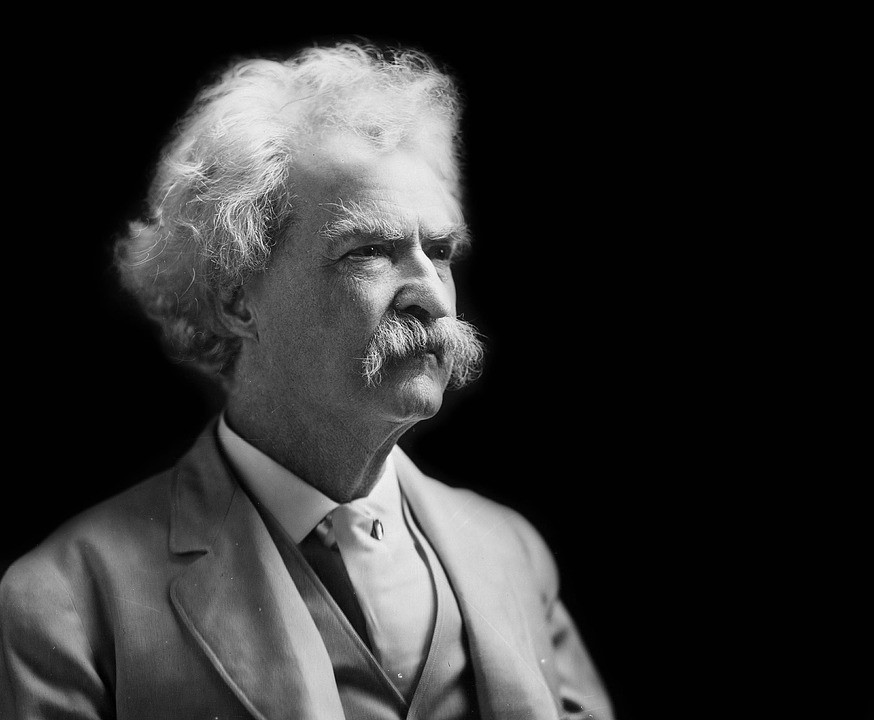
Mark Twain had a crisis apparition of the death of his younger brother a few weeks before his brother’s death.
Crisis apparitions.
Crisis apparitions refer to people who are not dying, but who can touch, smell, hear, or see someone who is about to die or has just died. Crisis apparitions often occur before the people hear the news of the death, or even know that the person is dead. A famous example is described by Mark Twain in his autobiography. He had a realistic and specific vision in his twenties of his younger 20-year-old brother, wearing Mark’s suit, lying in a metal casket which was set on two chairs, with a very specific arrangement of flowers set on top of it. Within, a few weeks, his brother died from a riverboat accident and his funeral occurred precisely as Mark had foreseen in his dream. Miller, Deathbed Experiences, 17-19, 21, 66-72.
Terminal lucidity.
Terminal lucidity refers to “a common phenomenon experienced by dying people whose brains have become severely compromised over time, with some being comatose. Suddenly, they regain full consciousness, communicate clearly, say their goodbyes, and die shortly thereafter.” An example was reported by pediatrician and researcher, Melvin Morse. A 5-year-old boy was dying from a brain tumor and was comatose for three weeks. The boy was surrounded by his family when their minister suggested that they tell the boy that they would miss him, but he could go ahead and die if he wished. “Suddenly and unexpectantly, the boy regained consciousness, thanked the family for letting him go, and told them he would be dying soon. He died the next day.” Naturalism and materialism cannot explain how a 5-year-old boy knows he is going to die. Instead, naturalists would predict that the tumor would continue to grow and destroy his brain to the point that he could not speak lucidly, and then he would die . Miller, Deathbed Experiences, 21, 136.
Evidence of terminal lucidity.
The evidence of terminal lucidity is well established. Even though terminal lucidity involves the unexpected sudden arousal from comma, dementia, Alzheimer disease, or confused mental state with mental clarity and memory shortly before death, terminal lucidity is a well established phenomenon going back to ancient Greece when it was noted that mental confusion, epilepsy and melancholia may all improve with the approach of death. Early authors that were prominent physicians from the United States, the United Kingdom, France, and Germany, reported and discussed terminal lucidity in the 1700s and 1800s. Even people who are mentally challenged, with their brains never working properly their entire lives, have experienced terminal lucidity. The more recent peer reviewed articles and the peer reviewed PSI (“Psi” is the modern collective term for the psychic functions of telepathy, clairvoyance, precognition and psychokinesis) Encyclopedia also confirm that terminal lucidity is common. In addition, since terminal lucidity incidents tend to be brief (63 percent lasted 30 minutes to two hours according to one study), many nurses may miss them, especially because nobody is expecting them to happen. Also, family may not report each incident to the nurses. The unexpected nature of the of these incidents makes it less likely that they are the result of imagination or grief. Moreover, researcher Michael Nahm took 49 reports of terminal lucidity that provided a time of death and found, “In 84 percent of the cases, terminal lucidity seems to occur within the last week before death, with 43 percent occurring within the last day of life.” The evidence for terminal lucidity poses problems for naturalists and materialists who predict that once people’s brains deteriorate, they should not be able to regain the mental functions that they had lost over time. Instead, terminal lucidity incidents are consistent with vivid experiences in the afterlife that demonstrate the mind functions independently of the brain. The dying report to family members something about the afterlife and or express gratitude for the afterlife. Miller, Deathbed Experiences, 132-149.
After death communications.
After death communications refer to bereaved people reporting vividly sensing and/or communicating with the deceased. An example is the appearance of a father to his daughter after her father died of cancer four years earlier. She turned off the lights, but could see her father very clearly because of the glow around him. She called out to him, “Daddy!” He smiled and said he was doing fine, would always be with her, and needed to check on her three-year-old son in the next room. The next day, her son reported that he saw Granddaddy the previous night. He insisted that he was not dreaming-it was real. Miller, Deathbed Experiences, 21-22.
Another example, occurred to the famous skeptical atheist Michael Shermer and his wife. His wife had a transistor radio from the 1970s that had deep sentimental value to her because she and her grandfather often listened to music on the radio when they spent time together. Her grandfather died. Years later, shortly after she married Shermer, her radio was not functional. But she and Shermer heard the radio playing the same type of music she used to listen to with her grandfather. The radio played all night and into the next morning, and then it went dead again and never worked again thereafter. She felt the presence of her grandfather with her while the radio played the music. That incident cracked open the door and made Shermer think that it might be possible that this was an after death communication and that he should believe in God. But this experience still did not convince Shermer to believe in God. Miller, Deathbed Experiences, 154-164.
Evidence of after death communications.
The evidence of after death communications starts with the Harvard Bereavement Study 1974 report on bereaved widows. There are two main findings of the study. First, the period of mourning extended much beyond the standard view that widows should accomplish their “grief work” during the four to six week period after the loss of a spouse. Instead, although the widows will grieve less over time, some degree of grieving may continue for the rest of their lives, and this long term grieving is healthy in most cases. The second finding was unexpected. It was normal and healthy for the widows to have after death communications with the dead husbands as a “sense of presence” in which they consulted their husbands about current decisions. These senses of presence of the deceased husbands seemed to facilitate the widows’ abilities to move on with their lives. In addition, these long term communications did not diminish with time. Although the researchers tended to label the experiences as illusions or hallucinations, they assumed natural explanations without thoroughly questioning the widows regarding whether the widows thought the apparitions of their dead husbands was real. The researchers most likely did not thoroughly question the widows because it would be risky for academics to appear unscientific by even entertaining such questions. Miller, Deathbed Experiences, 164-168.
Researchers from The United States, Germany, and Israel updated the research on grief of widows after death through 1996 in the Continuing Bonds Study. This study re-confirmed that the updated research did not generally support the old model of grief that held it was unhealthy and pathological to mentally hang on to a deceased loved one. The Continuing Bonds Study expanded the Harvard Bereavement Study of grieving of widows that had after death communications with their dead spouses to the grieving of other family members that lost love ones including parents, siblings, and children. Like the Harvard study, the Continuing Bonds Study researchers did not explore the question of whether the “continuing presence” after death communications were real, and failed to offer any evidence that the communications were generated for the surviving persons’ minds or from the afterlife. However, some of the specific data and conclusions of the Continuing Bonds Study provide evidence in support of the afterlife. For example, 70% of university women (from 18 to 23 years old) who lost loved ones reported ongoing attachments to the deceased. Also, 30% of those women reported that the attachments were not comforting or desirable. If someone was “constructing” a continuing relationship, they would construct a good relationship, not a bad relationship. To the contrary, many women described the ongoing relationship as real. Many of the grieved women were hesitant to speak about the ongoing relationship for fear that people would think they are crazy. Since 70% of the women reported that the ongoing relationships were positive, supportive, and helped them move forward in life, the researchers concluded that it should not be considered psychotic and unhealthy. Other more recent studies literature reviews reported similar findings. Additional findings included: 30 to 35 percent of the people in the general population are likely to experience one or more after death communications; 80 to 85 percent of the people in the first year of bereavement are likely to experience at least one after death communication; the subjects studied are not psychotic or delusional; the experiences were unexpected; the experiences were real and undeniable; most experiences were pleasant, positive, helpful, comforting, healing, and reassured that the deceased continues to live and is okay; and some first experiences were frightening or confusing until they gained understanding of the experience and shed their grief. Therefore, these after death communications provide evidence that bodily death does not end life, that the mind/soul/spirit leaves the body with its personality to live in the afterlife, and that the mind/soul/spirit may communicate to loved ones that are still living on earth. Miller, Deathbed Experiences, 168-194. See the CHANNELING subpage of the “Is heaven for real?” page of this website for a discussion about how using a medium to channel or communicate with the dead is unbiblical, and for caution about how alleged direct communications with the dead may be demonic spirits imitating loved ones that die.
Shared death experiences.
Shared death experiences refer to people in the room with the dying, or perhaps from a distance, report sharing the spiritual experiences of the dying. An example was reported by Dr. Raymond Moody. A mother died in the presence of her four children and daughter-in-law. A bright light appeared in the room that all of them saw them together. For a little while they were frightened. Then, the mother died and everyone saw her spirit depart through a passageway while they all felt complete joy and a chorus of joyful feelings. Miller, Deathbed Experiences, 21-22, 150-151. There are also shared death experiences that that occur after someone’s death. For example, a husband and wife both saw the husband’s deceased father at the same time, a few days after his death. Miller, Deathbed Experiences, 192-194.
Evidence of shared death experiences.
The evidence of shared death experiences are the numerous reported cases in the books by Raymond Moody, Glimpses of Eternity: Sharing a Loved One’s Passage from This Life to the Next; and a chapter in the book by Bill and Judy Guggenheim, Hello From Heaven! (New York, NY: A Bantam Book, 1995), 243-258. There are also scholarly peer reviewed articles. One article by Peter Fenwick and Sue Brayne reported that five percent of end-of-life experience accounts were shared death experiences. The shared experiences refute several possible objections to DBEs being authentic. First, since they are shared by healthy people, they are not caused by a dying brain. Second, they cannot be attributed to expectations because they are unexpected. Third, they are not hallucinations because more than one person is sharing the same experience. Also, whereas shared death experiences are consistently meaningful and predictable as the dying person departs to the afterlife, hallucinations are bizarre and wildly vary. Miller, Deathbed Experiences, 150-153, 196.
Nearing death awareness.
Nearing death awareness refers to people who know they are about to die, even though the physical symptoms and doctor’s prognosis do not indicate imminent death. An example is reported in the British Medical Journal by a physician. A mother consulted the physician about her 4-year-old daughter, who said for days she was going to leave her mother, but not to worry, because she was going to a beautiful place. In this place, she would be able to see her mother, but her mother would not be able to see her. Although the daughter appeared healthy and alert when she told her mother about where the daughter was going, the daughter suddenly developed acute meningitis and died in a few days. Miller, Deathbed Experiences, 21-22.
Distressing DBEs.
Distressing DBEs refer to experiences that are more frightening than joyful or ecstatic. In some cases, the dying are distressed not by the nature of the experience itself, but because the dying were not expecting such an event and don’t understand it. As the dying reflect and have further similar experiences, they accept it. In other cases, these DBEs are by their very nature distressing. An example was reported in the extensive study in the United States and India of DBEs by academic researchers Karlis Osis and Erlendur Haralds-son. A college-educated man in his 20s was recovering from a bacterial infection of the middle ear. He was doing well after a stay at the hospital. He was about to be discharged and both he and his doctor expected a full recovery. Suddenly he shouted, “Someone is standing here dressed in white clothes. I will not go with you!” Thereafter, he died within 10 minutes. Miller, Deathbed Experiences, 23, 186. It is possible that some distressing DBEs confirm that in the afterlife, God will banish to hell those who reject God.
Phantasms.
Phantasms refer to impressions, voices, or figures of persons undergoing some crisis-especially death, that are perceived and predicted in advance by their friends and relatives that may or may not be far distances away. From the 1880s to the early 1900s and thereafter from 1980 to 1984, large scale studies and censuses of phantasms and visions were conducted by highly respected academics to confirm that phantasms and visions could not be attributed to and explained by chance. Therefore, it is likely that these phantasms and visions are instances of supersensory action of one mind on another. Phantasms and visions could also be evidence of spiritual communion and prayer. Additional research of phantasms and visions needs to be conducted regarding their implications about the afterlife. The researchers’ seminal point is that somehow, some people know about the deaths of others before they are told by natural means. It cannot be attributed to random chance. This could be groundbreaking for science and evidence that the mind/soul/spirit exists separate from the material brain and that people, along with their personalities, survive death, and continue in the afterlife. Miller, Deathbed Experiences, 83-125.
Are DBEs and related experiences clear and convincing evidence of the afterlife?
Yes. DBEs and related experiences provide clear and convincing reasons to believe in the afterlife.
First, the research scholars in a variety of fields that have done the most extensive study of DBEs and related experiences over 90 years have concluded that the mind/soul/spirit exists separate from the brain and survives death, and that these experiences are best explained by the reality of the afterlife.
Second, if you do your own analysis of DBEs and related experiences, you should come to the same conclusions.
The studies indicate these experiences should be considered a normal part of the dying experience. The dying appear to know that they are about to die and that someone will come to accompany them to the other side, which is a better place.
The well established evidence for terminal lucidity poses problems for naturalists and materialists, who predict that once people’s brains deteriorate, they should not be able to regain the mental functions that they had lost over time. Instead, terminal lucidity incidents are consistent with vivid experiences in the afterlife that demonstrate the mind functions independently of the brain.
The DBEs of young children tend to be more credible than DBEs of adults, because the children are less likely to have pre-conceived ideas and notions of what they experience shortly before death.
After death communications provide evidence that bodily death does not end life, that the mind/spirit leaves the body with its personality to live in the afterlife, and that the mind/soul/spirit may communicate to loved ones that are still living on earth. However, these communications with the dead also may be with demonic spirits impersonating dead loved ones.
The shared death experiences provide evidence that DBEs are authentic after death experiences because they are shared by healthy people and are not caused by a dying brain; they cannot be attributed to expectations because they are unexpected; and they are not hallucinations because more than one person is sharing the same experience and the experiences are consistently meaningful and predictable as the dying person departs to the afterlife.
Some dying people know about the deaths of others before they are told by natural means. This cannot be attributed to random chance.
Based on the above, some people find that near death experiences, DBEs, and related experiences to be more powerful reasons to believe in God and the afterlife than the traditional cosmological argument, the intelligent design argument, and the moral argument. Miller, Deathbed Experiences, 27, 219-243.