


The universe is like a complicated machine with dials that need to be finely tuned to operate properly.
- The universe and Earth appear to be finely tuned so that life can exist and so that this same life can examine the universe.
- The universe has more than 100 attributes that must be finely tuned such as the strong nuclear force, weak nuclear force, electromagnetic force, gravitational constant, cosmological constant, and speed of light.
- The Earth also has many attributes that must be finely tuned like the Earth’s 23 degree tilt axis and its distance from the sun.
- This fine tuning cannot be the result of random and unguided chance.
- Therefore, a God exists who designed the universe and Earth to support human life.
- It also follows that God has revealed his existence as the creator and fine tuner so that human life can examine and confirm God is the creator and fine tuner.
- IF THE UNIVERSE AND EARTH ARE FINE TUNED, THERE MUST BE A FINE TUNER.
EVIDENCE IN SUPPORT OF THE FINE TUNING (ANTHROPIC) ARGUMENT
If we imagine that there is a machine for creating universes with knobs that controlled the fundamental laws and constants of the universe, those machine knobs would need to be finely tuned to construct a universe that could support advanced forms of life. Physicist Paul Davies explains, “If we could play God, … we would find that almost all the knob settings would render the universe uninhabitable. Some knobs would have to be fine-tuned to enormous precision if life is to flourish in the universe.” Paul Davies, “The Unreasonable Effectiveness of Science,” in Evidence of Purpose: Scientists Discover the Creator, editor John Marks Templeton (New York: The Continuum Publishing Company, 1994), 49.
Four of the necessary factors to have a universe capable of supporting complex life are the four fundamental forces in nature.
Gravitational force-constant
If the gravitational force-constant were minutely larger, the stars would become too hot and burn out too quickly. If it were smaller, stars would never burn at all and heavy elements would not be produced.
Electromagnetic force
If the electromagnetic force were minutely stronger or weaker, atomic bonds, and thus complex molecules, could not form.
Weak nuclear force
If the weak nuclear force were minutely different, then either there would not be enough helium to generate heavy elements in stars, or supernova explosions could not scatter heavy elements across the universe.
Strong nuclear force
If the strong nuclear force were minutely more powerful, then there would be no hydrogen, an essential element of life. If it were minutely weaker, then hydrogen would be the only element in existence.
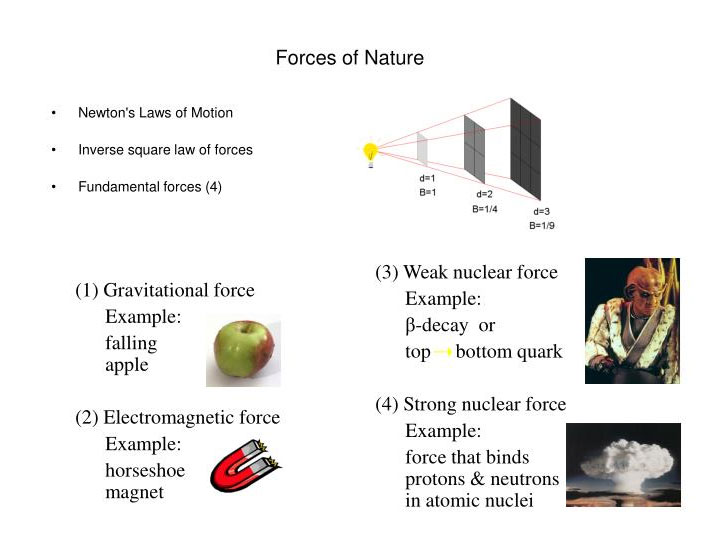
These finely tuned laws and constants of the universe represent specified complexity in nature. They are complex because their values and settings are highly unlikely. They are specified because they match the specific requirements for life.
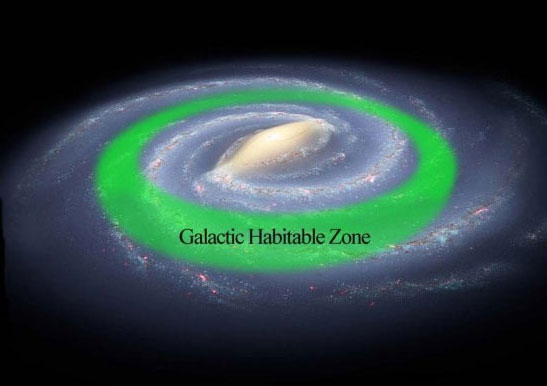
Our Milky Way Galactic Habitable Zone for Solar Systems
The Earth’s location and composition are also finely tuned for life and discovery. Our Milky Way galaxy is flat and disc-shaped with spiral arms. The giant black hole in the middle dismantles any star system that gets too close to it. In addition, the area around the galactic core is densely packed with stars and filled with intense radiation that would destroy Earth’s atmosphere and any life. However, a position towards the outer edge of the universe is also incompatible to life because of the lack of sufficient heavy elements necessary for complex life. The best location for life in our galaxy is a narrow band in the middle that escapes the large zones of deadly radiation at the core, yet contains the necessary elements for life. Our solar system exists precisely in this region and is called the “galactic habitable zone”. Plus, our solar system’s position between the galactic arms is also important. Were it inside the arms, extreme radiation from supernovae and “star nurseries” would become a problem for life. Finally, the solar system’s location also provides an ideal position to view and learn about the universe. Earth has a clear view of the galaxy and much of the universe between the spiral arms. The spiral arms full of dust and light that would obscure our astronomical observation just like city lights and clouds prevent us from viewing stars at night.
The Earth’s position within our solar system is also in a habitable zone for life. A planet’s surface temperature is determined by the type of star it orbits and the planet’s distance from the star. Our sun is a middle-aged single star with the right mass and brightness that is ideally suited for complex life. The Earths’ distance from the sun is also optimal for life. If Earth were too close to the sun, any water needed for life would only exist as a gas. If Earth were too far away from the sun, water would freeze. Earth’s orbit is also well-positioned and stable enough to constantly remain in the circumstellar habitable zone. This zone permits temperatures that are just right for liquid water necessary for life.
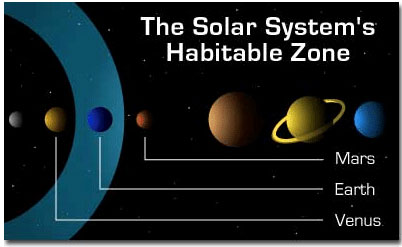
Earth’s Habitable Zone in our Solar System
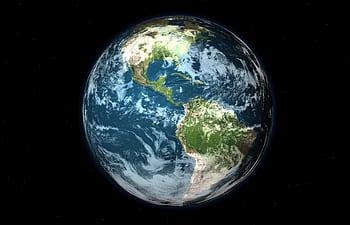
Planet Earth
Planet Earth
There are over 20 essential parameters that are required for life to be possible on a planet. Complex life requires heavy elements, such as iron and copper. Earth is a rocky terrestrial planet that has many of these elements. Earth’s tectonic plates are constantly in motion and recycle carbon, mix essential elements, and regulate Earth’s interior temperature. Earth’s liquid iron core moves and creates a magnetic field that protects life from harmful radiation and prevents the atmosphere from being stripped away. Earth’s atmosphere has the ideal combination of 78% nitrogen, 21% oxygen, and a small amount of carbon dioxide and other gases that guaranty a temperate climate, protects us from the sun’s radiation, and permits liquid water and complex life. The 23.5 degree tilt of Earth’s axis is just right. If the tilt were altered slightly, the surface temperatures would be too extreme for life. Since our moon is about one-quarter the size of Earth, the moon’s gravitational pull stabilizes the axis tilt causing relatively mild seasonal changes. Jupiter and Saturn are massive giant planets in comparison to Earth. Their strong gravitational pull protects Earth by attracting and absorbing asteroids or deflecting them out of the solar system.
For more detailed discussion on the Fine Tuning Anthropic Argument based on scientific evidence relating to the universe, the Milky Way Galaxy, our solar system, and Earth, see Guillermo Gonzalez and Jay W. Richards, The Privileged Planet: How Our Place in the Cosmos is Designed for Discovery (Washington, D.C.: Regnery, 2004); Gary Kemper, Hallie Kemper, Casey Luskin, Discovering Intelligent Design-A Journey into the Scientific Evidence, (Seattle, WA: Discovery Institute Press, 2013), chapters 4-6, Hugh Ross, The Creator and the Cosmos: How the Latest Scientific Discoveries Reveal God, (Covina, CA: RTB Press, 4th ed., 2018), chapters 15-17, appendixes A and B.
OBJECTIONS TO THE FINE TUNING (ANTHROPIC) ARGUMENT
Answer: The laws of physics only explain how the universe operates, they do not state how the laws were established. Some agent must have set into place these laws so the universe could operate. As Oxford mathematician John Lennox explains, “The laws of physics can explain how the jet engine works, but someone had to build the thing, put in the fuel, and start it up. The jet could not have been created without the laws of physics … Similary, the laws of the physics could never have actually built the universe. Some agency must have been involved.” Kemper, Discovering Intelligent Design, 55.
Answer: “Chance” is not a true cause of anything. “Chance” is only an expression of probability to predict an event. It does not define what caused this random fluctuation. It is essentially impossible that the universe, with all of the scientific parameters required for life, was created by a random fluctuation or other event.
Answer: No. Even if there were multiverses, we would still need to determine what created the multiverses. Each multiverse would have a beginning.
Answer: The quantum vacuum itself is something, not nothing. The quantum theory predicts that quantum events will occur within range of well-defined statistical parameters that each require a highly ordered set of circumstances. It is highly unlikely that there is no underlying cause.
THE OBJECTIONS FAIL TO REFUTE THAT THE UNIVERSE, THE MILKYWAY GALAXY, AND EARTH ARE FINELY TUNED FOR LIFE. THEREFORE, THERE MUST BE A FINE TUNER.