

LIMBO & THE APOSTLES’ CREED
“Limbo” is a Roman Catholic theological term.
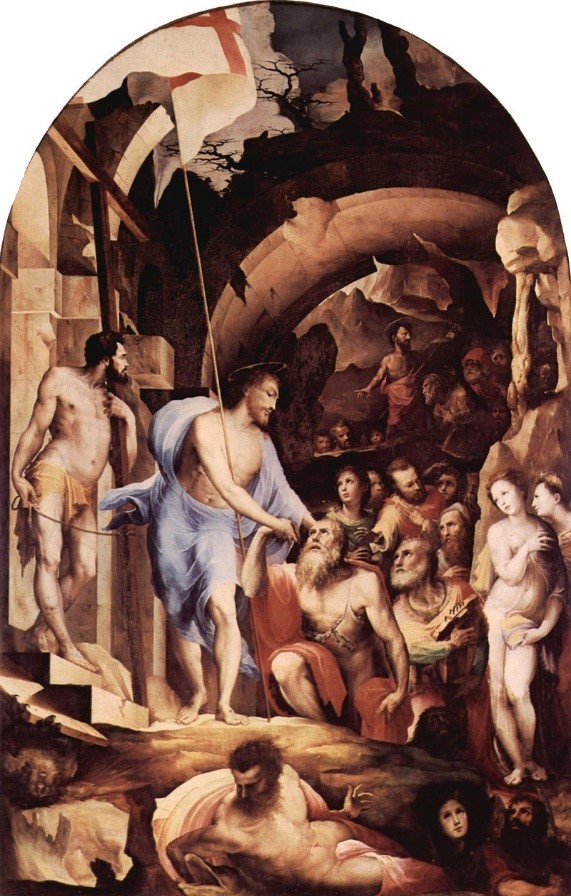
The Roman Catholic theological term “limbo” is defined as the outer edge or boundary of hell. Roman Catholics hold to the limbo of the patriarchs like Abraham, Isaac, and Jacob, who died before Jesus Christs’ death on the cross, and infants that die before being baptized. In essence, limbo is a temporary place for the souls of those who, having died in friendship with God, await “the harrowing of hell”-during which the crucified Christ preached to spirits in the realm of the dead. Richard P. McBrien, General Editor, The Catholic Encyclopedia (New York, NY; Harper San Francisco, 1995), 771.
Patriarchs and the penitent.
When Christ preached to the spirts in the realm of the dead, he rescued from limbo the patriarchs and the penitent like the thief on the cross, gloriously ushering them from the boundary of hell into the hallowed regions of heaven. Ibid.
Popes affirm limbo as a credible theological possibility.
The Roman Catholic theologian Augustine contended that although infants that die before being baptized are deprived of the supernatural presence of God in heaven, these infants are in limbo where they nonetheless enjoy the state of maximal natural happiness and well-being on the hem of hell. Ibid. In 2007, Pope Benedict XVI authorized the publication of Pope John Paull II’s theological document, The Hope of Salvation for infants Who Die Without Being Baptized, affirming limbo as a credible theological possibility that unbaptized infants may yet enjoy the Beatific Vision and enjoy the presence of God rather than being excluded from heaven as the Roman Catholic church previously held. The papal position is a prayerful hope rather than an absolute certainty.
Jesus in Limbo by Domenico Beccafumi.
Limbo is not biblical.
The Roman Catholic church has essentially abandoned limbo as stated above. There is no biblical support for limbo and Jesus going to hell to preach to the spirits in the realm of the dead in hell to rescue dead people in limbo.
1 Peter 3:19-20 does not support limbo.
The first Bible passage that allegedly supports limbo and Jesus preaching in hell is the apostle Peter’s letter/epistle stating that Jesus “went and preached to the spirits in prison- those who disobeyed God long ago when God waited patiently while Noah was building his boat“ (1 Peter 3:19-20 NLT). Some Christians contend that Jesus preached to the “spirits in prison” or demons who had impregnated fallen females during the days prior to Noah’s flood (Genesis 6:1-4). This is not biblical because nonphysical spirits or demons are incapable of having sexual relations and producing physical offspring. All of God’s living creations are designed to reproduce only “according to their own kinds” (Genesis 1:11-12, 21, 24-25 ESV). Other Christians contend that during the three days between Jesus’ death and resurrection, he went to hell to finish the work of redemption. This is not biblical because just before Jesus died on the cross, he cried out “It (atonement and salvation) is finished!” (John 19:30 ESV). Jesus meant that the debt for humanity’s sin was paid in full when Jesus died on the cross (Hebrews 9”1-14, 10:19-22). 1 Peter 3:19 has nothing to do with Jesus going to hell to preach to demonic spirits. Instead, those who disobeyed God in Noah’s day, Peter’s day, and in our current day comprise “the spirits in prison” (souls in hades) who await the day of God’s final judgment when they will be sent to the eternal prison of hell (Revelation 20:11-15).
Ephesians 4:9-10 does not support limbo.
The second Bible passage that allegedly supports limbo and Jesus descending to hell is the apostle Paul’s letter/epistle stating, “What does ‘he (Jesus) ascended’ mean except that he also descended to the lower, earthly regions? He who descended is the very one who ascended higher than all the heavens, in order to fill the whole universe” (Ephesians 4:9-10 NIV). This passage does not demonstrate that Jesus went to hell. Instead, this passage contains a Greek idiomatic expression referring to Jesus’ incarnation on earth. King David used a similar expression (“lower parts” or “depths of the earth”) when he exclaimed to God, “My frame was not hidden from you when I was made in the secret place, when I was woven together in the depths of the earth.
Your eyes saw my unformed body; all the days ordained for me were written in your book before one of them came to be” (Psalm 139:15-16 NIV). Clearly, David was not exclaiming that he was born in hell. In addition, when Jesus cried from the cross, he cried out that he would be present with God the Father in intermediate present heaven after he died, not hell. “Father, into your hands I commit my spirit” (Luke 23:46 NIV, cf. John 19:30).
Matthew 12:40 does not support limbo.
The third Bible passage that allegedly supports limbo and Jesus descending to hell is Jesus words about his death and resurrection being similar to Jonah being in a huge fish for three days and three nights. “For as Jonah was three days and three nights in the belly of a huge fish, so the Son of Man will be three days and three nights in the heart of the earth” (Matthew 12:40 NIV). While the phrase “heart of the earth” has been taken to mean the depths of hell, Jesus was actually speaking of his death and burial in the tomb of Joseph of Arimathea. Jonah’s entombment in the stomach of a large fish was the type of foreshadowing of Jesus’ entombment, which was the antitype or fulfilment of the type. In addition, there is no indication or reference in the Bible that Jesus experienced three days and three nights battling the forces of darkness in hell. Nor is there any biblical support indicating that hades (intermediate present hell) is located in the heart of the earth.
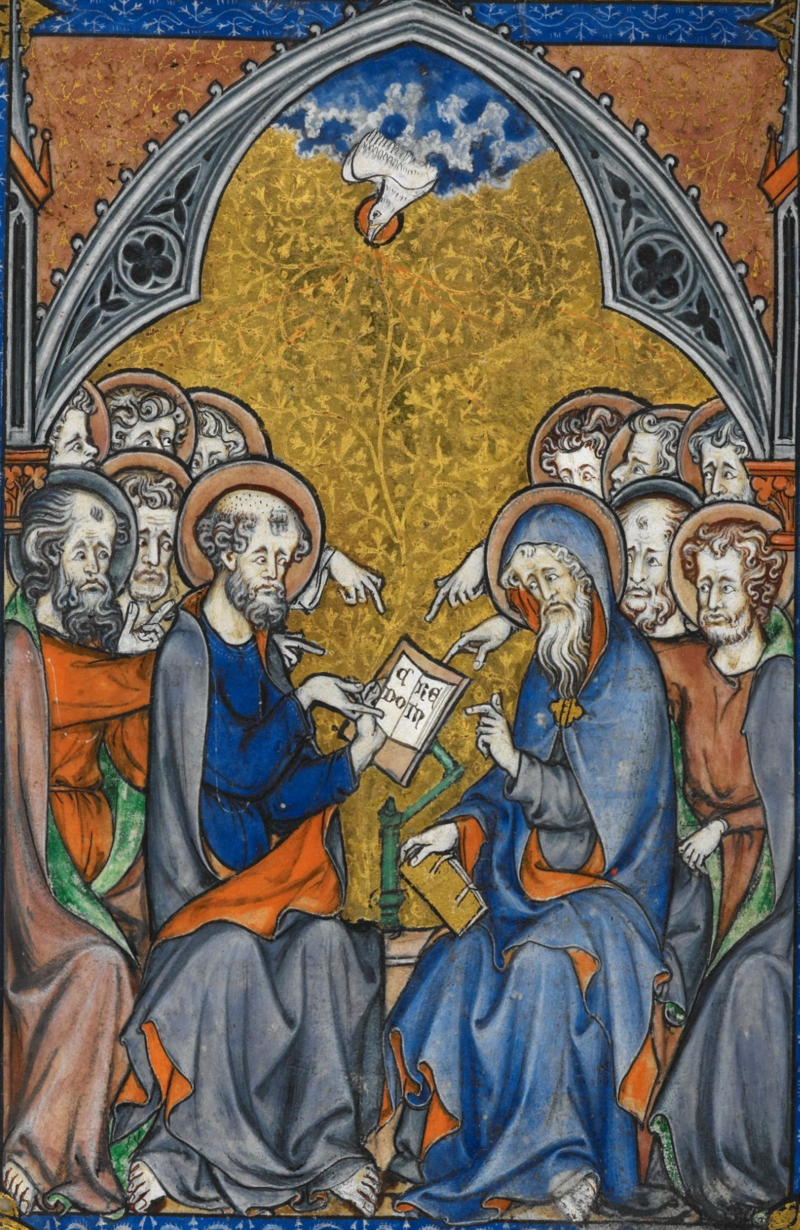
The apostles writing the creed by the Inspiration of the Holy Spirit. Thirteenth century illumination.
Why does the Apostles’ Creed state Jesus “descended into hell”?
The Apostles’ Creed is a precise and poetic summary of the Christian faith. The earliest version of the Apostles’ Creed did not contain the phrase “He (Jesus) descended into hell.” Some Christians remove the phrase, others reinterpret it, and still others refuse to recite it. The creed with the phrase is as follows:
I believe in God, the Father Almighty,
the Maker of heaven and earth,
and in Jesus Christ, His only Son, our Lord:
Who was conceived by the Holy Ghost (Spirit),
born of the virgin, Mary,
suffered under Pontius Pilate,
was crucified, dead, and buried;
He descended into hell.
The third day he arose again from the dead;
He ascended into heaven,
And sitteth (sits) on the right hand of God the Father Almighty;
from thence He shall come to judge the quick and the dead.
I believe in the Holy Ghost (Spirit);
the holy catholic (universal) church;
the communion of the saints (all Christians);
the forgiveness of sins;
the resurrection of the body;
and life everlasting.
Amen.
The creed was originally used as a rite of baptism without the phrase, “He descended into hell.” The creed later began to be regularly used as a confession or rule of faith because of Gnostic heresies of needing special spiritual knowledge that arose in the early Christian church prior to the A.D. 150; but the creed still did not include said phrase. The creed still did not contain the phrase through the late fourth century in the confession of the Old Roman Creed, codified by Bishop Marcellus of Ancrya. It was not until long after the fourth century (perhaps not officially until the eighth century) that the creed was standardized as the Received Creed, which included the phrase “He descended into hell.” Even if the early Christian church included the phrase in the creed, the intent would not have been to state that Jesus finished the work of redemption in hell. Church history indicates that early Christians celebrated Jesus Christ’s broken body and shed blood on the cross for the complete remission of sins. Christians that came to believe Jesus descended to hell most likely inadvertently substituted the word “hell” for the word “hades” in the creed. Jesus explained both parts of hades when he reported the account of the deaths of a rich man and a poor beggar named Lazarus. Lazarus went to Abraham’s bosom (the intermediate present heaven part of hades) and the rich man went to the intermediate present hell part of hades (Luke 16:23-26). The angel from heaven revealed to the apostle John that the intermediate present hell portion of hades would be thrown into the lake of fire (hell) which will be called “the second death” (Revelation 20:14). Therefore, the reference to Jesus going to hell may actually be referring to either the present immediate heaven portion of hades or the present intermediate hell portion of hades, not the future eternal hell.
Hank Hanegraaff, After Life: What You Need to Know About Heaven, the Hereafter & Near-Death Experiences (Brentwood, TN: Worthy Publishing, 2013), 112-113, 120-128; Philip Schaff, Editor, The Creeds of Christendom with a History and Critical Notes, Vol. 1 (Grand Rapids, MI: Baker, 1985), 16, 45-46, 69).