

4 VIEWS OF THE MILLENNIUM IN REVELATION
The angel of heaven reveals the end times to the apostle John. Illustration by Gustave Dore’.
An angel from heaven revealed to the apostle John about Jesus Christ’s return to the earth, the millennium, judgement of Satan, and judgment of the dead. There are four main views of the millennium in Revelation.
Historical premillennialism (historicist).
Historical premillennialism is the historicist view that Jesus will return to earth before (“pre-“) the millennium described in Revelation 20, but after the tribulation. Christians will remain on the earth and endure the time of tribulation. The tribulation will purify the Christian church by rooting out false believers. Historical premillennialists generally take a covenantal or new covenantal perspective on the relationship between Israel and the Christian church. The Christian church has replaced the nation of Israel as God’s covenant people. The thousand-year millennium is a literal future event.

The angel of heaven reveals the end times to the apostle John. Illustration by Gustave Dore’.
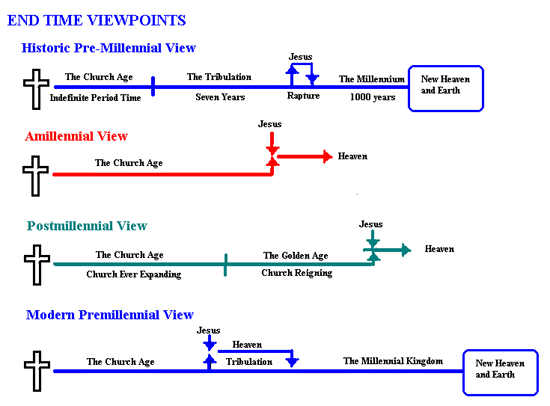
The earliest Christian church fathers during the first centuries believed in a time of testing Christians during the tribulation, followed by Jesus’ physical reign of the earth and restoration of all of God’s creation to its state of original goodness during the millennium (the millennium kingdom). Historical premillennialism fell out of favor with later Christian church fathers as they were influenced by Greek philosophy that viewed the physical world as evil and by the unfulfilled expectations of Jesus’ reign of the physically restored earth during the millennium. Historical premillennialists attempt to balance symbolic and literal interpretations of Revelation, and emphasize both what Revelation meant to Christians in the first century and how it might apply to Christians today.
Christian views of the millennium. Chart from Christianity Stack Exchange.
They also believe that God’s promises of the land and blessings to Abraham and his descendants were conditional promises, based on their obedience. Israel violated God’s covenant with Israel by persistently disobeying God. God continued the covenant of grace throughout the Old and New Testaments for all people who believed, trusted, and obeyed God. These people are the true Israel and are members of the Christian church today. (Romans 9:6-8; Galatians 6:16). Therefore, most of the references to “Israel” in Revelation refer symbolically to the Christian church.
Some of the Scriptures that appear to support dispensational premillennialism include the following:
The Antichrist is revealed before Jesus returns to the earth (2 Thessalonians 2:3-4).
The tribulation will root out false Christians from the Christian church (Revelation 2:22-23).
The Christian saints are on earth during the tribulation (Revelation 13:7).
God’s promises to Abraham and his descendants were conditional (Genesis 22:18; 2 Chronicles 33:8; Isaiah 1:19-20; Jeremiah 7:6-7).
The New Testament often uses the terms “Israel” and “the twelve tribes” to refer to Christians (Matthew 19:28-29; Romans 9:6-8).
Amillennialism (preterist).
Amillennialism is the preterist view that the millennium is the spiritual reign of Jesus in the hearts of his followers, not a literal 1,000 years. The amillennialists believe that the millennium, the church age, and the tribulation all occur at the same time. The millennium is occurring now and is in progress in which the gospel is spreading throughout the world and Jesus Christ is ruling at the right hand of God the Father. The “first resurrection” (Revelation 20:4-5) is not a physical resurrection from the dead. It is a spiritual resurrection or regeneration or new birth of Christians. Jesus Christ’s initial defeat of Satan by his death and resurrection in AD 30 limited the power of Satan on the earth (Revelation 20:1-3). The tribulation or persecution of Christians will occur until Jesus returns to the earth and defeats Satan and the powers of evil for a second and final time. The great tribulation represents disasters, wars, and persecutions that have happened throughout church history. Also, when Jesus returns, he will expand and rule God’s kingdom on earth and bind Satan during the millennium until his final defeat after the millennium. At the end of time, Jesus will resurrect Christians and non-Christians, judge them, and deliver Christians to heaven and non-Christians to hell as their final eternal destinies (Revelation 20:7-15).
Amillennialists generally emphasize the historical context of Revelation and how it was understood by first-century Christians. Many of them interpret Revelation as consisting of seven sections of apocalyptic language that describe the entire time from Jesus’ first coming to earth (4 BC to AD 30) to his second coming described in seven different ways, rather than interpreting the seven sections as successive time periods. They also interpret most references to “Israel” in Revelation as symbolic references to authentic Christians (Romans 9:6-8; Galatians 6:16). The numbers in Revelation represent concepts, not literal numbers or statistics. For example, 6 represents man’s incompleteness, 7 represents God’s completeness, 10 indicates something is extreme but limited, 12 represents the perfection of God’s people, and 1,000 represents a long period of time.
In the fifth century, many Christians began to believe in amillennialism. Amillennialism has remained widespread throughout church history. Many church history scholars believe that the church father Augustine of Hippo (354-430) was the first amillennialist, with other Christians following thereafter, including but limited to, Protestant reformers Martin Luther and John Calvin.
Some of the Scriptures that appear to support amillennialism include the following:
The Bible often uses the number 1,000 to represent a long period of time or a large approximate number (Psalm 50:10, 90:4, 105:8; 2 Peter 3:8).
The first resurrection (Revelation 20:4-5) could mean the spiritual resurrection or regeneration or new birth of Christians (Romans 11:13-15; Ephesians 2:1-4; Titus 3:5; 1 Peter 1:3).
The second coming of Jesus Christ and the resurrection of Christians and non-Christians will occur at the same time (Daniel 12:2-3; John 5:28-29).
The Christian saints are on earth during the tribulation (Revelation 13:7).
Postmillennialism.
Postmillennialism is the view that the second coming of Jesus Christ to earth will occur after the millennium. The millennium reign of Jesus on earth through the Holy Spirit and through the Christian church (Revelation 20:1-6) is a long time period when most of the people in the world will believe in, trust in, and surrender to Jesus through the preaching of the gospel (Matthew 24:14; Mark 3:37, 13:10). However, Jesus will not be physically present on the earth. During the millennium, Satan will have no power over the earth, and evil regimes will fall (Revelation 19:19-20:3). There will be a golden age of peace as more and more people become Christians (Psalm 2:8; Isaiah 2:2-4; Jeremiah 31:34, Daniel 2:35, Micah 4:1-4). The great tribulation may occur before or during the millennium. The “first resurrection” (Revelation 20:4-5) is not a physical resurrection from the dead. It is a spiritual resurrection or regeneration or new birth of Christians. At the end of time immediately after the millennium, Jesus will resurrect Christians and non-Christians, judge them, and deliver Christians to heaven and non-Christians to hell as their final eternal destinies (Revelation 20:7-15).
Some charismatic Christians hold the view of dominion postmillennialism. This view is that through the modern-day charismatic movement, God has been binding Satan. When the Christian church achieves the full extent of its power through the Holy Spirit, the church will establish God’s kingdom on earth and bring about the golden age of the millennium
Some postmillennialists believe the tribulation will be a brief time of persecution that occurs immediately before the millennium. Others known as “preterists,” believe that the great tribulation describes the 7 year period (AD 66-73) of the First Jewish-Roman War and destruction of the Jewish temple in AD 70.
Postmillennialists generally emphasize the spiritual power of the gospel to transform people, societies, and countries so that Christianity will eventually spread in such a way that nearly everyone in the world will become Christian.
As early as AD 300, church leaders started to embrace Postmillennialism. In the 1800s, this view became more widespread. Some Christians even believed that the success of Christian missionaries throughout the world represented the beginning of the millennium. However, beginning in the early 1900s, World War I and the economic depression caused many people to question whether the world was becoming a better place. This concern increased with World War II. Therefore, this view has decreased in popularity.
Some of the Scriptures that appear to support postmillennialism include the following:
All nations will receive the gospel before the second coming of Jesus (Matthew 24:14; Mark 13:10).
The first resurrection (Revelation 20:4-5) could mean the spiritual resurrection or regeneration or new birth of Christians (Romans 11:13-15; Ephesians 2:1-4; Titus 3:5; 1 Peter 1:3).
The second coming of Jesus Christ and the resurrection of Christians and non-Christians will occur at the same time (Daniel 12:2-3; John 5:28-29).
Dispensational premillennialism (futurist and rapture).
Dispensational premillennialism is the futurist view that Jesus will come back to earth two times. First, he will come back to earth and rapture or remove or carry away Christians to heaven before (“pre-tribulation”) or during (mid-tribulation) the 7 year tribulation, but before the literal 1,000 year millennium (1 Thessalonians 5:9; Revelation 3:10, 4:1-2). The tribulation or persecution of Christians will occur until Jesus returns to the earth and defeats Satan and the powers of evil. The great tribulation represents disasters, wars, and persecutions of Christians during the 7 year tribulation period.
In a separate second event, Jesus will come a third time at the start of the millennium in what is still called “the second coming.” Jesus will expand and rule God’s kingdom on earth during a time of peace and bind Satan during the millennium until his final defeat after the millennium. At the end of time, Jesus will resurrect Christians and non-Christians, judge them, and deliver Christians to heaven and non-Christians to hell as their final eternal destinies.
During the great tribulation, about one-third of the Jews will believe and trust in Jesus Christ. At the end of time, God will give to the nation of Israel the land described in Genesis 15:18 (from the river of Egypt to the river Euphrates, which is otherwise known as the full extent of King Solomon’s kingdom).
Dispensational premillennialists generally emphasize literal interpretations of Revelation. All references to Israel in Revelation refer to the nation of Israel. Israel and the Christian church are distinct. God’s promises to Abraham and his descendants are unconditional, including but limited to, Gods promise that the Jews will receive the Promised Land at the end of time (Genesis 15:18). The establishment of the state of Israel in 1948 is a key fulfilment of end times prophecy.
Dispensational premillennialism did not emerge until the 1800s when this view was held by the Plymouth Brethren, a group of fundamentalist Bible Churches founded in the 1820s. This view greatly increased in popularity in the late 1800s and continues to be popular today.
Some of the Scriptures that appear to support historical premillennialism include the following:
Jesus will rapture or remove or carry away Christians to heaven before God outpours his wrath during the tribulation (1 Thessalonians 5:9; Revelation 3:10, 4:1-2).
God’s promises to Abraham and his descendants are unconditional (Genesis 15:7-21).
The Christian church is not specifically referred to between Revelation 4 and 19.
Timothy Paul Jones, Rose Guide to End-Times Prophecy (Peabody, MS: Rose Publishing, 2011), 67-72, 275-351; Gregg, Revelation: Four Views, Revised & Updated, a Parallel Commentary (Nashville, TN: Thomas Nelson, 2013), 46-48.