

OLD TESTAMENT END TIMES PROPHECIES
Although there are numerous Old Testament prophecies about the end times in the Old Testament, the prophet Daniel’s prophecies are the most detailed and specific.
Jesus’ return and resurrection of the of the dead was
foreshadowed in the Old Testament.
The final resurrection of the dead is clearly foreshadowed in the Old Testament.
Although the New Testament provides a much more complete explanation and illustration of the final resurrection of the dead, the Old Testament also clearly foreshadowed the final resurrection of the dead.
When God tested Abraham, Abraham had faith and trusted that if he sacrificed his son as a burnt offering to God, God could and would bring his son, Isaac, back from the dead. But Abraham passed God’s test and God stopped Abraham from sacrificing Isaac to God, and God provided a ram as an alternative burnt offering sacrifice to God. (Genesis 22:1-18; Hebrews 11:17-19).
Job knew that God his Redeemer would resurrect him and that he would see God (Job 19:25-27).
Elijah raised a widow’s son from the dead (1 Kings 17:17-24).
Isaiah prophesied and praised that God would bring salvation to the earth in that day, “But those who die in the LORD will live; their bodies will rise again! Those who sleep in the earth will rise up and sing for joy! For your life-giving light will fall like dew on your people in the place of the dead!” (Isaiah 26:19 NLT).
Daniel’s vision of the final resurrection at the end times was one of the most comprehensive visions of all the Old Testament prophets. “There will be a time of distress such as has not happened from the beginning of nations until then. But at that time your people—everyone whose name is found written in the book—will be delivered. Multitudes who sleep in the dust of the earth will awake: some to everlasting life, others to shame and everlasting contempt” (Daniel 12:2 NIV). This awakening “from the dust of the earth” implies a bodily resurrection from the dead. Thereafter, the final judgement will follow when every Christian “whose name is found written in the book” shall receive “everlasting life” in heaven and everyone else will receive “shame and everlasting contempt” in hell. It is interesting that this vision to Daniel included a promise that Daniel, himself, would be resurrected. “As for you (Daniel), go your way till the end. You will rest, and then at the end of the days you will rise to receive your allotted inheritance (eternal relationship with God in heaven)” (Daniel 12:13 NIV).
Timothy Paul Jones, Rose Guide to End-Times Prophecy (Peabody, MS: Rose Publishing, 2011), 147-173.
Daniel’s prophecies about the coming of the Messiah
Daniel’s other prophecies are some of the most difficult prophecies to interpret because there is a lot of disagreement about some parts of Daniel’s prophecies. Yet nearly all Christians see the coming of the Messiah as the central fulfillment of Daniel’s prophecies (especially the 70 weeks of Daniel 9). Specifically, certain dreams and visions are predictions of the rise and fall of empires from the time of the Babylonian captivity to the establishment of the Messianic Eternal Kingdom of God.
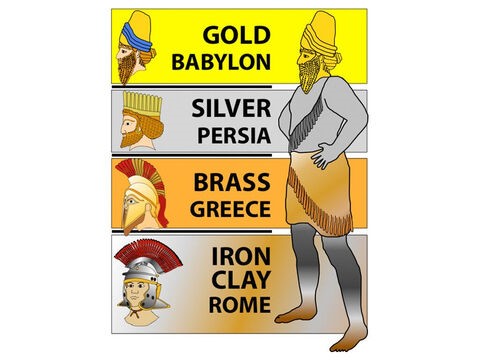
The statue in King Nebuchadnezzar’s dream. Free Bible Images.
Daniel 2: King Nebuchadnezzar’s dream.
In Daniel 2 after Daniel was taken into captivity in Babylon in 605 BC when Daniel was a teenager, King Nebuchadnezzar of Babylon had a dream in which he saw a large statue with a head of gold, chest and arms of silver, a belly and thighs of bronze or brass; and legs of iron and feet of iron mixed with baked clay. Then a rock that was cut out, but not by human hands, struct the statue on its feet of iron and clay and smashed them. None of the king’s magicians, enchanters, sorcerers and astrologers could tell him what he had dreamed. God told Daniel the dream and how to interpret the dream so the king would understand the dream came from God. Then Daniel interpreted this dream to mean a prediction concerning the rise and fall of four kingdoms that dominate as world empires. Thereafter, we recognize the head of gold as the Babylon Empire (608 BC-539 BC); the chest and arms of silver as the Medo-Persian Empire (539 BC-331 BC); the belly and thighs of bronze or brass as the the Empire of Greece (332 BC-146 BC); and the legs of iron and feet of iron mixed with baked clay as the divided or Roman Empire (146 BC-AD 476). The rock that was cut out, but not by human hands, that struck and smashed the feet of iron and clay represents the Messianic Eternal Kingdom of God that is more powerful than any other kingdom and will destroy all of these evil empires. King Nebuchadnezzar believed God reveled his dream and interpretation to Daniel, and the king made Daniel ruler over Babylon (Daniel 2:1-49).
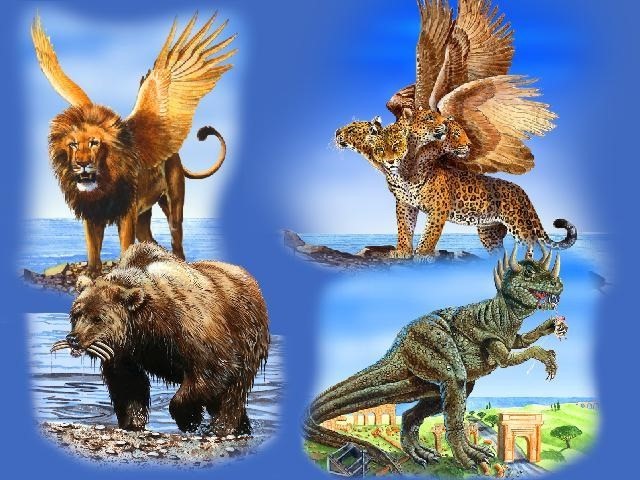
Daniel’s vison of four beasts. The Christian Truth Center.
Daniel 7: Daniel’s vision in his dream of four beasts.
More than 50 years after King Nebuchadnezzar’s dream, King Belshazzar had been given authority in 553 BC. At this time, Daniel was in his late 60s and had a vision in his dream about four great beasts. The four beasts are the four kingdoms that ruled over the Jews in Daniel 2 (see also Daniel 7:17). But the Most High’s (God’s) holy people will eventually in the end times receive the kingdom and possess it forever (Daniel 7:18). Daniel sees the four beasts come out of the sea. The first beast is a lion with eagle’s wings; the second beast is a bear with three ribs in its mouth that was raised up on one of its sides;
the third beast is a leopard with four heads and four wings; and the fourth beast is a terrifying, frightening, very powerful beast, with large iron teeth. It crushed, devoured, and trampled underfoot whatever was left. It has 10 horns, among which is a horn with humanlike eyes and a mouth that speaks boastfully.
The first beast, the lion with eagle’s wings (Daniel 7:4), may further describe the Babylonian kingdom that is compared to a lion (Jeremiah 4:7, 50:44) and to an eagle (Ezekiel 17:3, 11-12).
The second beast, the bear with three ribs in its mouth that was raised up on its side (Daniel 7:5), may further describe the Medo-Persian Empire as an illustration of Persia’s dominance over Media. The three ribs in the bears mouth may illustrate the three major empires that Persia conquered (Babylon, Egypt, and Lydia). The bear was commanded to devour much flesh, which may refer to Persia’s military expansion throughout the ancient world.
The third beast, the leopard with four heads and four wings (Daniel 7:6), may further describe the Empire of Greece. The four wings may symbolize the speed of Alexander the Great’s conquest. The four heads may represent Alexander’s divided empire into four provinces after Alexander’s death: Egypt under the Ptolemies, Syria under the Seleucids, Macedonia under the Antigonids, and Pergamum under the Attalids.
The terrifying, frightening, very powerful fourth beast, with large iron teeth with 10 horns (Daniel 7:7-8) is the fourth kingdom or empire that will appear on earth (Daniel 7:26). This beast most likely points to both Rome and the end times. The 10 horns are the 10 kings that will come from this kingdom or empire (Daniel 7:24). Three of the first 10 horns are kings that would be uprooted. After the 10 horns or kings, another man or king would will arise that is different than the earlier kings (the “little horn” with eyes and a mouth that boasts). This man or king will subdue the three kings. He will also speak against God and persecute Christians (Daniel 7: 25-26). Some Bible scholars believe that this little horn man is Antiochus Epiphanes (Antiochus IV) or the foreshadowing of the antichrist. Antiochus was a Greek king of the Seleucid Empire who reigned over Syria from 175 BC until 164 BC. He almost conquered Egypt and brutally and ruthlessly persecuted of the Jews, which precipitated the Maccabean Jewish revolt (167-166 BC). Antiochus Epiphanes was a ruthless and often capricious ruler. He raided the temple in Jerusalem, stole its treasures, set up an altar to Zeus, sacrificed swine on the altar, and ordered the Jews to worship Zeus. The Jews revolted. He self-proclaimed himself “Epiphanes,” which means “illustrious one” or “god manifest.” However, the Jews referred to him as “Epiphanes,” which means “mad one” because of his bizarre and blasphemous behavior. Other Bible scholars believe that this little horn man and related visions point forward to the Roman empire’s role in crucifixion of Jesus and the destruction of Jerusalem and its temple in AD 70. Still other Bible scholars believe this little horn man and related visions will be fulfilled in the future when Jesus returns in the end times. However, all Bible scholars agree that the text indicates that eventually, God would throw the little horn man or king that came from the fourth terrifying beast into the blazing fire (hell) (Daniel 7:7-8, 19-27).
After seeing the four beasts in a vision, Daniel saw the Ancient of Days (God the Father) sitting on his throne of fire with the books opened before him as ‘’thousands upon thousands” attended him and “ten thousand time ten thousand” stood before him. God killed, destroyed, and threw the body of the man (the fourth beast’s little horn) that was boasting into the blazing fire (hell). God also stripped the other beasts of their authority, but he allowed them to live for a period of time. Then the son of man (Jesus Christ) approached God and was led into his presence. God gave Jesus authority, glory, and sovereign power. All the nations and peoples of every nation worshiped him. Jesus’ dominion is everlasting and will not pass away, and his kingdom will never be destroyed. (Daniel 7:9-14, 19-27). This vision of the son of man (Jesus) and Ancient of Days (Father God) destroying and banishing all the kingdoms that oppressed God’s people, establishing God’s kingdom forever, and God’s people worshiping God forever, is a further description of the stone that was cut out, not by human hands (by God’s hand), that struck the statue in Daniel 2 on its feet of iron and clay and broke them to pieces.
Daniel 8: Daniel’s vision of a ram and a goat.
In 551 BC When Daniel was about 70 years old during the third year of the reign of King Belshazzar over Babylon, Daniel had a vison of a ram and a goat. First, he saw a ram with two long horns, with one longer than the other, even though the longer horn was younger than the shorter horn. The ram was charging in every direction, dominating everyone in its path (Daniel 8:1-4). Then a male goat approached from the distant west with a horn between its eyes and charged the ram, shattered the ram’s horns, and trampled the ram. The goat became great, but soon its own horn was broken, and four other horns took its place (Daniel 8:5-8). A little horn arose from one of the four horns, and the little horn grew very quickly, even to heaven, where it pulled down and trampled the stars.

Daniel’s vison of a ram.
The little horn set itself up as the great commander of the army of the LORD. It also took away the daily sacrifice from the LORD, and the LORD’s sanctuary was thrown down. Some of the LORD’s people rebelled and gave the daily sacrifice to the little horn. The little horn prospered in everything it did, and truth was thrown to the ground (Daniel 8:9-12). Near the end of Daniel’s vision, he heard two “holy ones” discussing how long it would take for Daniel’s vision to be fulfilled with the trampling underfoot of the LORD’s people. One “holy one” said “it will take 2,300 evenings and mornings” until the sanctuary was reconsecrated or restored (Daniel 8:13-14 NIV).

Daniel had a vision of a shaggy goat.
The angel Gabriel explained to Daniel that his vison was a confirmation of history. “The two-horned ram that you saw represents the kings of Media and Persia. The shaggy goat is the king of Greece, and the large horn between its eyes is the first king. The four horns that replaced the one that was broken off represent four kingdoms that will emerge from his nation, but will not have the same power” (Daniel 8:20-22 NIV). These four kingdoms are Alexander the Great’s four generals that succeeded him and ruled over his fragmented kingdom. The little horn represents the same evil little horn or man or king of Daniel 7. He will cause deceit to prosper, devastate and destroy God’s people in Jerusalem, and exalt himself over God by defiling the temple with idols. But in the end times, God will destroy this king, restore the temple, and exalt God’s people and kingdom.
“Evenings and mornings” means evening and morning sacrifices. This could be a literal 2,300 evenings and mornings or a symbolic 2,300 to mean a long period of time. God revealed these devastating time periods in advance to demonstrate God’s firm control and guidance, even over the times of persecution.
Daniel 9-12: the Seventy “Sevens” or 70 sets of 7 years (490 years).
When Daniel was almost 80 years old and almost 70 years in exile in Babylon under the reign of King Darius, Daniel was studying prophecy in the book of Jeremiah (Jeremiah 25:11-12, 29;10) that the exile of Jews would end after 70 years. At that time, Daniel confessed Israel’s sins and refusal to obey God, and prayed to God for God’s mercy to restore Israel (Daniel 9:1-18) God interrupted Daniel’s prayer and sent the angel Gabriel “in swift flight” to give Daniel insight and understanding of the vision about the dark future of Israel and the city of Israel (Daniel 9:20-23).
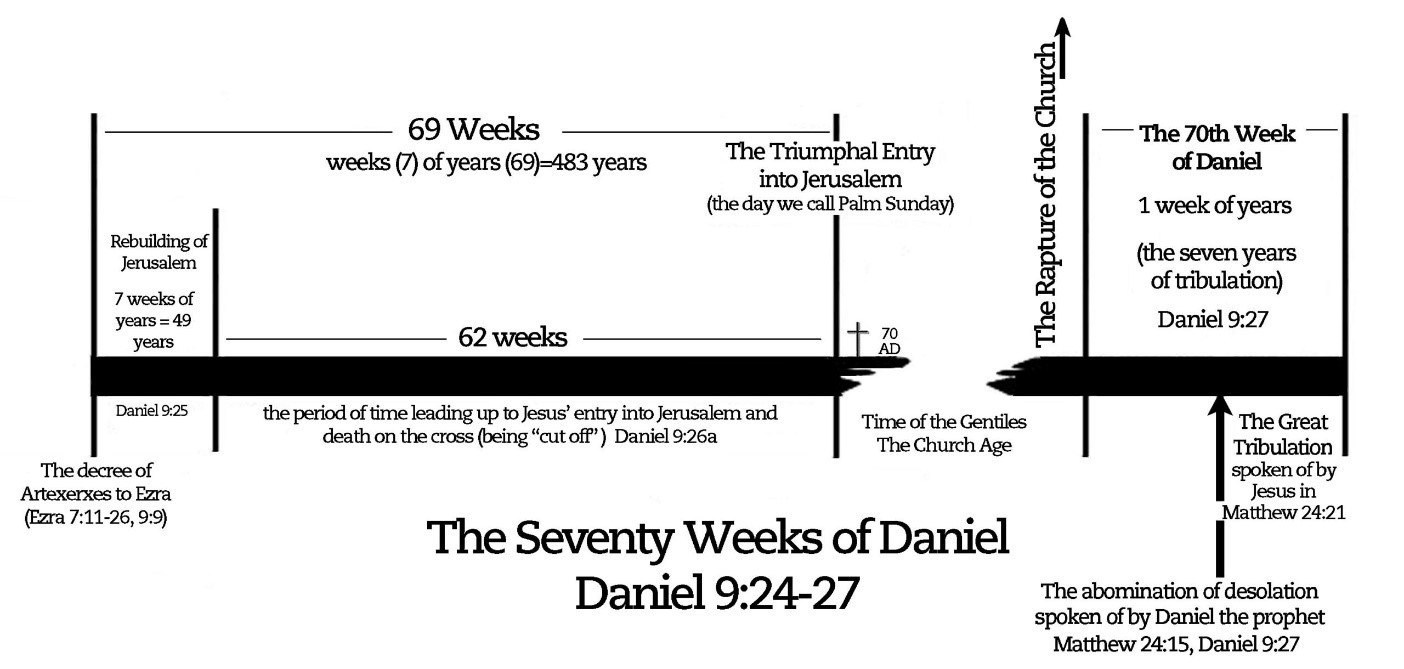
Futurist view of Daniel’s vision of seventy weeks. Internet Archive.
Gabriel starts the prophetic vision, “Seventy ‘sevens’ are decreed for your people and your holy city to finish transgression, to put an end to sin, to atone for wickedness, to bring in everlasting righteousness, to seal up vision and prophecy and to anoint the Most Holy Place” (Daniel 9:24 NIV). The word “sevens” is the Hebrew word that means weeks. Seventy literal weeks of seven days each week calculates to 490 days. But most Bible scholars believe 490 days is far too short a time for all the events prophesied in Daniel 9:24-27 to occur. So they interpret the text “seventy sevens” as seventy sets of seven years each, which calculates to 490 years that God decreed it would take to resolve the problem of Israel’s sins once and for all.
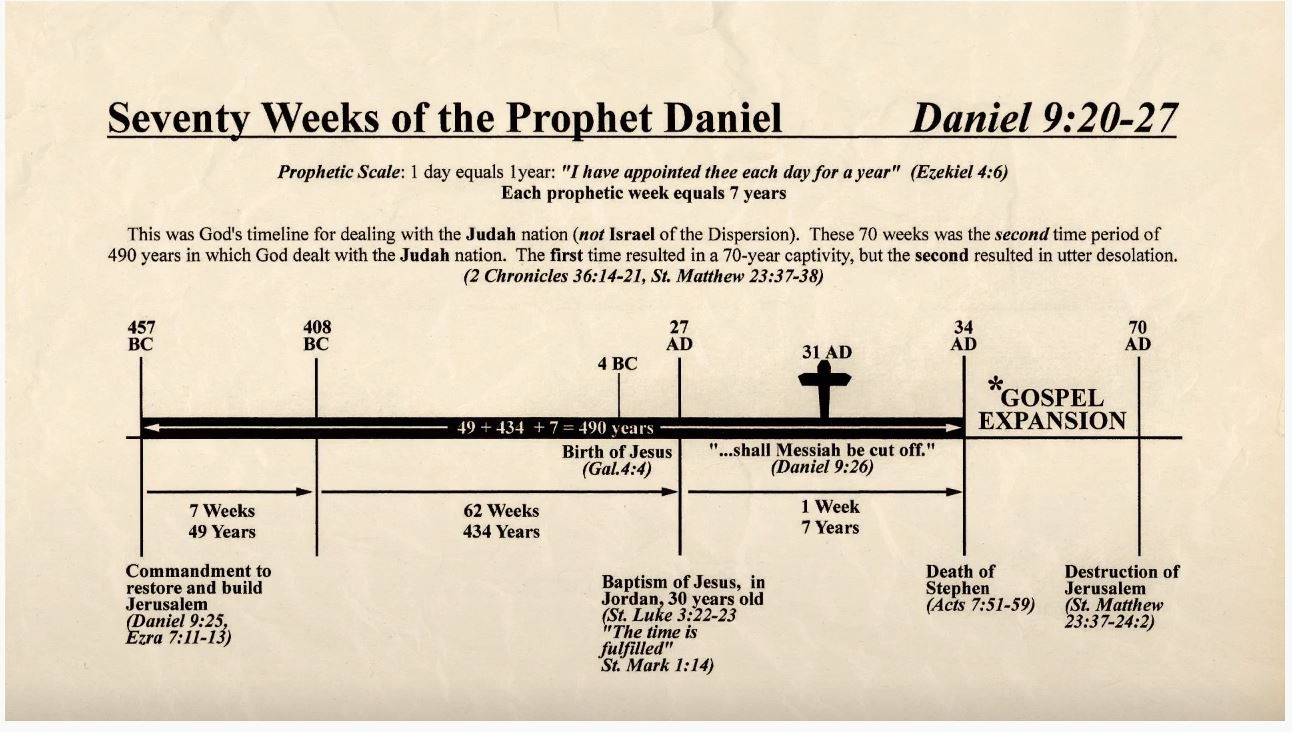
Historicist view of Daniel’s vision of seventy weeks. Created by Matthew Dyer. Internet Archive.
The 490 years starts from the time of a decree to “restore and rebuild Jerusalem until the Anointed One (Jesus Christ), the ruler comes” (Daniel 9:25 NIV). Bible scholars differ on which of the three known decrees in history is the start date of the 490 years and the interpretation of how the years add up to 490 years. In 538 BC, King Cyrus of Persia decreed that he would allow the Israelites to rebuild the Jerusalem temple (2 Chronicles 36:22-23; Ezra 1:1-4, 6:1-12, Isaiah 44:28, 45:13).
If the angel Gabriel meant Cyrus’ temple decree of 538 BC, then the 490 years would need to be rounded to arrive sometime from AD 27 to AD 32 when Jesus triumphantly entered Jerusalem (Matthew 21:1-11) and was crucified and resurrected, because 490 years calculates to 48 BC when nothing occurred regarding rebuilding and restoring Jerusalem or Jesus’ arrival at that time. In 458 or 457 BC, Persian ruler Artaxerxes repeated Cyrus’ original decree (Ezra 7:12-26). If Artaxerxes’ decree is the start of the 490 years, then using exact 365-day years, the 490 years would arrive close to AD 27 which is within the range of years of Jesus’ arrival, crucifixion, and resurrection. In 445 BC, Artaxerxes issued another decree selecting Nehemiah to return to Jerusalem to rebuild it (Nehemiah 2:1-8). If Artaxerxes’ second decree is the start of the 490 years, then using exact 360-day years as the apostle John used in Revelation (42 months in Revelation 11:2, 13:5 equaled 1,260 days in Revelation 11:3, 12:6,), the first 69 sevens of the 490 years would arrive at AD 32, which some scholars believe to be the year of Jesus’ triumphant entry into Jerusalem (Matthew 2-11).
According to Gabriel, God’s plan for his people would occur in three segmented periods: Seven sets of seven (7 years), then 62 sets of sevens (434 years), and on final set of seven (7 years). During the first seven sets of seven (49 years), the destroyed city of Jerusalem would be rebuilt with “streets and a trench but times of trouble” (Daniel 9:5 NIV). God fulfilled this segment through Nehemiah (Nehemiah 2:19, 4:1-21, 6:1-14) over several decades from around 445 BC to 432 BC. During the next 62 sets of sevens (434 years) after the rebuilding of Jerusalem, nothing happened for several centuries (about 434 years) from a prophetic perspective until the arrival of the “Anointed One (Jesus)” (Daniel 9:25 NIV). The third and final segment is final set of sevens (7 years) when Jesus arrives as the “Anointed One” and is “cut off” or “put to death” (Daniel 9:25-27).
Thereafter, “The people of the ruler (Satan) who will come will destroy the city and the sanctuary. The end will come like a flood: War will continue until the end, and desolations have been decreed. He will confirm a covenant with many for one ‘seven.’ In the middle of the ‘seven’ he will put an end to sacrifice and offering. And at the temple he will set up an abomination that causes desolation, until the end that is decreed is poured out on him” (Daniel 9:25-27 NIV).
Daniel’s final vision is described in Daniel 10 to 12 describes the same sequence of empires or kingdoms as in his prior visions: Medo-Persia, Greece and the Alexander the Great, the lesser kings, and the final “king of the north.” This final king will invade Jerusalem, set up idols in the temple, and exalt himself above God. The vision ends like the prior visions. God ruins and destroys the final king.
The seventy weeks or sets of seven years in Daniel 9 prophesying a time line of history is difficult to understand with many possible interpretations. Yet, nearly all Bible scholars agree that the coming of the Messiah Jesus Christ is the central message and fulfillment of Daniel’s seventy weeks or sets of seven years.
Jones, Rose Guide to End-Times Prophecy, 147-173.