

When examining the evidence for whether God has spoken through the Bible, not only should you consider each piece of evidence; you should consider the synergistic effect of how all the pieces of evidence interact to support your conclusion. In other words, the pieces of evidence reinforce one another, producing an effect stronger than any piece of evidence by itself. As stated in this website, the evidence that God has spoken through the Bible and that the Bible accurately communicates God’s message to humanity includes the following.
A library of books with a purpose.
The Bible is a library of books, not a single book. The Bible includes 66 books that were written over about 1,600 years (from about 1500 BC to AD 100), by more than 40 authors. The Old Testament has 39 books (written about 1500 to 400 BC) and was written mainly in Hebrew and some in Aramaic. The New Testament has 27 books (written about AD 45-100) and was written in Greek. Christianity is a special revealed religion of truths about God. The Bible is a unique library of books from the mind of God that tells us that God loves the world and wants to have a relationship with us through Jesus Christ. Erwin W. Lutzer, Seven Reasons Why You Can Trust the Bible, (Chicago, IL: Moody Press, 1998), 16.
Error-Free or Infallible and Inerrant.
The word, “infallible” is derived from a Latin word that means “unable to deceive” or “not liable to err.” When we refer to the Bible as “infallible,” we mean that the Bible tells the truth and never deceives us. In other words, God does not lie (Romans 3:4; Titus 1:2). The Bible is also inerrant which means “not in error.” Inerrancy applies to the original writings/autographs of the texts. It does not mean that the manuscript copyists never made any mistakes or that the Bible is scientifically precise or does not use numeric estimates or figures of speech. God spoke through the Bible through human authors in different genres and styles of literature. To the extent precision is necessary to express the truth, God communicates the truth through the Bible with precision. Jones, How We Got the Bible, 13-16.
Sufficient to communicate knowledge of God’s truth with accuracy to preserve God’s truth.
Christians consider the Bible sufficient in two ways. First, the Bible is sufficient to communicate knowledge of God’s truth in order to understand how to have a relationship with God. Second, the Bible has been copied with sufficient accuracy to preserve God’s truth. Jones, How We Got the Bible, 15-18.

Scribes copied the biblical manuscripts.
Old Testament Copyists were meticulous.
The Old Testament copyists engaged in the practice of meticulously hand-copying biblical manuscripts letter by letter. Most of the Old Testament manuscripts were copied in “paleo-Hebrew” letters, which is a non-square script similar to lower case English letters. Sometime after the sixth century AD, the Jewish scribes began to write Hebrew words in square-script letters, which were similar to capital English letters. Timothy Paul Jones, PhD, How We Got the Bible (Peabody, MA: Rose Publishing, 2015), 36-40.

The caves in Qumran, Israel where the Dead Sea Scrolls
were discovered.
In 1947, the Dead Sea Scrolls were discovered in Qumran, Israel containing copies of all the major sections of the Old Testament, except Ruth, dating back more than a century before Jesus. Specifically, the Dead Sea Scrolls (300-200 BC) pre-dated the earliest extant Masoretic text (AD 1000) by more than 1,000 years in the form of the oldest complete Masoretic Hebrew Bible prior to the discovery of the Dead Sea Scrolls: The Leningrad Codex, which dates to AD. 1008. Yet when Masoretic text was compared to the Dead Sea Scrolls, differences in style and spelling in about 5% of the text were noted, but there was no significant difference in substance. Hank Hanegraaff, Has God Spoken? Memorable Proofs of the Bible’s Divine Inspiration (Nashville, TN: Thomas Nelson, 2011), 10-12; Wegner, A Student’s Guide to Textual Criticism of the Bible, 63-78. Therefore, the Dead Sea Scrolls demonstrated that the text of the Old Testament was accurately copied over many centuries.
.
The Jewish people recognized the books of the Old Testament or Hebrew Bible without controversy.
The Jewish people recognized the texts of the Old Testament through God himself or his prophets. The Old Testament canon pertained to the covenant that God made with Israel and the written texts that stated the terms of the covenant (Exodus 24:7, 31:18, 34:1, 28; Deuteronomy 4:13, 29:21, 30:10; 2 Kings 23:2; 2 Chronicles 34:30). Josh McDowell and Sean McDowell PhD, Evidence that Demands a Verdict: Life-Changing Truth for a Skeptical World (Nashville, TN: Thomas Nelson: 2017), 26.
God etched the 10 Commandments in stone (Exodus 31:18, 32:15-16). God also spoke directly through Moses throughout Israel’s exodus, and his writings were immediately received as the “book of the covenant” from God (Exodus 24:3-7, 33:11; Numbers 11:10-35).

Most Christian scholars agree that Moses likely wrote most of
the first 5 books of the Old Testament called the Torah.
The Jews do not refer to their Scriptures as the “Old Testament.” The Hebrew Bible is known as the Tanakh, which is an acronym created from the first letter of each of the three sections of Jewish Scripture. Most Bible scholars agree that Moses wrote the first section of the Hebrew Bible called the Torah, which is typically referred to as the “Law” and includes the first five books of the Old Testament: Genesis, Exodus, Leviticus, Numbers, and Deuteronomy. The second section of the Hebrew Bible is the Neviim, which means “the Prophets.” This section documents the lives of the prophets and their message and includes: Joshua, Judges, Samuel, Kings, Isaiah, Jeremiah, and Ezekiel, and one book containing the 12 Minor (meaning shorter, not less important) Prophets. The third section of the Hebrew Bible is called the Keuvim, which means “the Writings.” This section covers wisdom literature, songs, and miscellaneous stories and includes: Psalms, Proverbs, Job, the Five Scrolls, Ezra/Nehemiah, Chronicles, and Daniel. Jones, How We Got the Bible, 51-56; Doug Powell, Holman QuickSource Guide to Christian Apologetics (Nashville, TN: Holman Reference, 2006), 178-187.
When Moses wrote the Torah, he most likely had and worked with numerous documents that were passed down from generation to generation. Since the Hebrews were aware of their unique role as God’s people, they were motivated to state and document what God revealed to them. They accepted that Moses’ writings were from God because of the many miracles that God performed through Moses, and Moses conducted his ministry openly, not for his benefit, but for the benefit of the people. By the time of Moses’ death, the Israelites recognized and received a functional canon that was a set of authoritative texts that were God’s words that their leaders proclaimed and preserved. Jones, How We Got the Bible, 51-52; Powell, Guide to Christian Apologetics, 180-182.
Similarly, the Hebrews accepted the writings of the Neviim prophets because God gave them a sign, primarily fulfilled predictive prophecy, that authenticated that the prophets spoke for God. In the Old Testament, accurate predictive prophecy was so important that a false prophet was to be stoned (Deuteronomy 18:20). They preserved the messages and histories in the writings of the Neviim prophets to document what God told them and how God interacted with them. After Nehemiah, the canon of the Neviim prophets closed and came to an end. Powell, Guide to Christian Apologetics, 181-182.
The remaining books of the Hebrew Bible/Tanakh were accepted as Jewish Scripture because they were held in high esteem and commentaries were written about them, such as the books of Psalms, Job, and Proverbs. For example, commentaries of these books were found among the Dead Sea Scrolls. Jesus referred to the Hebrew Bible/Tanakh as actual history (Luke 24:44). In addition, the New Testament writers directly (18 of 22 books) or indirectly (4 of 22 books) referred to the persons and events documented in the Hebrew Bible/Tanakh as actual and reliable. Powell, Guide to Christian Apologetics, 182-183.
The first century Christians learned, taught, and passed on the testimony and teachings of Jesus and the apostles within the context of an oral culture.
The New Testament of the Bible covers ministry of Jesus, the growth of the early Christian Church, and letters written or authorized by the apostles regarding Christian doctrine. The ancient Jewish and Greco-Roman cultures were oral cultures that prized memorization skills. Rabbis memorized the entire Old Testament and part of the sizeable body of oral law. Elementary education for Jewish boys from ages 5 to 13 included memorizing the Old Testament books. See Deuteronomy 6:4-9. The same applied to the New Testament writings. Michael J. Wilkins and J.P. Moreland, editors, Jesus Under Fire: Modern Scholarship Reinvents the Historical Jesus (Grand Rapids, MI: Zondervan, 1995), 32, 79-80. One of the reasons people in the first century AD relied on oral historical testimonies was widespread illiteracy: fewer than half the people in the Roman Empire could read and even fewer were able to write. Accordingly, oral histories or testimonies to truth were memorized, and shared with others during the lifetimes of eyewitnesses. This oral history transmission process was a useful form of passing down information from generation to generation. The accounts of Jesus’ life and ministry and the activities and teachings of the apostles were memorized and shared in the context of a tight-knit fellowship of Christian congregations. If one Christian incorrectly retold an aspect of these events and teachings, other Christians would quickly correct the error. In addition, during the early expansion of the Christian church, eyewitnesses of Jesus and his apostles were still alive and could refute false accounts and restate the truth about the events and teachings. Timothy Paul Jones, PhD, How We Got the Bible (Peabody, MA: Rose Publishing, 2015), 67-70.
An excellent example of a reliable oral history or testimony was documented when the apostle Paul included one of these testimonies in his letter to the Corinthians.
“I passed on to you what is most important and what had also been passed on to me-that Christ died for our sins, just as the Scriptures said. He was buried, and he was raised from the dead on the third day, as the Scriptures said. He was seen by Peter and then by the twelve apostles. After that, he was seen by more than five hundred of his followers at one time, most of them are still alive, though some have died by now. Then he was seen by James and later by all the apostles. Last of all, I saw him too, long after the others, as though I had been born at the wrong time. For I am the least of all the apostles, and I am not worthy to be called an apostle after the way I persecuted the church of God” (1 Corinthians 15:3-9 NLT).
Conservative and liberal scholars agree that the apostle Paul wrote this creed in 1 Corinthians as part of his first letter to the church in Corinth between AD 55 and 56. This was within 25 years of the resurrection of Jesus in about AD 30 or 33. Paul wrote down the testimony he received from others. He most likely received it from Peter and James in Jerusalem after his conversion (Galatians 1:18), which occurred about five years after the resurrection. This creed dates right back to at least about 8 years after the resurrection, but some scholars contend that the creed dates to about 18 months after the resurrection, or even earlier. Gary Habermas, The Historical Jesus (Joplin, MO: College Press, 1996), 152-157; Gary R. Habermas and Michael R. Licona, The Case for the Resurrection (Grand Rapids, MI: Kregal, 2003), 51-53, 221. For an in-depth scholarly discussion of the history of the early Christian belief in the resurrection, see N.T. Wright, The Resurrection of the Son of God: Christian Origins and the Question of God, Volume 3, (Minneapolis, MN: Fortress Press, 2003). This oral history or testimony confirms the New Testament eyewitness sources and documents are of very early origin.
Dating the New Testament books and letters.
Numerous New Testament books and letters were written in the 50s A.D. or earlier. These include James (AD 40-50), Galatians (A.D. 48), 1 Thessalonians (AD 50-54), 2 Thessalonians (AD 51-55), 1 Corinthians (AD 55-56), 2 Corinthians (AD 56), and Romans (AD 57-58). Three of the gospels and Acts (AD 62-64) also were written on or before AD 65: Mark (AD 55-65), Matthew (AD 60-65), and Luke (AD 60). Most scholars conclude that John was written from approximately AD 75-90, but some scholars contend that John was written earlier on or about AD 65-70, because John does not mention the destruction of the Temple in Jerusalem in AD 70. If John wrote his books after AD 70, he would have mentioned the destruction of the Temple. The remaining books of the New Testament were written in the following chronological order in or about: Ephesians (AD 60), Colossians (AD 60), Philemon (AD 60), Philippians (AD 61), 1 Timothy (AD 62-64), 1 Peter (AD 62-64), Titus (AD 64), 2 Timothy (AD 64-68), 2 Peter (AD 67), Hebrews (AD 68), Jude (65-69), 1 John (AD 65-70 or 85-90), 2 John (AD 65-70 or 90), 3 John (AD 65-70 or 90), Revelation (AD 65-70 or 95) Geisler and Turek, I Don’t Have Enough Faith to Be an Atheist, 242-243, Hank Hanegraaff, Has God Spoken? Memorable Proofs of the Bible’s Divine Inspiration (Nashville, TN: Thomas Neslon: 2011), 28-31.
The New Testament books were written by the apostles, people authorized by the apostles, or people that had encounters with Jesus.
From on or about AD 45 to 100, the apostle eyewitnesses of Jesus after his resurrection, the people authorized by the apostles, or other people who had encounters with Jesus wrote the four gospels (Matthew, Mark, Luke, and John), history of the church (Acts), letters (epistles) to other Christians, and end times prophecies (Revelation). They quoted 31 of the 39 Old Testament books. These books contained the “New Covenant” or “New Testament” that God promised the people in the Old Testament (Jeremiah 31:31-34). The accounts of Jesus remained the same as they were written, copied, and spread across the Roman Empire. Josh McDowell and Sean McDowell PhD, Evidence that Demands a Verdict: Life-Changing Truth for a Skeptical World (Nashville, TN: Thomas Nelson: 2017), 42-46.
The New Testament and Old Testament have more manuscripts and shorter time gap between the autographs and earliest manuscripts when compared to selected classical literature.
The number of complete and partial extant manuscripts of the New Testament and Old Testament books is continually increasing because not all manuscripts have been carefully cataloged and new manuscripts are being found. Scholars may have counted some manuscripts twice. However, it is safe to state that there are over 5,000 Greek New Testament manuscripts. In addition, there are over 18,130 non-Greek New Testament manuscripts. There are over 42,300 Old Testament scroll and codex manuscripts. Therefore, combining the Old and New Testament, there are more than 65,000 manuscripts. For the Greek New Testament manuscripts alone, there are more than 2.6 million pages. From a visual perspective, a stack of extant manuscripts for the average classical writer would measure about 4 feet high, while the New Testament manuscripts would measure more than 1 mile, the Old Testament would measure about 1.5 miles, and the entire Bible would measure over 2.5 miles. Josh McDowell and Sean McDowell, Evidence that Demands a Verdict, 48-55; Elijah Hixson and Peter J. Gurry, editors, Myths and Mistakes in New Testament Textual Criticism (Downers Grove, IL: IVP Academic, 2019), chapters 3 and 13. A sampling of selected classical literature that have been accepted by historians and the corresponding number of manuscripts and time gap between the autographs and the earliest manuscripts is as follows:
In or about 800 BC, Homer wrote the epic poem The Iliad, which tells of anger, war, and the final year of the Trojan war: over 1,900 manuscripts; earliest manuscript is about 415 BC; time gap of 385 years from the original autograph.
In or about 453 BC, Herodotus, a Greek historian and vivid detailed storyteller from the fifth century BC, wrote Histories of the Greco-Persian Wars: about 106 manuscripts; earliest manuscript is about AD 100; time gap of 553 years from the original autograph.
In or about 468 BC, Sophocles was a great tragic playwright of Athens, Greece, wrote over 100 dramas in the fifth century BC, but only few manuscripts remain: about 226 manuscripts; earliest manuscript is about 250 BC; time gap of 218 years from the original autograph.
In or about 400 BC, Plato, a philosopher from the fifth century BC, wrote dialogues on the fundamental concepts of truth, goodness, beauty, best city government, and a person’s self-government, wrote four groups of his works called Tetralogies: 238 manuscripts; earliest manuscript is about 250 BC; time gap of 150 years from the original autograph.
In or about 72 BC, Gaius Julius Caesar was a Roman general and statesman who led first century BC wars that spread Roman authority over the Mediterranean and Europe, wrote the Gallic Wars: over 251 manuscripts; earliest manuscript is about AD 850; time gap of 922 years from the original autograph.
In or about 21 BC, Livy (64 or 59 BC to AD 17), one of Rome’s great historians that lived until the earlier years of Jesus, wrote his History of Rome, which became a classic in his lifetime: about 473 manuscripts; earliest manuscript is about AD 350; time gap of 371 years from the original autograph.
In or about AD 100, Tacitus (AD 56 to120) was a Roman orator, public official, and one of the great historians that wrote about the Roman Empire from AD 14 to 66 called Annals: 36 manuscripts; earliest manuscript is about AD 950; time gap of 850 years from the original autograph.
Based on the above sampling of comparative number of manuscripts, if skeptics reject the New Testament based on the number of manuscripts and the time gap between autograph and the earliest manuscript and, they must also reject all other manuscripts of classical literature of antiquity. Josh McDowell and Sean McDowell, Evidence that Demands a Verdict, 55-59.
The approximate time gap of 50 to 250 years between the original New Testament autographs and the earliest extant manuscripts is relatively short when compared to other gaps for the above selected classical literature.
Paul and John referred to their writings. Paul made reference to his writings on parchment when he requested that Timothy, “When you come, bring the cloak that I left with Carpus at Troas, also the books, and above all the parchments” (2 Timothy 4:22 ESV). Also, John mentioned his writings in the final greetings closing of his second letter, “Though I have much to write to you, but I would rather not use paper and ink. Instead I hope to come to you and talk face to face, so that our joy may be complete” (2 John 1:12 ESV).
The time gap between the original New Testament autographs and the earliest extant manuscripts is approximately 50 to 250 years, depending on the manuscript. As stated in the above sampling of classical literature, the time gap between the sampling of original selected classical literature autographs and earliest extant manuscripts ranges from about 150 to 850 years. Therefore, the New Testament time gap is about one-third of the typical original selected classical literature. But even if there is a New Testament time gap of 50 to 250 years, we can still independently confirm the text of the New Testament by: 1. Papyri manuscripts of the New Testament books that were discovered in Egypt, dating as early as AD 125. 2. There are extensive quotations of the New Testament in the writings of the early church Fathers. Lutzer, Seven Reasons Why you can Trust the Bible, 76-77; Josh McDowell and Sean McDowell, Evidence that Demands a Verdict, 55-59; Hixson and Gurry, Myths and Mistakes in New Testament Textual Criticism, chapter 4.
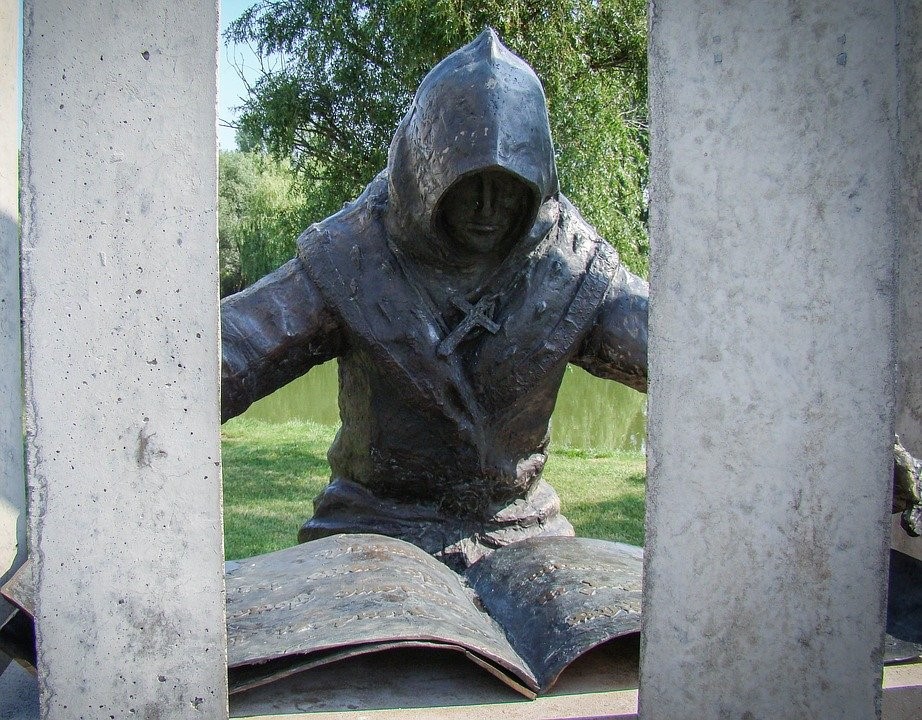
Scribe copyist statue by anonymous.
Many of the New Testament copyists sacrificed themselves to the tedious practice of accurately copying the text.
In contrast to the Old Testament, the New Testament copyists did not utilize the same or similar systemized copyist practices. Many of them loved God and sacrificed themselves to the tedious practice of accurately copying the text. Some stood at writing desks, and others worked in extreme cold. They recognized the importance of their copyist practices and did their best to not add to or take away from the text as admonished in Deuteronomy 12:32 and Revelation 22:18-19. They engaged their copyist practices in awe of God similar to the Old Testament copyists.
Copyists were also hired as professional copyists that were not necessarily Christians. So they had no incentive to change or alter the text. In addition, most of the the New Testament manuscripts were in use for 150 to 200 years and some were in use for 300 to 400 years. There was overlap between the manuscripts to ensure the new manuscripts could be checked against old manuscripts. The papyrus manuscripts were named as “P” for papyrus followed by the number of the manuscript. Examples of early manuscripts that overlap each other and the original autographs are the following. The P45 manuscript of the four Gospels date to AD 200 to 250. The P66 manuscript of 156 pages of parts of the Gospel of John was written between AD 100 and 200. The P75 manuscript of the end of the Gospel of Luke and the beginning of the Gospel of John dates back to AD 175 to 225 and reads nearly identical to the Codex Vaticanus which was written about 100 years after P75. These manuscripts were most likely written while the original autographs of the four Gospels were still in use. Dr. Craig Evans, Dr. Dan Wallace, narrated by John Rhys-Davies, Can We Trust the Bible? Fragments of Truth (Faithlife Films, 2018); compare to Hixson and Gurry, Myths and Mistakes in New Testament Textual Criticism, chapters 7, 8, and 11.
There were copyist mistakes in the manuscripts, but we have so many manuscripts by which textual critics can sort out the manuscript copying errors, even apart from context and common sense. Hanegraaff, Has God Spoken?, 12-13. For example, according to New Testament textual criticism scholar, Peter Gurry, John 18 is about 800 words in Greek and we have almost 1,700 complete manuscripts. This calculates to 1,360,000 translated words. In John 18, there are about 3,000 reported variants. Therefore, 1,360,000 translated words divided by 3,000 variants equals about 1 variant per 453 translated words or 0.22% variant per translated word. Gurry reports there are about 500,000 variants not counting spelling differences in the Greek manuscripts in the New Testament. The New Testament is about 138,000 words long. As illustrated above, the relevant question to ask to put the variants in proper context is, “How many variants are there per words copied by the scribes?” We have so many variants because we have so many manuscript copies. We can determine and correct the variants by comparing the manuscript in question to other accurate manuscripts. Hixon and Gurry, Myths and Mistakes in New Testament Textual Criticism, chapter 10; see also to Think Biblically podcast with Peter Gurry, December 11, 2020, https://www.biola.edu/blogs/think-biblically/2020/trust-copying-of-bible
There are extensive quotations of the New Testament in the writings of the early church Fathers.
Between AD 100 to 400, the early Christian church fathers quoted the New Testament approximately 36,000 times. We can reproduce a substantial portion of the original text and reconstruct at least an outline of the New Testament and many of its essential details. Josh McDowell and Sean McDowell, Evidence that Demands a Verdict, 64-66; Hixson and Gurry, Myths and Mistakes in New Testament Textual Criticism, chapter 12.
How was it determined which books would be included in the New Testament?
Early Christians with a Jewish background recognized the need for the New Testament because they believed the Old Testament was unfinished, they wanted to document the New Testament that God promised in in the Old Testament (Jeremiah 31:31-34), and they believed the apostles possessed the authority of Jesus to write the New Testament. Josh McDowell and Sean McDowell, Evidence that Demands a Verdict, 26-27.
Scribe copyist statue by anonymous.
From the first century AD forward, the early Christians recognized the 27 books of the New Testament were authoritative and included them in the New Testament. They recognized the canon or the definite standards to determine which writings were authoritative. They rejected any writings that were not trustworthy testimony about Jesus. There were 30 or less known gospels, but unlike the 4 New Testament gospels, many of these other gospels only contained isolated teachings or fragmented incidents from the life of Jesus and all of them could not be clearly connected to persons who were eyewitnesses of Jesus and his resurrection or close associates of these eyewitnesses. No specific church council or church leader created the New Testament canon. Instead, a unanimous Christian consensus on 19 of the New Testament books emerged by the second century AD and the remaining 8 books were accepted as authoritative by the end of the fourth century. These are the same 27 New Testament books contained in the Bible today and can be traced back to apostolic eyewitnesses and their associates. Jones, How We Got the Bible, 87-97.
The specific canon principles/tests that the early Christians utilized to determine the canon of the New Testament books included the following:
- The book was written by an apostle or an authorized close associate of an apostle.
- The writer was confirmed by God by performing a miracle which “is an act of God to confirm the Word of God given through a prophet of God to the people of God.”
- The writer’s message told the truth about God because God cannot contradict himself (2 Corinthians 1:17-18) nor can God speak what is false (Hebrews 6:18). To assure there were no falsehoods in the canon, the early church fathers’ policy was, “If in doubt, throw it out.” The book had to be written within the lives of the apostles, which was before AD 100. The books were consistent with authentic Christian doctrine that was consistent with God’s truth communicated in the past.
- The book was “living and active” (Hebrews 4:12 NIV), meaning it could transform people to become spiritually “born again, … imperishable” (1 Peter 1:23 NIV) Christians that were fully equipped to act on behalf of God (2 Timothy 3:17).
- Christians accepted the message of the book “not as the word of men, but as it actually is, the word of God” (1 Thessalonians 2:13). When the book was received, collected, read, and taught by the Christians, it was regarded as Scripture just like the Old Testament. For example, the apostle Peter recognized Paul’s writings as Scripture the same as he recognized the Old Testament as Scripture (2 Peter 3:16).
Norman L. Geisler and William E. Nix, A General Introduction to the Bible: Revised and Expanded (Chicago, IL: Moody Press, 1986), 210, 223-229, 283 ; Josh McDowell and Sean McDowell, Evidence that Demands a Verdict, 27-28.
In Hank Hanegraaff’s book, Has God Spoken?, he presents a helpful subacronym COPIES: Copyist Practices. Oral Culture. Papyrus and Parchment. Internal Evidence. External Evidence. Science of Textural Criticism. He uses COPIES to remember the reasoning that demonstrates that extant manuscript copies faithfully preserve the words of the original biblical text. Hanegraaff, Has God Spoken?, 1-56, Kindle location 239-252.

Archeology tools.
The trend in recent archaeological artifacts corroborates that the Bible preserves an accurate historical account.
Archaeology involves the study of the ancient world through found artifacts, which are ancient objects made or modified by humans including statutes, altars, jewelry, weapons, tools, inscriptions, paintings, coins, scarabs, tablets, papyri, stelae, reliefs, and pottery. These artifacts are visual and informational aids that provide insight into the ancient context and an accurate understanding and interpretation.
The majority of secular archaeologists, scholars, and historians called biblical minimalists regard the Bible as historically unimportant and irrelevant beyond literary and religious studies. This is because archeology is a “soft” science that involves interpretation of the artifacts with the preconceptions and biases of the researchers. In addition, we must recognize the fact that only a small amount of artifact evidence has survived and discovery of biblical artifacts is difficult because of floods, fires, natural deterioration, burial, temperature, political climate, and time. However, over the past 25 years and accelerating since 1999, archaeologists have unearthed hundreds of artifacts that show and corroborate that the Bible preserves an accurate historical recounting of the events, people, and places mentioned in the Bible. The Bible remains one of the best existing historical and geographical sources from the ancient Near East. For example, if the biblical artifacts are interpreted fairly taking into account the historical and cultural context, they convincingly demonstrate that the Bible accurately states that Abraham, Isaac, and Jacob belong to the Middle Bronze Age (1950-1540 BC) and the cultural elements found in the biblical historical accounts of Moses and Joshua match those of the late Bronze Age. Titus Kennedy, Unearthing the Bible. 101 Archaeological Discoveries that Bring the Bible to Life (Eugene OR: Harvest House Publishers, 2020), 9; Josh McDowell and Sean McDowell PhD, Evidence that Demands a Verdict: Life-Changing Truth for a Skeptical World (Nashville, TN: Thomas Nelson: 2017), 414-422.
In addition, many artifacts demonstrate the accuracy and reliability of the New Testament gospels regarding the life and ministry of Jesus Christ, the apostles, the growth of the Christian church despite the persecution of Christians, and the places mentioned in the Bible. Moreover, the discovery of historically early manuscript copies of the gospels confirm the early gospel accounts were from eyewitness testimony. Titus Kennedy, Excavating the Evidence for Jesus: The Archaeology and History of Christ and the Gospels, (Eugene, OR: Harvest House Publishers, 2022).
Finally, although archeological artifacts cannot prove that all the biblical supernatural events, miracles, signs, and wonders occurred, they do corroborate many of the historical biblical accounts. No artifacts have refuted any of the biblical accounts. Since new artifacts are being discovered, we can be confident that they will continue to present cumulative clear and convincing evidence that the biblical accounts are historically true and accurate. In Part 2 of Hank Hanegraff’s book, Has God Spoken?, he utilizes the subacronym SPADE, meaning the archeologist’s spade, and demonstrates that archeology “documents time and time again, … the people, places, and particulars found in sacred Scripture have their roots in history and evidence. As such, what was concealed in soil corresponds to what is revealed in the Scriptures. From steles to stones to the Epic of Gilgamesh, archaeological artifacts cry forth from antiquity: God has spoken-“Scripture cannot be broken” (John 10:35 NASB). Hanegraaff, Has God Spoken?, Kindle location 252-257.
The cumulative evidence for the Bible. In conclusion, the cumulative effect of the historical reliability and transformational effect of the Bible’s storyline of redemption of humanity are clear and convincing evidence that God has spoken to us through the Bible. It makes sense that God would communicate to his creation through a library of books with one theme of the redemption of God’s creation. God has ensured that all of the books needed to communicate his message are included in the canon of the Bible and books that were not from him are excluded. Only allowing many thousands of manuscript copies of the Scripture to survive and not the original autographs ensures that God’s message and storyline will not be corrupted because the manuscripts correct each other by scholarly textual criticism when human copying errors or variants appear in the manuscript copies of the Bible. In addition, the original autograph texts are not available to worship and no person or organization can change the original autograph text. Finally, the Bible has withstood the test of time and persecution and is the best-selling book of all time for good reason. Based upon the cumulative historical and transformational evidence for the Bible as stated above, there is clear and convincing evidence that the Bible is a unique library of books from the mind of God that tells us that God loves the world and wants to have a relationship with us through Jesus Christ.