

Since languages change over time, every Bible translation has a limited time of usefulness. The goal of each modern Bible translation is to make a more accurate and readable Bible translation. There are three primary approaches to modern Bible translation. A formal equivalency translation attempts to translate word-for-word from Hebrew, Aramaic, and Greek. This translation can be more difficult to read because words do not always translate the intended thoughts from language to language. A functional (dynamic) equivalence translation attempts to translate the original languages phrase-by-phrase or thought-for-thought, following the thought flow of the text without necessarily translating every word. This translation is easier to read, but may be difficult to use for detailed Bible study because some of the words and phrases are modified to make the text read more smoothly in English. The third approach is a paraphrase, which is not a translation because a paraphrase attempts to restate the ideas in the biblical text in ways that we would express those ideas today. A paraphrase adds a lot of explanations and interpretations of the text. A paraphrase is easy to read, but does not follow the exact wording of the original text. Timothy Paul Jones, PhD, How We Got the Bible (Peabody, MA: Rose Publishing, 2015), 140-143. For a chronological summary of modern Bible translations through the 2005 New English Translation (NET), see Rose Publishing pamphlet, How We Got the Bible, Editors Timothy Paul Jones, et al, 2008.
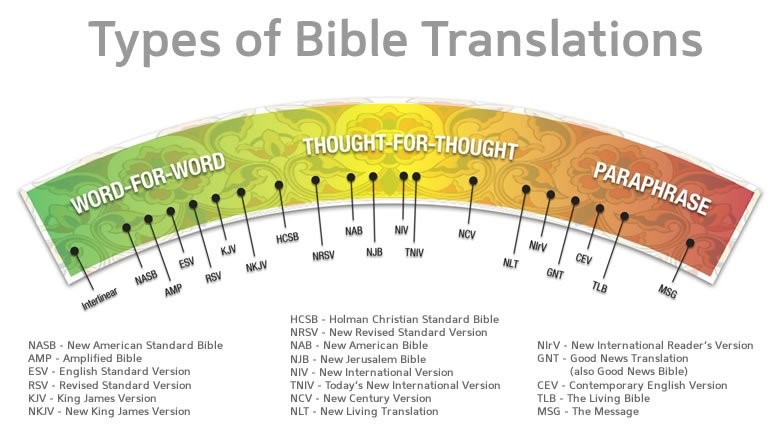
Modern Bible Translations chart by Chapter 3 Ministries.
The following are the most popular modern translations.
Modern and Early King James Versions (KJV).
In 1885, the first modern translation was published when the KJV was republished as the Revised Version, which took into account the older and more reliable biblical manuscript texts than were previously available. In 1901, the revised KJV was published in the United States as the American Standard Version (ASV) in American English. The KJV is a formal equivalency translation.
New King James Version (NKJV).
In 1982, the New King James Version was published as a modernization of the language of King James Version to make it more readable while still using the same manuscripts. The NKJV is a formal equivalency translation.
New American Bible (NAB).
The NAB is the official version of the Roman Catholic Church that was originally published in 1970. In 1986, the New Testament was revised. The NAB is a formal equivalency translation.
New American Standard Bible (NASB).
The NASB is a literal formal equivalency translation that was published in 1971 and updated in 1995.
The Living Bible and New Living Translation (NLT).
In 1971, the Living Bible paraphrase was published. It is a popular paraphrase. In 1996, the Living Bible was revised to make it a functional (dynamic) equivalence translation, the NLT. In 2020, the third edition of the NLT was published.
New International Version (NIV).
The NIV is a functional (dynamic) equivalence translation that was first published in 1978 and updated in 1984. In 2011, the NIV was updated and revised many verses to make them gender neutral. As of January 2020, the NIV was the best-selling Bible translation.
Revised Standard Version (RSV), New Revised Standard Version (NRSV), and English Standard Version (ESV).
In 1952, the KJV-American Standard Version (ASV) in American English was revised and published as the RSV. In 1971, the RSV New Testament was revised. In 1989, the RSV was updated and revised many verses to make them gender neutral and published as the NRSV. In 2001, the RSV was updated to make it a literal formal equivalency translation, the ESV, which is more conservative than the NRSV.
The Message (MSG).
In 2002, Eugene Peterson published a very popular paraphrase from the original languages, the MSG.
Holman Christian Standard Bible (HCSB) and Christian Standard Bible (CSB).
The HCSB is a balance between a word-for-word formal equivalency translation and a thought-for-thought functional (dynamic) equivalence translation that was published in 2004. The CSB is a revision of the HCSB, updating translation and word choices in order to improve on the HSCB’s balance of faithfulness and clarity, and to enhance the readability for new Christians or those reading the Bible for the first time. The CSB was first published in 2017 and was updated in 2020 to help with consistency in grammar, style, and punctuation.
New English Translation (NET).
The NET pairs a readable, everyday English translation with the largest set of translators’ notes ever created for a Bible by 25 Bible scholars. The NET’s 60,000 plus notes bring complete transparency to every major translation decision and invites the reader to look over the translators’ shoulders, allowing the reader to come to the reader’s own understanding of the Scriptures. The NET was first published and 2005 and the last revision was in 2019.