

The Bible has a fascinating history of the collection and acceptance of the canon of original books, the copying and translation process while under persecution, and its current day status of the most printed and read book of all time. The following is a summary of the some of the most important historical developments of the Bible. For a more complete discussion of where the English Bible came from, see Timothy Paul Jones, PhD, How We Got the Bible (Peabody, MA: Rose Publishing, 2015), 123-144 and Rose Publishing pamphlet, How We Got the Bible, Editors Timothy Paul Jones, et al, 2008.
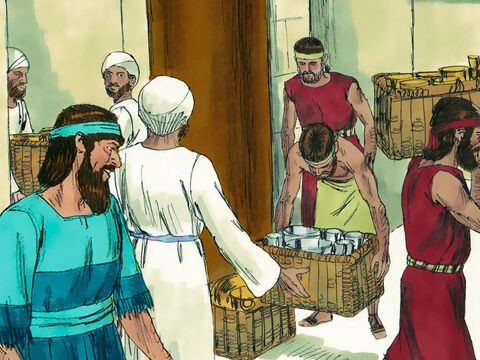
Ezra returns to Jerusalem and collects and arranges the scroll
writings of the Old Testament. Free Bible Images.
OLD TESTAMENT (2000-400 BC). God inspires Moses, leaders, kings, and prophets to write the events in the Old Testament. The writings were mostly in Hebrew with portions in Aramaic. These writings were on leather scrolls, papyrus, and other materials. In about 450 BC, Ezra, a priest and scribe, collects and arranges some of the writings according to Jewish tradition. Collectively, these writings compose the Hebrew Scriptures or Old Testament.
OLD TESTAMENT TRANSLATION (400-4 BC). No later than the 100s BC, 70 or 72 Jewish scholars in Alexandra, Egypt translate the Hebrew Bible/Old Testament into Greek and is named the Septuagint, which means 70 and is often abbreviated as the Roman numeral LXX. The Septuagint’s books are loosely arranged by chronology and genre (history, poetry and wisdom, prophets). It includes “hidden” or “unclear” books called the Apocrypha, which are Jewish religious writings that were never previously included in the Hebrew Bible.
THE LIFE OF JESUS (4 BC-AD 33 or 0 BC to AD 30). Jesus often quoted the Old Testament Scriptures, or referred to Old Testament people, places, and events as history, and how they were relevant to his ministry. For example, the resurrected Jesus explained to the two disciples on the Road to Emmaus, “And beginning with Moses and all the Prophets, he explained to them what was said in the Scriptures concerning himself“ (Luke 24: 27 NIV). Then he told a group of disciples, ‘’This is what I told to you while I was still with you: Everything must be fulfilled that is written about me in the Law of Moses, the Prophets and the Psalms.’ Then he opened their minds so they could understand the Scriptures” (Luke 24:44-45 NIV).
x
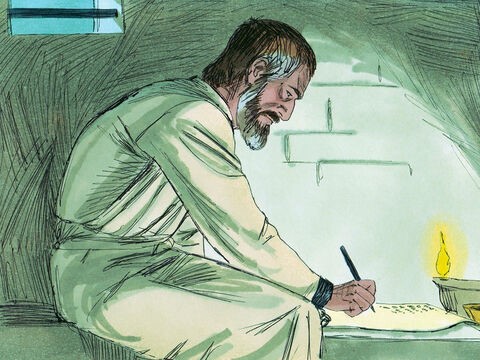
The apostle Paul wrote some of his letters from prison.
Free Bible Images.
THE AGE OF THE APOSTLES (AD 30-160). Jesus’ apostles wrote the New Testament Gospels of Matthew, Mark, Luke, and John, Acts or history of the early church, letters/epistles, and Revelation of the end times in Greek and they were received by churches, copied, and compiled in books/codices. These writings became known as the “New Covenant” or “New Testament” that God made with the people as God promised in Jeremiah 31:31-34.
.
POST APOSTOLIC ERA (AD 160-345). Latin became the common language of the people and replaced Greek. Although there were about 15 different Latin translations of the Bible, there was no standard Latin translation. From AD 200-300, the Bible was translated into Latin, Coptic (Egypt), and Syriac (Syria). The church fathers accept the writings of the apostles and their close associates as the canon or standard of faith of the books of the New Testament. These books were collected and circulated throughout the known world. In AD 313, Emperor Constantine legalizes Christianity.
JEROME AND THE LATIN VULGATE TRANSLATION (AD 345-400). In AD 382, Jerome started to translate the Bible from Hebrew and Greek into Latin and took 23 years to finish. Jerome’s Latin Vulgate translation became the official Bible translation of the Roman Catholic church for about 1,000 years. By the 400s AD, the church reached a consensus that the 27 books of the New Testament could be traced to the eyewitness apostles and their close associates. This was confirmed by Athanasius, Jerome, Augustine, and three church councils, including the Synod of Carthage in AD 397.
INCOMPLETE ATTEMPTS TO TRANSLATE THE BIBLE FROM LATIN TO ENGLISH (AD 400-1300). From AD 378 to 600, the Roman Empire declined and Germanic people migrated into the Roman Empire and introduced new languages.
The Masoretes.
From AD 400 to 1000, the Masoretes (Jewish scribes) made copies of the Old Testament Hebrew Scriptures by using a meticulous system of counting the numbers of words in each book to make sure they copied them accurately. These copies are known today as the Masoretic Text.
Caedmon, the Original Singing Cowboy.
In AD 676, Caedmon, an English illiterate cow-hearding monk, taught portions of scripture in Anglo-Saxon (Old English) poetry and song. Caedmon’s singing the storyline of the Scripture in English began a tradition of making Scripture accessible in English.
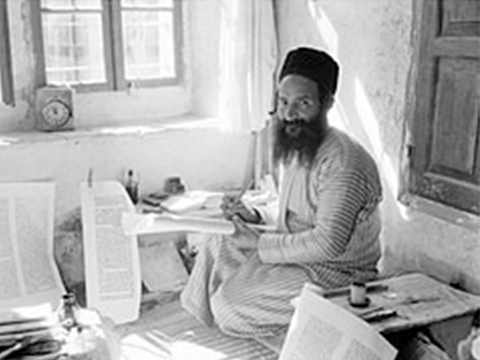
Modern Jewish scribe copying the Old Testament.
Image from Wikimedia Commons.
Aldehelm of Sherborne. In AD 709, Aldhelm of Sherborne dies while working on the first translation of the Psalms into Old English.
Bede. In AD 735, Bede, a monk and scholar, died after translating the Latin Vulgate Bible Old Testament and part of John’s Gospel into Old English.
Alfred the Great. From AD 871 to 901, Alfred the Great, King of Wessex, England translated the first 50 psalms from Latin into Old English and included parts of the 10 Commandments into his laws.
Aldred. In AD 950, Aldred, Bishop of Durham, glosses or inserts a translation in Northumbrian (a dialect of Old English) between the lines of the Latin Lindisfarne Gospels, which are the oldest surviving translation of the gospels into English.
Aelfric. From AD 955 to 1020, Aelfric translated 7 books of the Old Testament into Old English.
Various partial translations of the Bible. From AD 676 to 1200, various people translated only parts of the Bible.
In AD 1066, the Normans conquer England and Middle English develops from a combination of Old English and French. After 1200, there were no attempted translations of the Bible into English until 1382. In the early 1200s, Archbishop of Canterbury Stephen Langton added the same chapter numbers in the Latin Vulgate that we still use today in modern Bible translations. In 1551, Robertus Stephanus (a/k/a Robert Estienne) divided chapters into verses in his Greek New Testament. ‘
SUCCESSFUL ENGLISH TRANSLATIONS (AD 1324-1525).
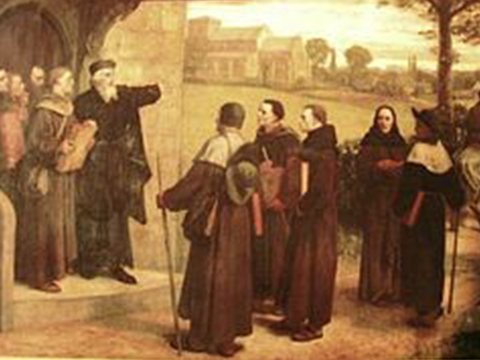
John Wycliffe Giving “The Poor Priests” his translation of the
Bible. By William Frederick Yeames (1835-1918).
John Wycliffe, the Morning Star of the Reformation.
From 1324 to 1384, priest and Oxford scholar John Wycliffe wanted common people to have the Bible to learn correct and truthful Christian doctrine that would lead people to Christ, but the Roman Catholic Church did not want the common people to read and study the Bible because the Catholic Church wanted to have full control over Christian doctrines and practices. Wycliff criticized the power and authority of the popes, and some of the Catholic Church’s practices such as praying to the saints, pilgrimages, clerical celibacy, and the sale of indulgences, which was a type of monetary payment of a penalty for sin to the church to absolve one of past sins and/or release one from purgatory after death. Wycliffe did not actually translate the Bible. Instead, he used his position as a scholar and pastor to have other scholars translate the Bible into English. In 1384, Wycliffe’s scholars completed the English translation from the Latin Vulgate.
Wycliffe’s followers, the Lollards (meaning “mumblers”), used and preached from the Wycliffe Bible and included his criticisms in the preface to the Wycliffe Bible. The Catholic Church in England was not pleased with Wycliffe, the Lollards, and the Wycliffe Bible. In 1394 and 1408, the Catholic Church made it illegal to translate or read the Bible in common English without the permission from a Catholic bishop. Reading the Bible in common English was a heresy and people were burned at the stake for doing so. In 1384, Wycliffe died of a stroke. In 1415, the Catholic church denounced Wycliffe and in 1428 it exhumed and burned his bones for heresy.
Desiderius Erasmus and the Textus Receptus.
In AD 1516, Desiderius Erasmus, a Roman Catholic priest and Greek scholar, produced a new Greek edition of the New Testament alongside a corrected Latin translation. He wanted to reform the church within the church without leaving the church. His translation is called the “textus receptus” and was later used by Martin Luther, William Tyndale, and the King James Version translators. Martin Luther used it to help him translate the New Testament from Greek to German in 1522.
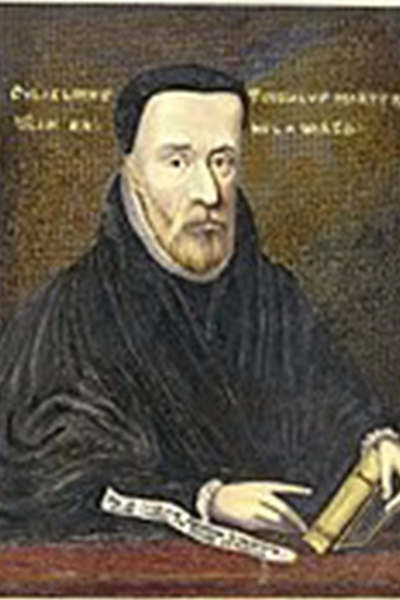
Portrait of William Tyndale (1494-1536).
Image from Wikimedia Commons.
William Tyndale, the “Father of the English Bible.”
William Tyndale was a Roman Catholic priest and Oxford scholar that lived from 1494 to 1536. He produced the first English translation of the Bible from the Hebrew and Geek. He is called the “Father of the English Bible” because his translation formed the basis of the King James Version. The style and vocabulary known as “biblical English” is from his translations such as “salt of the earth,” “daily bread,” “twinkling of the eye,” “let there be light,” “the powers that be,” “fishermen,” “seashore,” “scapegoat,” etc.. His goal was to produce a translation that a boy that drove a plow could read and learn so that he would understand the Bible better than the priests and bishops of the Catholic Church. In 1525, he finished his translation of the New Testament from Greek, but he could not get approval to publish it in England. He moved to Germany and printed Bibles and smuggled them into England in sacks of corn and flour. In 1535, he published part of the Old Testament from Hebrew. In 1536, King Henry VIII ordered that he be strangled and burned at the stake. Tyndale’s final words before he died were, “Lord! Open the King of England’s eyes!”
ENGLISH TRANSLATIONS AFTER TYNDALE AND THE REFORMATION TO THE KING JAMES VERSION (AD 1525-1885).
The Coverdale Bible. In 1535, Miles Coverdale used Tyndale’s New Testament and portions of Tyndale’s Old Testament and finished an English translation of the Old Testament and published the Coverdale Bible. This was the first complete English translation of the Bible. Coverdale dedicated it to Anne Boleyn, one of King Henry VIII’s wives. As a result of this dedication, this was the first English Bible to circulate without opposition by the church or king of England.
The Matthew’s Bible. In 1537, John Rogers under the pen name “Thomas Matthew,” published the Matthew’s Bible, which is the first Bible published with the kings’ permission. Rogers was a good friend of Tyndale. Rogers relied heavily on Tyndale’s New Testament and his Bible even has Tyndale’s initials printed in block letters on the last page of the Old Testament. Rogers improved Coverdale’s Bible and made it more readable.
The Great Bible (a/k/a The Chained Bible). King Henry VIII’s advisor, Thomas Cromwell, entrusted Coverdale to revise Matthew’s Bible to make the Great Bible. In 1539, the archbishop under King Henry VIII, Thomas Cranmer, ordered that a Great Bible be placed in every church. Some people stole the Great Bibles from the various churches, so the Bibles were chained to church pillars to prevent theft. Therefore, the Great Bible was also known as the Chained Bible.
Persecution of English Bible Scholars. From 1540 until his death in 1547, King Henry VIII turned against the Protestants and ordered the destruction of the Tyndale, Coverdale, Matthew’s, and Great Bibles. King Edward VI was the next king and ruled for a few years and tried to authorize alternate translations of the Bible. In 1555, England’s Queen Mary (a/k/a “Bloody Mary”) persecuted Protestants and promoted the Roman Catholic Church. She banned the Protestant translations of the English Bible and ordered that John Rodgers and Thomas Cranmer be burned at the stake. Later she ordered about 300 faithful Protestant men, women, and children be burned.
The Geneva Bible. The persecuted English Bible scholars fled England to Geneva, Switzerland. In 1560, they printed the Geneva Bible, a complete revision of the Great Bible with the Old Testament translated from Hebrew. The Geneva Bible was the first Bible to contain theological notes from Protestant scholars Calvin, Beza, Knox, and Whittingham. It also was the first Bible to use chapter summaries before each chapter, verse divisions, words in italics added for clarification of the original text, Roman type instead of black letter, and full color maps.
The Bishop’s Bible. In 1568, Queen Elizabeth I succeeded Queen Mary and authorized a new Catholic study Bible translation called the Bishop’s Bible. It was a revision of the Great Bible, but the translators of the Bishop’s Bible were not of the same scholarship as the translators of the Geneva Bible. The top scholars of England that translated the Geneva Bible fled England because of Queen Mary’s persecution. The Bishop’s Bible formed the basis of the King James Bible, but never became more popular than the Geneva Bible.
The Rheims-Douai Bible. In 1582, Catholic scholar Gregory Martin was exiled in France and translated the New Testament of the Latin Vulgate into English as the Rheims-Douai Bible. By 1609, Martin translated the Old Testament. It was produced as an alternative to the Protestant Bibles and was the first Roman Catholic Bible translation in English. It became the standard English translation for the Roman Catholic Church for centuries.
The King James Version.
In 1603, King James I succeeded Queen Elizabeth I. Protestant Puritans complained that there still were too many Roman Catholic practices that still persisted in the Church of England. In 1604, King James I invited Puritans to a conference at the palace of Hampton Court west of London, England. He considered the Puritans’ requests and agreed to order that there should be only one translation of the Bible that would be read and used at church. The Bishop’s Bible was the official Bible, but it was unpopular because it was not easy to read. The Geneva Bible was easy to read, but it had footnotes by Calvin and others that questioned the absolute power of kings. Therefore, King James I commissioned 54 scholars to produce a new Bible translation. Over six years, six teams of scholars used earlier English translations (at least two-thirds of the translations could be traced back to William Tyndale), Greek New Testaments based on Erasmus’ text, and Hebrew and Aramaic texts to publish the King James Version and the Authorized Version in 1611. Scholars revised it several times.
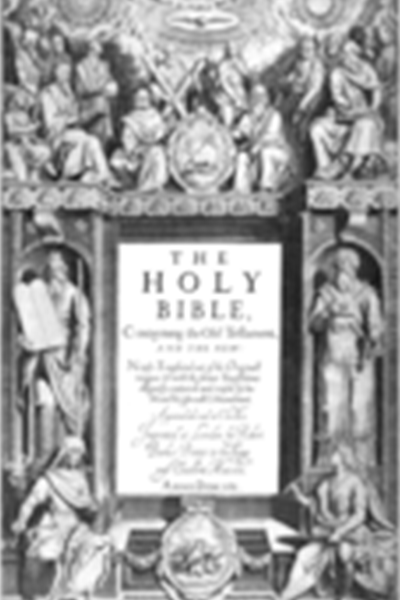
King James Bible 1611 First Edition Title Page.
12 Apostles at the top. Moses and Aaron flank
the central text. Matthew, Mark, Luke, and
John in the 4 corners. Wikimedia Commons.
The revision in 1769 is the edition that is used today. In 1885, scholars in England revised it to reflect the findings from the manuscripts that were discovered in the previous two centuries. They also retranslated words based on new linguistic information about Hebrew, Aramaic, and Greek. This version was published in 1885 as the Revised Version. The King James Version was the most popular English Bible for more than 300 years.
Discovered Manuscripts after the King James 1611 Version.
One of the criticisms of the King James Version is that thousands of Greek New Testament texts have been discovered since 1611 as follows:
The Codex Alexandrinus (AD 400s) was made available to Western scholars in 1629. It is one of the earliest and most complete copies of the New Testament.
The Codex Sinaiticus (AD 300s) was discovered in St Catherine’s Monastery near Mr. Sinai, Israel in 1844. It contains almost all of the New Testament and over half of the Old Testament.
The Codex Vaticanus (early AD 300s) was released to scholars in 1889. It is the earliest and perhaps the most reliable copy of the New Testament.