

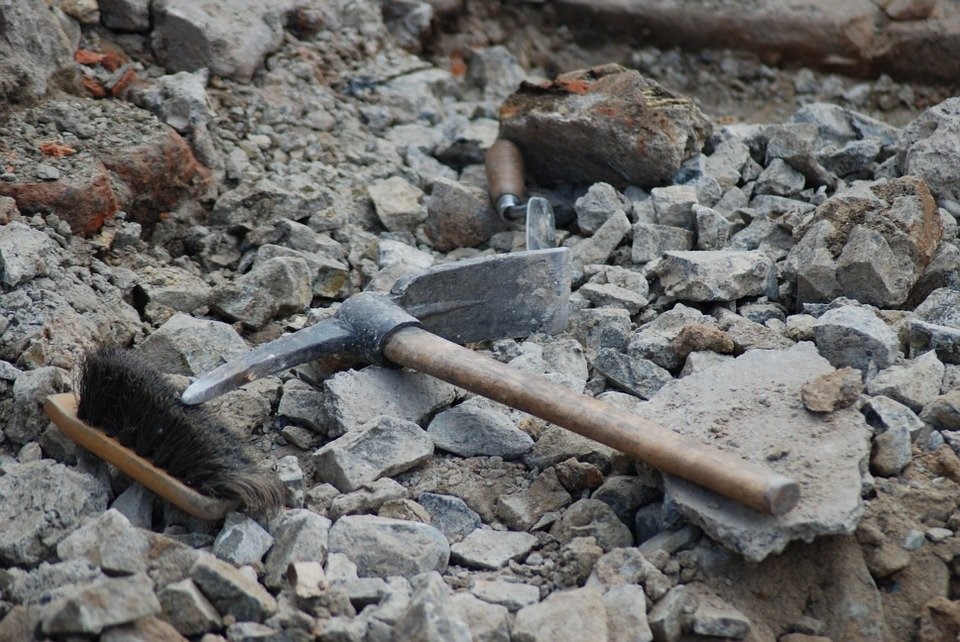
Archeology tools.
The trend in recent archaeological artifacts corroborates that the Bible preserves an accurate historical account.
Archaeology involves the study of the ancient world through found artifacts, which are ancient objects made or modified by humans including statues, altars, jewelry, weapons, tools, inscriptions, paintings, coins, scarabs, tablets, papyri, stelae, reliefs, and pottery. These artifacts are visual and informational aids that provide insight into the ancient context and an accurate understanding and interpretation. The majority of secular archaeologists, scholars, and historians called biblical minimalists regard the Bible as historically unimportant and irrelevant beyond literary and religious studies. This is because archeology is a “soft” science that involves interpretation of the artifacts with the preconceptions and biases of the researchers. In addition, we must recognize the fact that only a small amount of artifact evidence has survived and discovery of biblical artifacts is difficult because of floods, fires, natural deterioration, burial, temperature, political climate, and time. However, over the past 25 years and accelerating since 1999, archaeologists have unearthed hundreds of artifacts that show and corroborate that the Bible preserves an accurate historical recounting of the events, people, and places mentioned in the Bible.
The Bible remains one of the best existing historical and geographical sources from the ancient Near East. For example, if the biblical artifacts are interpreted fairly taking into account the historical and cultural context, they convincingly demonstrate that the Bible accurately states that Abraham, Isaac, and Jacob belong to the Middle Bronze Age (1950-1540 BC) and the cultural elements found in the biblical historical accounts of Moses and Joshua match those of the late Bronze Age. Titus Kennedy, Unearthing the Bible. 101 Archaeological Discoveries that Bring the Bible to Life (Eugene, OR: Harvest House Publishers, 2020), 9; Josh McDowell and Sean McDowell PhD, Evidence that Demands a Verdict: Life-Changing Truth for a Skeptical World (Nashville, TN: Thomas Nelson: 2017), 414-422.
A sampling of artifacts that corroborate the Bible’s historical account.
A sampling of artifacts that corroborate that the Bible provides an accurate historical account include, but are not limited to, the following:
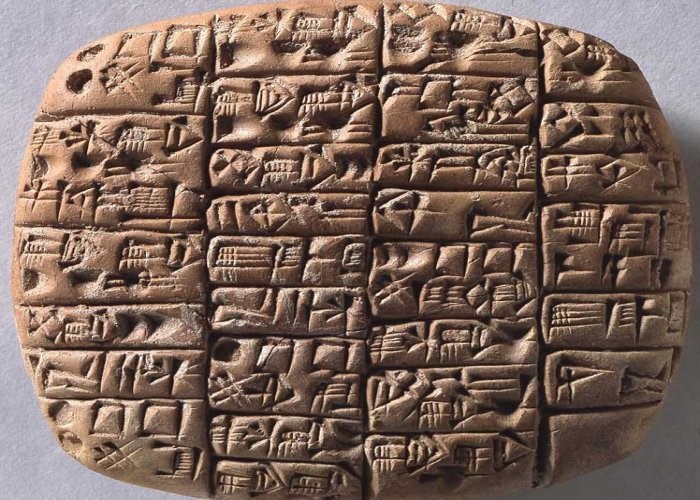
Cuneiform tablet from Girsu, dated to 2370 BC. Image by
Max Planck Gesellschaft. Ancientpages.com.
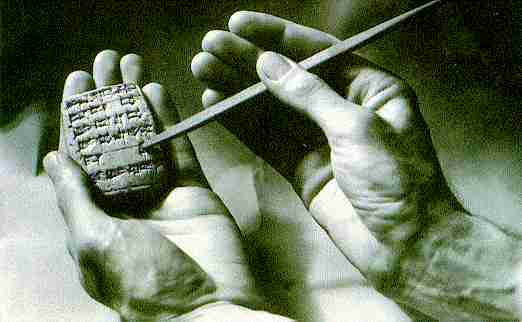
Cuneiform characters were impressed on soft clay tablets with a
pointed stylus and baked to form a long lasting writing. Image by
Howard Vos. Nelson’s New Illustrated Bible Dictionary.
OLD TESTAMENT ALTERNATE CREATION TABLETS (Girsu and Ebla). Date: 2900-2000 BC. Discovered: Girsu (Tell Telloah, Iraq) and Elba (Tell Mardikh, Syria). Bible Period: Genesis 1-11. Bible Passages: Genesis 1:1-2:1; Job 38:4-7; Psalm 148.1-5; Colossians 1:15-16. The oldest written records ever discovered are the Sumerian cuneiform inscription (wedge shaped form of writing on wet clay) on a clay tablet in Girsu, Tell (Tell or Tel is a mound of debris from ancient towns or cities built on top of each other) Telloah, Iraq. It recounts the beginning of creation in which daylight and moonlight did not shine because the “lesser gods” (or angels) and the sun, moon, fields, and vegetation were not created until after the earth was filled with water. This is similar to the Genesis account of the existence of angels before the creation of the sun, moon, water on the earth, and vegetation.
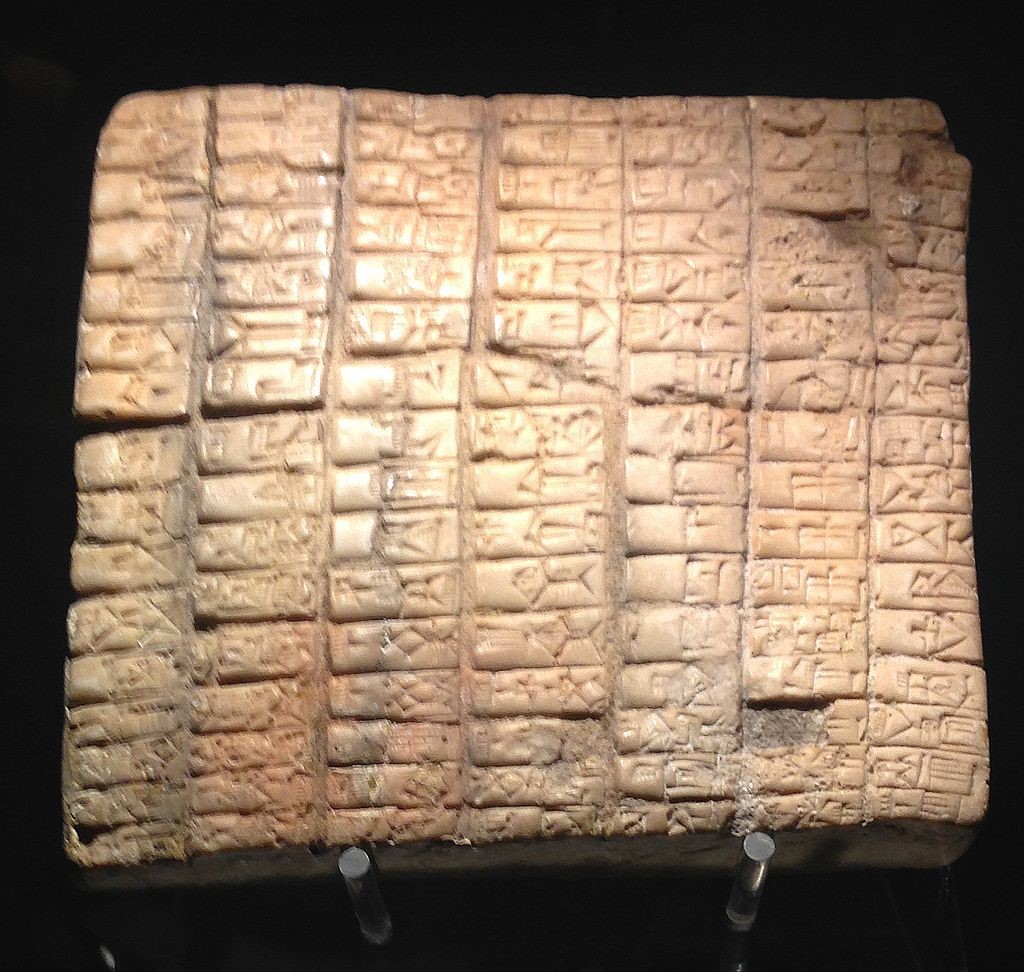
A tablet from the archive at Elba. Image by David Maura
Wikipedia. org.
Enuma Elish, Enki and Ninhursag, Adapa.
Image by Titus Kennedy.
Another ancient creation account written on three clay tablets in both Sumerian and Akkadian (the oldest known Semitic language of Mesopotamia) found during excavations at Ebla, Tell Mardikh, Syria, dated to about 2400-2000 BC. The inscribed poem states, “Lord of heaven and earth, you had not made the earth exist, you created. You had not established the sun, you created. You had not made the morning light exist.“ It also states that this Lord is divine, saves, and has words that produce effects. The Girsu and Elba creation accounts share more similarities to the Genesis creation account than any other known creation inscriptions, and are also the oldest copies of creation accounts discovered to date as of the year 2020. Titus Kennedy, Unearthing the Bible. 101 Archaeological Discoveries that Bring the Bible to Life (Eugene OR: Harvest House Publishers, 2020), 12-13.
The DOUBLE CREATION OF HUMANS (Enuma Elish (meaning “when on high”), Enki and Ninhursag, Adapa). Date: 1800-1000 BC. Discovered: Nineveh, Iraq. Bible Period: Genesis 1–11. Bible Passage: Genesis 1:26–3:24. The Enuma Elish Babylonian creation epic involves a struggle among the original gods before creation with the Babylon god Marduk being the supreme god. The text is divided into 7 sections and tablets with the separation of the heavens and earth, the creation of angelic beings, the creation of man by shaping him from clay and combining that with divine blood in the sixth section, and honoring Marduk and resting of the gods in the seventh section. This is similar to the Genesis creation days with the God existing before creation, God creating the heavens and earth, God creating angels, God creating Adam from the dust of the earth and breathing divine breath into him on the sixth day, and God resting on the seventh day. This account of creation dates from about 1800-1000 BC.
In the Sumerian creation epic, clay is fashioned into the first man and brought to life. Thereafter, five additional humans are created and appointed jobs. This account of creation dates from 1800-1300 BC. A man, Adapa or Adamu (according to some linguists), talked with the gods before the great flood, underwent a test from the gods involving the food and water of life in the realm of the gods, was judged by another god for his refusal to eat what the god offered, and was sent back to earth without eternal life and with the penalty of disease on humanity. The linguistic link between Adapa and Adam and related narrative have been debated, but the similarities are noteworthy.
These ancient Mesopotamia creation epics record the creation epics of man had been passed down from centuries before, most likely in oral and written form, and adapted to apply to various gods and theologies. But they all have noteworthy similarities to the Genesis creation account in the Bible. Kennedy, Unearthing the Bible, 14.
THE MESOPOTAMIAN VERSION OF THE FLOOD (Atra-Hasis and the Epic of Gilgamesh). Date: 2100-1900 BC. Discovered: Unknown, Iraq. Bible Period: Genesis 1–11. Bible Passages: Genesis 6:5–8:22; 2 Peter 2:5. Atra-Hasis, meaning “exceedingly wise,” is the title of an ancient Akkadian creation and flood, which is a detailed ancient flood story that is similar to the Noah flood account in Genesis 6. A tablet written about 1900 BC containing about 60 lines of cuneiform discusses the flood story of Atra-Hasis, who interacts with the god Enki. The gods want to destroy all humans by a flood; one god warns a man about the flood and instructs him to build a boat; dimensions are given for a massive boat to be built with
Atri-Hasis Flood Tablet. Image by
Titus Kennedy.
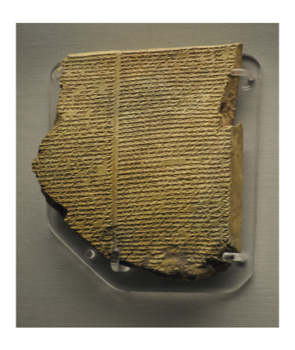
Tablet 11 of the Epic of Gilgamesh.
Image by Titus Kennedy.
bitumen, multiple decks, and a roof; animals were taken on board two by two; a storm rages and the world floods; the boat lands on a mountain; and the survivor offers a sacrifice to the god who saved him. The differences with the Noah flood account include: multiple gods instead of one God; the gods sent the flood because of overpopulation and noise instead of human sin; city craftsman help Atra-Hasis build the boat instead of only Noah and his family building the ark; it rains for 7 days instead of 40 days, the gods eat a sacrifice, and the dimensions of the boat and ark are slightly different. Kennedy, Unearthing the Bible, 18-19;
Tablet 11 of the Epic of Gilgamesh contains the flood story as told by Utnapishtim, who appears to be the same person as Atra-Hasis. The Gilgamesh flood story is about a man building a boat to survive a flood sent by the gods that wipes out mankind goes back to 2100 BC in Sumerian texts, and all of the earliest flood accounts, including Atra-Hasis, Gilgamesh, and Ziusudra, appear to descend from a common source. Although the Genesis flood account is the only one that mentions only one God exists and sent the flood because of human sin, the Mesopotamian texts, along with several others from the ancient world, such as the Deucalion version in Greek, recount the same basic story as the Genesis flood account. Kennedy, Unearthing the Bible, 19; Hank Hanegraaff, Has God Spoken? Memorable Proofs of the Bible’s Divine Inspiration (Nashville, TN: Thomas Nelson, 2011), 96-104.
One of Tablets of the Enmerkar and Lord of Arattta
alternate version of the account of the Tower of Babel.
Image by Titus Kennedy.

Egyptian Execration Text on Small
Statue. Image by Titus Kennedy.
THE TOWER OF BABEL (Enmerkar and the Lord of Aratta). Date: 2600-2000 BC. Discovered: Nippur; Ur; Kish. Bible Period: Genesis 1–11. Bible Passage: Genesis 10:8–11:9. The ancient Sumerian story of Enmerkar and his conflict with the Lord (unnamed king) of Aratta was written from about 2600-2000 BC or earlier, making Enmerka one of the earliest known kings. Enmerkar, king of Uruk, founded of the city of Uruk and attempted to build the E-Abzu temple in the city of Eridu. The text is a composite from 27 currently known tablets and fragments discovered in at least 3 different locations in Mesopotamia. Archaeologically, Eridu is often considered the earliest known city in the world, and the E-Abzu temple ziggurat is the largest and oldest known, yet it was also unfinished. The Tower of Babel was probably a massive ziggurat. These ziggurats were designed as large stepped-platform structures made from fired clay bricks and constructed with a temple at the top as a house for the gods of heaven or as a link between heaven and earth. Enmerkar attempts to construct a gigantic ziggurat building called “a holy mountain,” “a temple brought down from heaven,” “a great shrine,” and “an abode of the gods,” indicating both its size and its function.
Then, an incantation is sung that all the people may address the god Enlil in a single language. At that time, the god Enki will change the speech in their mouths so the speech of mankind is truly one. This Sumerian epic appears to discuss the building of a massive tower temple reaching toward the heavens like the Tower of Babel in one of the first cities of Mesopotamia, a direct connection to the city of Erech/Uruk, and the reference to a single language of humanity that came about as an act of divine intervention. However, the Enmerkar story seems to be a partial reversal of the Genesis account, because one of the gods changes the many languages back to one language as it was before the building of the Tower of Babel, and there is no record of the failure to complete the tower temple or of the dispersion of the people in rebellion. A section of the story reads as “the whole universe… may they all address Enlil together in a single language! For at that time… Enki… shall change the speech in their mouths, as many as he had placed there, and so the speech of mankind is truly one.” According to the writings of Josephus, the Tower of Babel had been attributed to Nimrod in antiquity because he established Babel, and a few scholars have even suggested a connection between Nimrod and Enmerkar because both were kings, ruled over Erech/Uruk, and both have an association with a massive tower or ziggurat, and there was a change of human speech through divine intervention. Although the timelines and all of the details are not exactly the same, the story of Enmerkar and the Lord of Aratta appears to include knowledge of an alternative version of the Tower of Babel. Kennedy, Unearthing the Bible, 22-23.
Biblical minimalist archeologists, historians, and other scholars contend that the history of ancient Israel (recorded in the books of Exodus, Leviticus, Numbers, and Deuteronomy) regarding Israel being in Egypt, the Exodus, and wandering in the wilderness for 40 years are all myths and never happened. There ae many artifacts that corroborate the Bible’s historical account of Ancient Israel. A sampling of these artifacts follows.
DESECRATION OF NAMES (Execration Texts). Date: 2000-1800 BC. Discovered: Saqqara, Egypt. Bible Period: Patriarchs. Bible Passages: Genesis 12:6-14:18, 33:18, 35:23-29; Job 1:1; Judges 17:6. The Egyptian Execration Texts (2345–1077 BC) consist primarily of the names of enemies of Egypt, including cities and personal names, and were typically written on clay statuettes, bowls, and tablets, and then shattered and buried in a curse ritual. Over 1,000 of the figurines and bowls have been excavated throughout Egypt. This demonstrates how common the practice was over a period of several centuries. The Execration Texts are an important source of information about the names of cities and personal names in use in the Canaan region. The texts mention more than 60 cities, tribes, and people in Canaan during the Middle Bronze Age from about 2000–1700 BC. Many of the names of cities and people mentioned in these texts are also found in the book of Genesis narratives set in the Middle Bronze Age, including Laish, Shechem, Jerusalem (Salem), Abraham (Aburahana), Zebulun, and even Job. Abram visited Salem (Jerusalem), Shechem, and Laish (Dan), while Jacob visited Shechem. Several other ancient texts and inscriptions from the Middle Bronze Age also mention names found in the patriarchal narratives of Genesis. For example, three cuneiform tablets from about 1965 BC found at the ancient Mesopotamian city of Dilbat, an area on the Euphrates south of Babylon and north of Ur, mention a man named Abarama son of Awel-Ishtar. These tablet texts show the use of the name Abram in southern Mesopotamia during the lifetime of Abram, son of Terah, who originated in Ur according to the book of Genesis. Many scarabs (amulets/good luck charms and impression seals in the shape of a scarab beetle) from Egypt and Canaan dated to the Middle Bronze Age have also been found inscribed with the name Yaqob or Jacob, and this type of “Amorite Imperfective” name, which was common during the period, is expressed in the names Isaac, Jacob, and Joseph. The use and frequency of personal names constantly changed over time in the ancient world. This meant that certain names were usually restricted to a particular time period and region. The city names generally stayed the same for century or millennia while these names were in use, except certain cities changed their names, such as Salem to Jerusalem and Laish to Dan. Therefore, since several personal names in Genesis that are known archaeologically from Middle Bronze Age sources and the place names changed after the period that those names were in use, it is likely that the biblical accounts about Abraham, Isaac, Jacob, Job, Zebulun, and others historically occurred in the period of approximately 2000–1600 BC. Kennedy, Unearthing the Bible, 26-27.
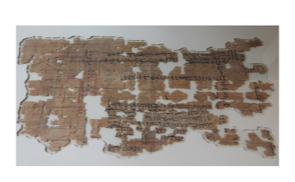
Papyrus Brooklyn. Image by Titus Kennedy.
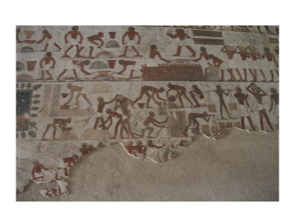
Tomb of Rekmire mural. Image by Titus Kennedy.
HEBREW SERVANTS IN EGYPT (Papyrus Brooklyn). Date: 1700-1600 BC. Discovered: perhaps Thebes, Egypt. Bible Period: Exodus. Bible Passages: Genesis 41:45, Exodus 1:5-22. An Egyptian list of domestic servants recorded on a papyrus from about the 17th century BC contains not only Semitic names but even Hebrew names. This period came just after the life of Joseph and preceded the Exodus, which was the time that the Hebrews lived in Egypt as settlers and then as slaves. A section of this papyrus contains a list of 95 servants. The servants with foreign names are given Egyptian names, just as Joseph was after he was promoted from a household servant under Potiphar to overseer of his house and in charge of all that Potiphar had in Egypt. 9 of these servants appeared to have the Hebrew names. The Hebrew names: Menahema, a feminine form of Menahem (2 Kings 15:14); Ashera, a feminine form of Asher, the name of one of the sons of Jacob (Genesis 30:13); Shiphrah, the name of one of the Hebrew midwives prior to the Exodus (Exodus 1:15); Aqoba, a name appearing to be a feminine form of Jacob or Yaqob (Genesis 25:26); Sekera, which is either a feminine name similar to Issachar, a name of one of the sons of Jacob, or simply the feminine form of Issachar (Genesis 30:18); Dawidi-huat, a compound name utilizing the name David (1 Samuel 16:13); Esebtw, a name derived from the Hebrew word eseb meaning “herb” (Deuteronomy 32:2); Hayah-wr, another compound name composed of Hayah or Eve (Genesis 3:20); and finally the name Hy’b’rw, which appears to be an Egyptian transcription of “Hebrew” (Genesis 39:14). Therefore, this list records that Hebrews lived in Egypt prior to the Exodus under and enslavement, and perhaps shows that some Hebrews may have migrated south or were taken south for work. Kennedy, Unearthing the Bible, 48-49.
BRICKMAKING SLAVES IN EGYPT (Tomb of Rekmire). Date: 1450 BC. Discovered: Valley of the Nobles, Egypt. Bible Period: Exodus. Bible Passages: Exodus 1:11, 2:11, 5:4-19. A tomb mural from the time of Pharaoh Thutmose III shows many slaves, including Asiatic or Semitic slaves, making bricks for the Egyptians. The slaves used mud and straw formed in a mold, dried in the sun, and then transported the bricks to use for in construction. During the New Kingdom in Egypt, slavery of Asiatics was a common practice. The Egyptian word Aamu (Asiatic) even came to mean slave. Prior to the Exodus, Hebrews were Egyptian slaves and made mud bricks for Egyptian building projects. A hieroglyphic text in the mural shows an Egyptian master reminding slaves to not be idle or they would receive a beating with the rod. Using slaves to make bricks and beating the slaves for not working is similar to the Exodus account of Hebrew slaves making bricks and Moses getting upset when he saw an Egyptian taskmaster beating a Hebrew slave.
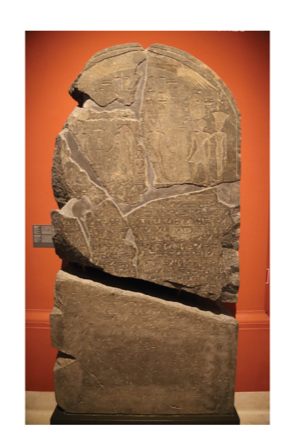
Elephantine Stele of Amenhotep II.
Image by Titus Kennedy.
Another Egyptian text, called the Louvre Leather Roll, also records an account of slaves similar to Exodus. In this time period, slaves had quotas of bricks they had to make, but when they did not have the necessary materials to complete all of the bricks, such as a lack of straw, the slaves were punished.
The Exodus account states that over time, a subsequent pharaoh, who did not know Joseph, enslaved the Hebrews and other Semites. This is consistent with the transition from the rule of the Hyksos to the 18th Dynasty and the subsequent enslavement of Asiatics and other non-Egyptians.
Papyri such as Leningrad Papyrus 1116A from the 18th Dynasty, most likely the reign of Pharaoh Thutmose III prior to around 1450 BC, specifies that immigrant people were enslaved to build Egyptian structures after the expulsion of the Hyksos under Pharaoh Ahmose I and subsequent rulers. This corresponds to the time of the enslavement of the Hebrews. Just as Egyptian documents and this wall painting mural demonstrate that Asiatics or Semites were forced to construct public buildings, the book of Exodus records that the Hebrews constructed storage buildings in the cities of Rameses, Pithom, and On (Heliopolis). Kennedy, Unearthing the Bible, 50-51.
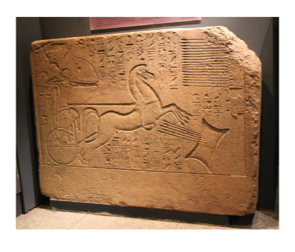
Artwork on the Elephantine Stele of Amenhotep II.
Image by Titus Kennedy.
PHARAOH OF THE EXODUS (Elephantine Stele of Amenhotep II). Date: 1440 BC. Discovered: Elephantine, Egypt. Bible Period: Exodus. Bible Passages: Exodus 2:11–5:1; 12:37-41; 14:4-30; Acts 7:20-30. “Pharaoh Amenhotep II reigned over Egypt beginning in about 1450 BC during the powerful 18th Dynasty of the New Kingdom. His monuments and inscriptions indicate that he was one of the most boastful pharaohs of ancient Egypt, claiming such feats as being able to shoot arrows through a copper target a palm thick, rowing a ship by himself faster and farther than 200 Egyptian sailors, singlehandedly killing 7 prince warriors of Kadesh, having the kings of Babylon, the Hittites, and Mitanni all come to pay tribute to him, and supposedly conducting the largest slave raid in Egyptian history. According to a match of chronological information from Egyptian king lists and the Bible, Amenhotep II was probably also the pharaoh of the Exodus, which occurred in approximately 1446 BC. One of the most significant artifacts relating to the circumstantial evidence for Amenhotep II being the pharaoh of the Exodus is a stele that he commissioned to commemorate one of his campaigns. While earlier in the 18th Dynasty the Egyptians had a powerful military, especially during the reign of Thutmose III, who conducted 17 known military campaigns, after the beginning of the reign of Amenhotep II there is a steep decline. In fact, Amenhotep II had only two confirmed campaigns during his reign—the first took place prior to the Exodus, while the second was primarily a slave raid that occurred soon after the Exodus and was recorded on the Elephantine Stele.” Kennedy, Unearthing the Bible, 56-57.
“This monumental stone inscription with its accompanying artwork was originally erected at the southern city of Elephantine, and it records the campaign of Amenhotep II to Canaan in which he claims to have brought back over 101,128 captives to be used as slaves. In comparison, other Egyptian military campaigns of the period brought back nowhere near that many captives, with the largest total being only 5,903, and as a result most scholars consider the number of slaves captured by Amenhotep II in this text to be a massive exaggeration. Because this happened right after the Exodus, perhaps it is indicative of an urgent need to replace the lost slave population in Egypt, or purely as propaganda making it appear that the pharaoh had recovered or replenished the slaves lost during the Hebrew Exodus.” Kennedy, Unearthing the Bible, 56-57.
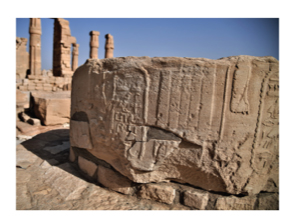
A temple pillar in the Sudan with an inscription that states
the “land of the nomads YHWH.” Image by Titus Kennedy.
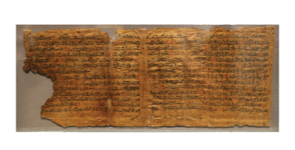
Admonitions of an Egyptian Sage. Image by Titus Kennedy.
WANDERING IN THE WILDERNESS WITH YAHWEH (Nomads of YHWH). Date: 1400 BC. Discovered: Soleb, Sudan. Bible Period: Exodus. Bible Passages: Exodus 7:4-7; Numbers 32:13. After the God (Yahweh) delivered the Israelites from Egypt, the Israelites rebelled against Yahweh. Then Yahweh became angry at the Israelites and made them wander in the wilderness for 40 years (Numbers 32:13). Two New Kingdom Egyptian temples and a temple pillar in Sudan from 1400 BC contain the earliest known hieroglyphic texts of name of the Hebrew God Yahweh in the form of hieroglyphic inscriptions that mention the “land of the nomads of YHWH” located somewhere in the Edom, Moab, and Canaan area. This is convincing evidence that these nomads were the Israelites or Hebrews wandering in the wilderness from about 1450 to 1400 BC before they settled in Canaan, because the Israelites or Hebrews were the only ancient people that were known to have worshiped Yahweh. This was consistent with the Egyptian practice of documenting and boasting a list of conquered people groups and places.
THE POETIC PLAGUES (Admonitions of an Egyptian Sage). Date: 1300-1200 BC, but some scholars contend the linguistics of the text and estimated 1300 BC date of the only surviving papyrus copy indicate it was originally written about 1600 to 1400 BC. Discovered: Perhaps Saqqara, Egypt. Bible Period: Exodus. Bible Passage: Exodus 7:14-12:36. A man named Ipuwer wrote an Egyptian poem called, the “Admonitions of an Egyptian Sage” as a lamentation addressed to “All Lord,” who is understood to be the sun god Ra. The poem describes when death, destruction, and plagues occurred in Egypt. The plagues were similar to the 10 plagues in Exodus: river being blood, blood everywhere, plague and pestilence throughout Egypt, the destruction of the grain, disease causing physical disfigurement, the prevalence of death, mourning throughout Egypt, rebellion against Ra the sun god, the death of children, the authority of pharaoh being lost, the gods of Egypt losing in battle, and the slaves now possessing jewelry. Kennedy, Unearthing the Bible, 54-55.
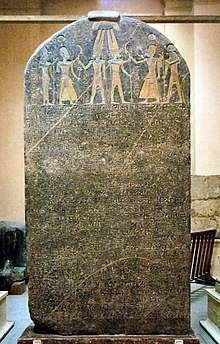
The Merneptah Stele. Image source:
Wikopedia.org.
ISRAEL IS LAID WASTE (Merneptah Stele). Date: 1219-1208 BC. Discovered: Thebes, Egypt. Bible Period: Conquest and Judges. Bible Passage. Judges 1:1-33, 17:6. This stele (a stone or wooden slab monument) is also known as the Israel Stele or the Victory Stele of Merneptah. It is a 7.5 foot tall black granite stone slab inscribed in Egyptian hieroglyphics. It contains an inscription by the ancient Egyptian Pharaoh Merneptath (reign 1224-1214 BC), son of Ramses II, that provides an account of Egypt’s victory over the Libyans and their allies (1237-1227 BC). The last 3 of the 28 lines discuss a separate conquest in Caanan, and it makes reference to Egypt’s defeat of Israel, “Israel is laid waste and his seed is not; Hurru is become a widow because of Egypt.” or “Israel is wasted; its seed is not; and Hurru is become a widow because of Egypt.” This inscription is a metaphor implying that Israel’s store of grain was destroyed and Israel no longer posed a military threat to Egypt. This is the earliest or at least one of the earliest references to Israel outside of the Bible. This interpretation refutes the claims of biblical minimalist archeologists, historians, and other scholars that the history of ancient Israel (recorded in the books of Exodus, Leviticus, Numbers, and Deuteronomy) regarding Israel being in Egypt, the Exodus, and wandering in the wilderness for 40 years are all myths and never happened.
Biblical archeologists contend that the “Israel” translation of the stele is consistent with the biblical text. In or about 1570 BC, the Egyptians from the south conquered the north and enslaved Joseph’s family of Israelites that came to Egypt and became numerous. Moses left Egypt and went to Midian and returned about 40 years later. God performed the 10 plagues through Moses, and Moses led the Israelites out of Egypt. The Israelites wandered for about 40 years until God allowed them to enter the Promised Land of Canaan in or about the late Bronze Age (1500-1200 BC). The military conquests of Canaan, Israel, and other people groups mentioned in the stele took place during the time (1237-1227 BC) of the Jewish judges when Israel had no king (Judges 17:6). Since the stele was inscribed on or about 1208 BC, it demonstrates that Israel was already in the Promised Land as a people group in or about 1230 BC, meriting the mention in the stele by Pharaoh Merneptah. However, biblical minimalists still claim that the hieroglyphics relating to “Israel” may actually refer to Canaanites, nomads, marauders, or a place. Hank Hanegraaff, Has God Spoken? Memorable Proofs of the Bible’s Divine Inspiration (Nashville, TN: Thomas Nelson, 2011), 62-64; Kennedy, Unearthing the Bible, 74-75. The presence of “Israel” on the Merneptah Stele is persuasive evidence that Israel was well established in the Promised Land and contended with many enemies prior to 1200 BC. Many scholars also argue that Israelite invasion under Joshua occurred around 1250 BC because of the destruction levels caused by Egypt in Canaan at various Late Bronze Age (1550-1200 BC) sites. But this argument “has largely collapsed since in fact no cities, with the possible exception of Hazor, have destruction levels that fit this interpretation.” Walter C, Kaiser, Jr. Editor and Gordon-Conwell Theological Seminary, NIV Archaeological Study Bible. An Illustrated Walk Through Biblical History and Culture (Grand Rapids, MI: Zondervan, 2005), 51.
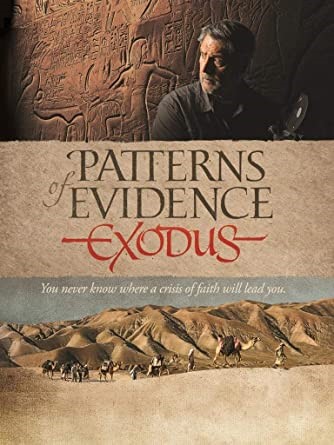
See the documentary by Timothy Mahoney, Patterns of Evidence: The Exodus (Virgil Films, 2019) for a well-produced objective film on the scientific archeological examination and biblical text analysis for contending that the Exodus occurred about 200 years earlier (1450-1400 BC) than the traditional time period that scholars estimated at from 1250-1200 BC. The film explores both scholarly sides of the Exodus dating debate, and presents the ”patterns of evidence” for a 200 year earlier dating of the
Exodus (not during the New Kingdom of Rameses II), which explains why traditional scholars find that there was no archeological evidence for the Exodus dating from 1250-1200 BC. Mahoney and his team of scholars concluded that there are convincing patterns of evidence that the Israelites arrived in Egypt when Joseph ruled on behalf of the pharaoh (an Egyptian tomb that may contain the remains of Joseph), the Israelites multiplied in number greatly while in Egypt, the Israelites were slaves in Egypt (mudbricks made by slaves shown in tomb inscriptions), God judged Egypt through the 10 plagues (Egyptian poem referring to plagues in Egypt), the Exodus of the Israelites out of Egypt, and the Israelites conquered the Promised Land of Canaan. See also Timothy Mahoney, Patterns of Evidence: The Moses Controversy. Who Wrote the First Five Books of the Bible? (Virgil Films, 2019) regarding whether Moses wrote the first five books of the Bible at the time of the Exodus, in the region of Egypt, with the power of an alphabet, and in a form of Proto-Sinaitic/Canaanite script writing like Hebrew. See also Timothy Mahoney, Patterns of Evidence: The Red Sea Miracle Part 1 (Thinking Man Films, 2021) and Timothy Mahoney, Patterns of Evidence: The Red Sea Miracle Part 2 (Thinking Man Films, 2021) regarding whether the Red Sea Miracle was a small scale more naturalistic crossing by about 20,000 people that occurred at one of the more shallow lakes closer to Egypt according to the Egyptian View, or was a large scale more miraculous crossing by over 2 million people that occurred farther from Egypt after traveling across the Sinai Peninsula at the deep Gulf of Aqaba north of the Red Sea according to the Hebrew View.
David Rohl, an agnostic Egyptologist and historian, is one of the leading scholars whose interpretation of the Egyptian hieroglyphic text and historical research caused him to conclude the 200 year earlier dating (1450-1400 BC) of the Exodus. In his book, Exodus: Myth or History (St. Louis Park, MN: Thinking Man Media, 2015 and 2020 Kindle version), he fairly presents the traditional scholars’ case and explains their incorrect dating of Ramesses II and the mis-identification of Shishak (a/k/a Shoshenq I who invaded Israel and Judah in about 926 BC, 2 Chronicles 12:1-9) based on an ambiguous hieroglyphic character. This misidentification has caused archeologists to place the Semites arrival in Israel in the Late Bronze Age IIB 1300-1200 BC). As a result, the archeological record provides no evidence of the Exodus events. Rohl Identifies Moses and the Pharaoh of Egypt (Dudimose II). After Rohl places the Israelites, Moses and the pharoah of the Exodus in the correct time period (1450-1400 BC), the archeological evidence at

Jericho, Bethel, Ai, Hazor, Shechem, etc. is consistent with the Biblical narrative of the Israelites temporarily settling in Egypt at the time of Joseph’s rule in Egypt on behalf of the pharaoh, their Exodus from Egypt, their wanderings in the wilderness for 40 years, and their conquest of the Promised Land in Canaan. For example, Joseph’s rule on behalf of the pharoah and the Israelites presence in Egypt are consistent with the ruins of Avaris, Egypt, which is the city beneath Ramesses. The extensive floodings of the Nile River in the time of Amenemhat III is consistent with the timing of Joseph’s rule in Egypt. Pharaoh Khaneferre Sobekhotep IV is the Khenephres that adopted Moses (as recorded by the Jewish historian, Artapanus of Alexandra, Egypt). Dudimose II is Manetho’s Tutimaios, the pharaoh of the Exodus (as recorded by the Jewish historian, Josephus). Israel’s conquest of Canaan under Joshua is consistent with the destruction of cities, including but not limited to, Jericho, Ai, and Hazor in the Middle to Late Bronze Age in about 1404 BC).
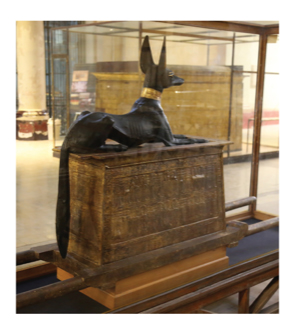
The Shrine or Ark of Anubis. Image by Titus
Kennedy
THE ARK OF THE COVENANT AND ANUBIS (Shrine of Anubis). Date: 1400-1300 BC. Discovered: Valley of the Kings, KV62, Egypt. Bible Period: Wandering. Bible Passages: Exodus 25:10-22; Numbers 4:5-6; Hebrews 9:4 The Anubis Shrine or Ark of Anubis was discovered in the tomb of Tutankhamun KV62 in the Valley of the Kings and designated Shrine 261. The shrine measures 37 inches (95 cm) long, 15 inches (37 cm) wide, and 21.4 inches (54.3 cm) high in the shape of a trapezoid. It was constructed as a wood chest with a layer of plaster covered in gold leaf, topped with a guardian figure of Anubis in the likeness of a jackal. Two poles were attached to the sides to carry it, and items were placed inside. The chest was decorated with the “djed pillar” associated with the afterlife and the underworld god Osiris, and two hieroglyphic inscriptions invoking Anubis. Inside the chest are four small compartments and one large compartment that contained amulets, statuettes of the god Thoth, a statuette of the god Horus, two shabtis, a clay scepter, and jewels. This Egyptian chest comes from the 1400-1300 BC, approximately 100 years after the Exodus and the construction of the ark of the covenant.
It demonstrates a crafting style used in Egypt that was also employed in the creation of the ark of the covenant. The sacred chest with a guardian on top is seen in Egyptian artwork from at least as early as the reign of Hatshepsut around 1500 BC, and therefore was an object in use in Egypt prior to the time of the Exodus. The biblical ark of the covenant was a chest made of acacia wood and plated in gold, measuring 2.5 cubits long, 1.5 cubits wide, and 1.5 cubits tall (approximately 52 inches long, 31 inches wide, and 31 inches tall or 1.31 m by 79 cm by 79 cm). It had a golden lid top that had two guardian cherubim/angel figures on it, the chest held the significant items of the two stone tablets of the 10 Commandments, the rod of Aaron, and a pot of manna. Similar to the Shrine of Anubis, it was a gold-plated wooden chest holding important items and carried by two poles, which attached to the chest, and was covered in a veil when transported. The two chests were similar in form and construction, and demonstrate that the Israelites were familiar with Egyptian material culture of the 18th Dynasty. However, the biblical ark was not a replica of the Shrine of Anubis or similar objects and the Israelites did not worship Egyptian Gods. But the Israelite craftsmen were able to use their skills and techniques they learned in Egypt to build a sacred ark that had features unique to the worship of the one and only Hebrew God Yahweh and the use of the ark in the tabernacle. Kennedy, Unearthing the Bible, 62-63.
During the periods of Joshua and judges, archaeological artifacts (royal seals, Egyptian and Canaanite documents, religious objects and artwork, etc.) demonstrate conquests of cities in Canaan by people outside of Canaan at the times and places recorded in the biblical books of Joshua and Judges. The book of Joshua states that Joshua led the Israelites in a 5-year campaign that involved the burning of the cities of Jericho, Ai, and Hazor, and the elimination of 31 local kings. However, the Israelites did not take possession of all of the cities and regions of Canaan during Joshua’s campaign. They still needed to establish new settlements. Then during the next 300 years, the Israelites acquired and settled the remaining cities and regions in the time of the judges as recorded in the books of Judges, Ruth, and the beginning of 1 Samuel. Then Canaan became Israel a new nation and the Israelites were no longer nomads. This conquest and settlement of Canaan/Israel occurred during the Late Bronze Age (about 1500-1200 BC) and the beginning of the Iron Age (about 1200-1000 BC). Kennedy, Unearthing the Bible, 68-69.
JERICHO AND PHARAOH AMENHOTEP III (Scarab of Amenhotep III). Date: 1410 BC Discovered: Jericho, Canaan (Tell es-Sultan). Bible Period: Conquest. Bible Passage: Joshua 6:20-26. Archaeological artifacts discovered in tombs at Jericho include a near continuous series of Egyptian royal scarabs spanning the 18th century BC to the beginning of the 14th century BC, or from the Egyptian 13th Dynasty to the middle of the 18th Dynasty. These discoveries include a rare scarab of the female Pharaoh Hatshepsut, one scarab and one seal of her coregent and successor Thutmose III, and two scarabs of Amenhotep III. The two scarabs of Amenhotep III are extremely important because those represent the latest pharaoh attested by artifacts from the Bronze Age city of Jericho. This means that the fall of Jericho occurred during his reign.
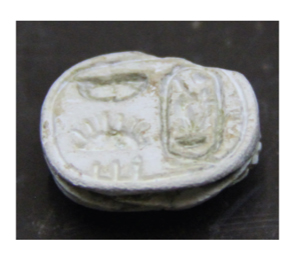
Amenhotep III Scarab. Image by Titus Kennedy.
Along with a 15th century BC cuneiform tablet and distinctive pottery found during excavations, including special painted wares, these scarabs suggest that the walled city of Jericho was inhabited from before 1700 BC to around 1400 BC. Then the destruction and abandonment of the city occurred during the time of Pharaoh Amenhotep III, whose reign extended from the 15th to the 14th century BC. One of the two Amenhotep III scarabs is of particular interest. The inscribed, flat side of the scarab contains the cartouche of the pharaoh with his throne name Neb Maat Ra (meaning “the god Ra is lord of truth/justice/order”) and shows extremely fine Egyptian craftsmanship, indicating that it was made in Egypt and imported to Canaan. To the left of the cartouche appears an early form of the Aten sun disk with its outstretched rays, perhaps linking it to the time when the prominence of Aten was emerging in Egypt, and when Amenhotep III was often referred to as “the Sun” in the Amarna Letters. This suggests that the scarab was made before subsequent religious reforms of extreme Atenism or the even later reversion to Amun worship. Kennedy, Unearthing the Bible, 68-69.
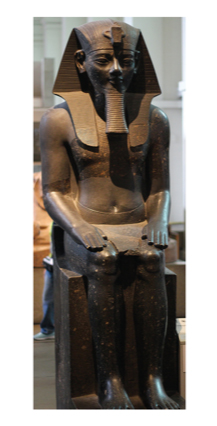
Amenhotop III Scarab. Image by
Titus Kennedy.
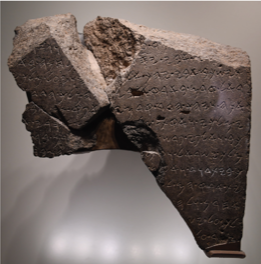
Fragments of the Tel Dan Stele with the inscription, “house of David.” Image by Titus Kennedy.
Therefore, this Amenhotep III scarab statue discovered at Jericho was made during his reign. This means that the destruction and abandonment of Jericho occurred around 1400 BC, which is also the approximate date according to a chronological analysis of the books of Numbers, Joshua, Judges, and Kings. Kennedy, Unearthing the Bible, 68-69.
THE ROYAL HOUSE OF DAVID (Tel Dan Stele). Date: 900-800 BC. Discovered: Dan, Israel. Bible Period: United Monarchy and Divided Kingdom. Bible Passage: 2 Samuel 3:1-6; 1 Kings 12:19-26, 15:16-22; Psalm 122:5. In the twentieth century, biblical critics claimed that King David never existed and King Solomon was merely a tribal chieftain instead of a king of a vast Jewish kingdom. But in 1993, an Israeli archeologist found a fragment of a stone monument at the site of ancient Dan with inscriptions referring to King David and his dynasty, the House of David. Hanegraaff, Has God Spoken?, 64-67. During excavations at ancient Dan in 1993, fragments of a 9th-century BC Aramean victory stele were discovered at the base of a wall on the edge of a plaza near the main city gate. The Israelites most likely smashed the stele when they regained power of Dan. Written in Aramaic, the recovered stele consists of 3 main fragments comprising 13 lines of text which state the victories of kings of Israel and Judah. On line 9 of the stele the “house of David” (byt dwd) is noted as the original ruling house of the Israelite kingdom. This demonstrates that David was known as the first king of Israel even by the neighboring Arameans, who were enemies of Israel. The stele is the earliest known reference to King David and his House/dynasty. The monumental inscription was carved into basalt and placed at Dan by the Arameans after they conquered the Israelites and subdued the city as early as 870 BC. In 1994, two more chunks of black basalt stone were excavated referring to the house of David. This phrase “house of David” also appears the books of Samuel, Kings, Chronicles, Psalms, Isaiah, Jeremiah, and Zechariah. The inscription “house of David” is extremely significant due to its ancient attestation of David as king of Israel, which was disputed by many scholars prior to the discovery of the Tel Dan Stele. After the Tel Dan Stele’s discovery, the 9th-century Mesha Stele or Moabite Stone that was discovered in 1868 was reevaluated and also found that it, too, had the phrase “house of David” referring to the royal descendants of King David. This is also consistent with the Luke’s New Testament reference that Jesus “was of the House and lineage of David” (Luke 2:4 KJV). Hanegraaff, Has God Spoken?, 64-67; Kennedy, Unearthing the Bible, 98-99.
KING JEROBOAM (Seal of Jeroboam). Date: 10th century BC Discovered: Megiddo, Israel. Bible Period: Divided Kingdom. Bible Passages: 1 Kings 11:40–12:33; 2 Kings 14:23–15:1; 23:15; Hosea 1:1; Amos 1:1; 7:9-11. In or about 931 BC, Israel divided into two separate kingdoms of Israel and Judah when Jeroboam, the former general of King Solomon, rebelled against Rehoboam, the son of Solomon and next king. Jeroboam ruled the 10 northern tribes, thereafter called the kingdom of Israel, from the city of Shechem. Rehoboam ruled the southern tribes of Judah and Benjamin, thereafter called the kingdom of Judah, from Jerusalem. During this Divided Kingdom period, Israel was heavily influenced by foreign nations, adopted many pagan deities and practices, and eventually was destroyed and dispersed by the Assyrians in 722 BC. Judah also engaged in polytheism and paganism, but many of the kings followed God and observed the Law of Moses. In 701 BC Assyria attacked Judah, but did not conquer Jerusalem. However, the Egyptians under Pharaoh Necho II controlled Judah briefly, appointing Jehoiakim as king. Soon after, in 605 BC, the Babylonians subdued Judah as a vassal kingdom, then finally destroyed Jerusalem and the temple in 587 BC after a rebellion, ending the period of the Jewish monarchy.
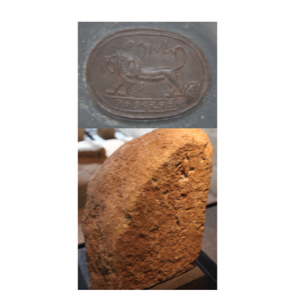
Seal of King Jeroboam. Image
by Titus Kennedy.
Biblical skeptics contend that the divided kingdoms of Israel and Judah were propaganda written by the Jewish scribes and priests of Judah, who had allegedly invented this new monotheistic religion and imposed it on the formerly polytheistic Israelites. However, the archaeological artifacts from this period are so numerous and verify the biblical narratives that it is unfounded and unreasonable to claim that books such as Kings and Chronicles are propaganda and fake history. For example, a seal with the Hebrew inscription “belonging to Shema, servant of Jeroboam” was excavated at Megiddo, Israel in the area of the gatehouse or palace of the late 10th century BC where it had likely been kept with other seals for official use. This seal, made of jasper, was decorated with a carved lion and painted on either side of the lion with an ankh and palm tree. Originally it was mounted on a ring of metal. Some scholars opined the seal is from the 8th century BC, but the stratigraphic evidence indicates the seal is from the 10th century BC and the reign of King Jeroboam I, the former warrior who became king (ca. 931–910 BC). Jeroboam son of Nebat, rebelled against King Solomon, fled to Egypt, returned after Solomon’s son Rehoboam was made king, and became the first king of the northern kingdom of Israel. Kennedy, Unearthing the Bible, 108-109.
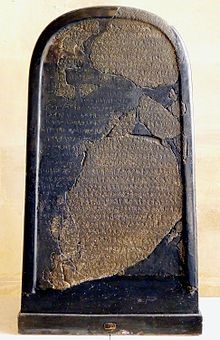
The Mesha Stele or Moabite Stone.
Image from Wikopedia.org.
MESHA OF MOAB (The Mesha Stele). Date: about 835 BC. Discovered: Dibon, Moab (today Dhiban, Jordan). Bible Period: Divided Kingdom. Bible Passages: Numbers 32:3; 1 Kings 11:7, 16:24-30; 2 Kings 3:4-27, 23:13. In 1868, the Mesha Stele or Moabite Stone was discovered in Dhiban, Jordan. It is one of the most significant discovered artifacts in the Middle East. It was erected to honor Chemosh, the chief god of the Moabites. It describes how King Mesha of Moab conquered the territory southeast of the Dead Sea that was controlled by the house of David. It also mentions King Omri, one of the most evil and significant kings of the northern kingdom of Israel.
He purchased and made Samaria the capital city of the northern kingdom of Israel (1 Kings 16:24-30). Chemosh allowed King Omri to repress the Moabites revolt under King Mesha of Moab, because Chemosh was angry at his land of the Moabites. Chemosh also ordered King Mesha to attack the town of Nebo originally captured by the tribe of Reuben (Numbers 32:3). This reference confirms Mount Nebo where God showed Moses the Promised Land and it was the place in Moab where Moses died and was buried (Deuteronomy 34:4-6). In 1994, the Mesha Stele or Moabite Stone was reevaluated and also found that it, too, had the phrase “house of David” referring to the royal descendants of King David. It also states that King Mesha said, “I took the vessels of YHWH (Yahweh, God of Israel) and I dragged them before Chemosh.” This is one of the earliest references to Yahweh, outside of the Bible. This confirms the Bible’s account of Yahweh the “Creator of heaven and earth” (Genesis 14:19 NIV) and “Chemosh the vile god of Moab” (2 Kings 23:13 NIV). Hanegraaff, Has God Spoken?, 67-68; Kennedy, Unearthing the Bible, 112-113.
QUEEN JEZEBEL (Seal of Jezebel). Date: 900-800 BC. Discovered: Unknown, Israel. Bible Period: Divided Kingdom. Bible Passage: 1 Kings 16:29-31. A stone seal was found in Israel with the inscription, “belonging to Jezebel” (L’YZBL). Jezebel means “where is Baal?” and was most likely a royal name. The seal dates to about 900-800 BC when only 1 percent of the seals from this region and period belonged to women. In the Bible during this time period, Queen Jezebel was a daughter of the Phoenician/Sidonian King Ethbaal who married King Ahab of the northern kingdom of Israel (1 Kings 16:31). Kennedy, Unearthing the Bible, 118.
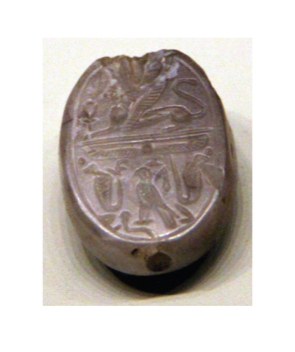
Seal of Jezebel. Image by Titus Kennedy.
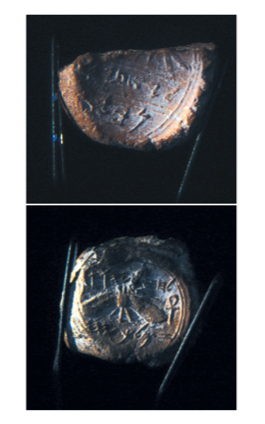
Bulla seal of Isaiah. Image by Titus
Kennedy.
ISAIAH THE PROPHET’S SEAL (Bulla of Isaiah). Date: 740-686 BC. Discovered: Jerusalem, Israel. Bible Period: Divided Kingdom. Bible Passages: 2 Kings 19:1-7; 1 Chronicles 1:29; Isaiah 1:1, 60:7; Hebrews 11:37. A clay bulla (a lump of clay molded around a cord and stamped with a seal) made from a stamped impression of a signet ring, apparently referring to the prophet Isaiah 740-686 BC, was discovered in the Ophel area of Jerusalem, Israel. It was found in the same archeological layer from 800-700 BC in an area outside a building called the “royal bakery” with the bulla of King Hezekiah of Judah and 32 others. At this location, administrators of the southern kingdom of Israel could have discarded old letters and their clay seals. The bulla appears to read, L-YSAYH[W] NBY[A] (“belonging to Isaiah, the prophet”) in the archaic Hebrew script used during much of the kingdom period. This is the first contemporary archaeological evidence discovered for Isaiah, who was a prophet and spiritual advisor of King Hezekiah. Isaiah ministered during the reigns of kings Uzziah, Jotham, Ahaz, Hezekiah, and Manasseh from about 760-680 BC. Isaiah lived from about 760-680 and may have been executed during the reign of Manasseh. Kennedy, Unearthing the Bible, 130-131.
THE SIEGE OF LACHISH. (Lachis Reliefs). Date: 700-681 BC. Discovered: Palace of Sennacherib in Nineveh, Assyria. Bible Period. Divided Kingdom. Bible Passages: 2 Kings 18:7-17; 2 Chronicles 32:9; Isaiah 36:1-2. Several years after the Assyrians conquered and disbursed the northern kingdom of Israel in about 722 BC, King Hezekiah of the southern kingdom of Judah stopped being a vassal of, serving, and paying tribute to Assyria. Then King Sennacherib of Assyria and his army started a campaign to conquer Judah in about 701 BC. Sennacherib’s army was able to conquer and destroy the fortified cities and towns of Judah. The most strategic conquered city was Lachish, which Sennacherib commemorated with elaborate stone wall panels with illustrations called reliefs in room 36 of his South-West palace in Nineveh, Assyria. These walls shown on the reliefs were compared to the site of Lachish and matched the walls at the ruined city of Lachish. Archeological excavations at Lachish also corroborated the reliefs illustrations of the Assyrians’ use of a siege ramp, prolific use of arrows, the fall of Lachish, the torture and execution of men of Judah, and the deportation of men, women, and children. The campaign and conquest of Lachish was also recorded in the official Assyrian records and Old Testament books of Kings, Chronicles, and Isaiah. Kennedy, Unearthing the Bible, 136-137.
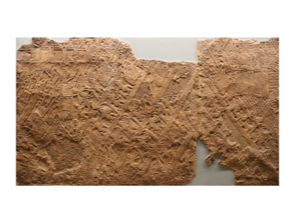
Lachish siege reliefs. Image by Titus Kennedy.
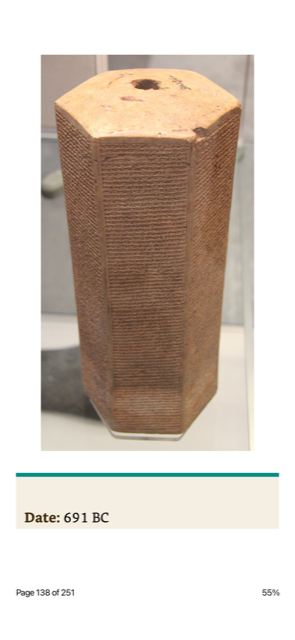
Oriental Institute Prism.
Image by Titus Kennedy.
SENNACHERIB AND HEZEKIAH. (Sennacherib Prisms). Date: 691 BC. Discovered: Palace of Sennacherib in Nineveh, Assyria. Bible Period: Divided Kingdom. Bible Passages: 2 Kings 18:13-19:37; 2 Chronicles 32:9-21; Isaiah 36:1-37:38. But Sennacherib was unable to conquer Jerusalem. The Assyrian records dated to about 691 BC in the form of three different baked clay cuneiform prisms (Taylor Prism, Oriental Institute Prism, and Jerusalem Prism) called the Annals of Sennacherib, document eight Assyrian campaigns including one against the kingdom of Judah in 701 BC. The prisms record that Sennacherib and his army were able to conquer 46 fortified cities and deport 200,150 people and animals, the siege of Jerusalem, King Hezekiah, and Judah’s forced tribute payment to Assyria. But the Assyrian records are silent after the siege and forced tribute and do not state that the Assyrians captured Jerusalem. The Old Testament account states that Hezekiah paid the tribute to Sennacherib more than Sennacherib initially demanded (2 Kings 18:14-15), but the Assyrians were unable to conquer Jerusalem because their officers and mightiest warriors died. So the Assyrians returned to Nineveh in shame. Both the Assyrian records and the Old Testament record that thereafter Sennacherib was assassinated and his son Esarhaaddon became king of Assyria (2 Kings 19:37; Isaiah 37:38). Kennedy, Unearthing the Bible, 138-139; Hanegraaff, Has God Spoken?, 80-82.
PERSIANS CAPTURE BABYLON (Nabonidus Chronicle). Date: 400-300 BC. Discovered: Babylon, Iraq. Bible Period: Babylon and Persia. Bible Passages: Daniel 5:25-6:2, 9:1-2, 11:1. The Old Testament book of Daniel records that the Persians conquered Babylon and killed King Balshazzar, but it does not record any type of battle for the city. Also, Daniel states that Darius the Mede ruled the city of Babylon instead of King Cyrus II the Great of Persia. Cuneiform writings on a clay tablet called the Nabonidus Chronicle and inscriptions on the Cyrus cylinder also state that there was no battle for the city of Babylon and Cyrus did not lead the army that captured Babylon in about 539 BC. Instead, a general from Media led the Persian army that took over Babylon and the general thereafter ruled as the governor of the city from about 535-525 BC. Daniel mentions Darius the Mede as potential candidate for this general that took over and initially governed Babylon. Kennedy, Unearthing the Bible, 162-163.

Nabonidus Chronicle. Image from the
British Museum.
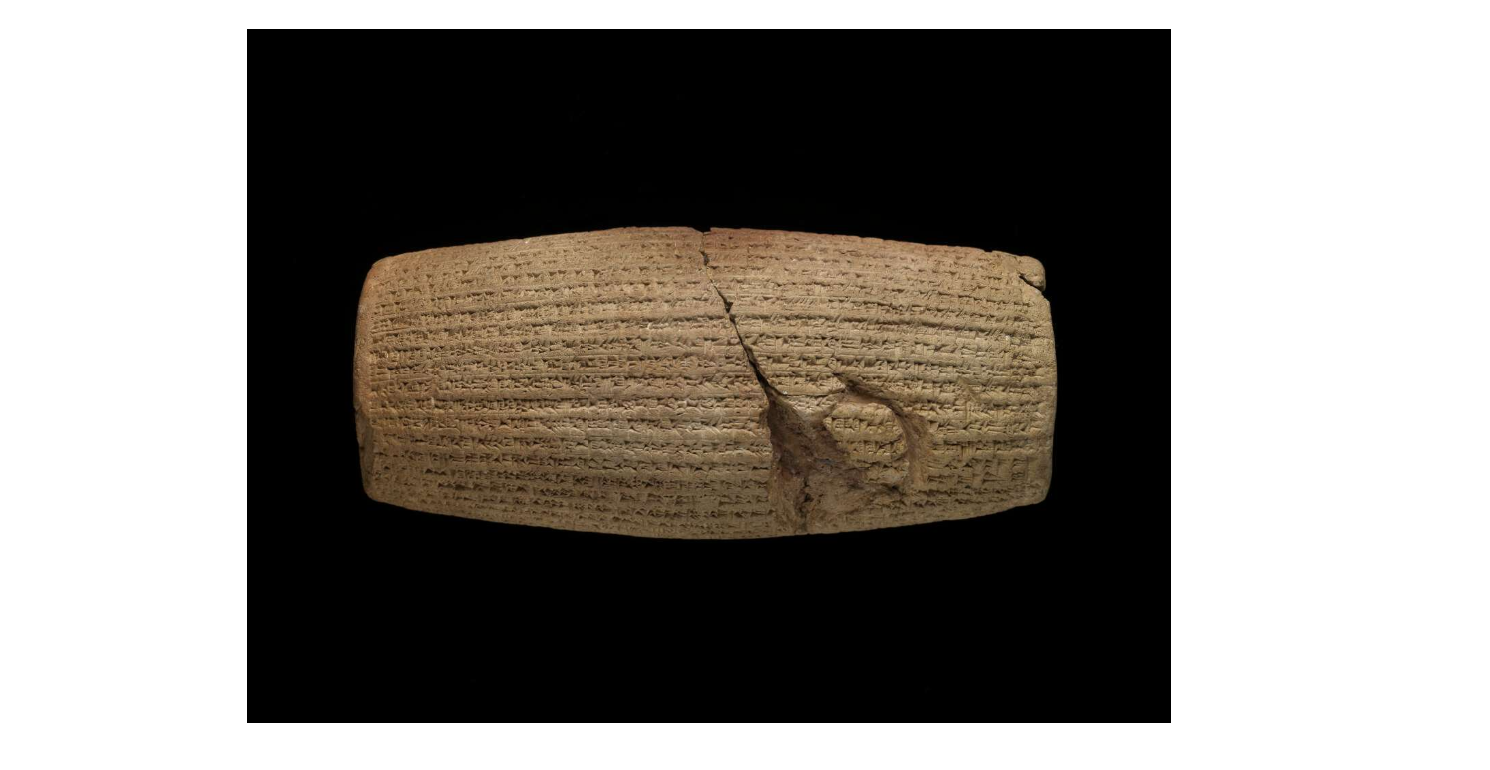
The Cyrus Cylinder. Image from the British Museum.
CYRUS ALLOWS THE EXHILES TO RETURN TO JUDAH (The Cyrus Cylinder). Discovered: Temple of Marduk (Babylon, Iraq). Bible Period: Babylon and Persia. Bible Passages: 2 Chronicles 36:22-23; Ezra 1:1-4. After Cyrus II the Great through his general captured Babylon in 539 BC, he issued a decree that the captive Israelites could return to their homelands, receive back their stolen religious objects, and rebuild their temple. The Cyrus Cylinder message was addressed to the Babylonian god Marduck and stated that Nabonidus, the previous Babylonian king, was a religious heretic and enslaved the free people of the city. So the gods chose Cyrus as a champion, liberator, and king of the world. The Old Testament book of Ezra contains essentially the same decree, but it was written to the southern kingdom of Judah and referred to Yahweh instead of Marduk. Cyrus was a religion pluralist and tolerated most beliefs in the Persian empire so long as they did not cause problems for the Persian government or lead to rebellion. Kennedy, Unearthing the Bible, 164-165.
DEAD SEA SCROLLS (Great Isaiah Scroll). Date: 300 BC. Discovered: Cave 1, Qumran, Israel. Bible Period: Between the Old Testament and New Testament. Bible Passages: Isaiah 1:1-66:24; 1 Peter 1:23-25. In 1946, Bedouin shepherds discovered scrolls called the “Dead Sea Scrolls” in ancient clay jars in caves by the Dead Sea in Qumran, Israel. The scrolls were dated as early as 300 BC and were most likely written and stored in the jars by the Essenes, a sect of Judaism that withdrew from society and lived in a devout religious community in Qumran. The scrolls contained every book of the Old Testament except Esther. The Essenes may not have regarded Esther as Scripture because it does not mention God and has secular characters.
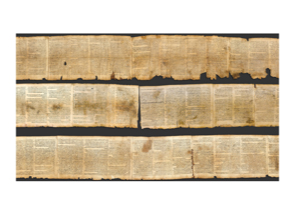
The Great Isaiah Scroll. Image by Titus Kennedy.
The scrolls date back more than a century before Jesus. Specifically, the Great Isaiah Scroll was the first found manuscript in Cave 1 at Qumran (1 QIsaiah-a) and has been dated to around 300 BC. It was made from 17 pages of parchment stitched together and is a complete copy of all 66 chapters of the book of Isaiah except for a few small damaged areas. In addition, the Dead Sea Scrolls pre-dated the earliest extant Masoretic text (AD 1,000) by more than 1,000 years in the form of the oldest complete Masoretic Hebrew Bible prior to the discovery of the Dead Sea Scrolls: The Leningrad Codex, which dates to AD 1008. Yet when Masoretic text was compared to the Dead Sea Scrolls, differences in style and spelling in about 5% of the text were noted, but there was no significant difference in substance. Hank Hanegraaff, Has God Spoken?, 10-12; Wegner, A Student’s Guide to Textual Criticism of the Bible, 63-78; Kennedy, Unearthing the Bible, 234-5. Therefore, the Dead Sea Scrolls demonstrated that the text of the Old Testament was accurately copied over many centuries.
NEW TESTAMENT (Artifacts). Many artifacts demonstrate the accuracy and reliability of the New Testament gospels regarding the life and ministry of Jesus Christ. In addition, the discovery of historically early manuscript copies of the gospels confirm the early gospel accounts were from eyewitness testimony. In addition to Kennedy, Unearthing the Bible, see Titus Kennedy, Excavating the Evidence for Jesus: The Archaeology and History of Christ and the Gospels, (Eugene, OR: Harvest House Publishers, 2022).
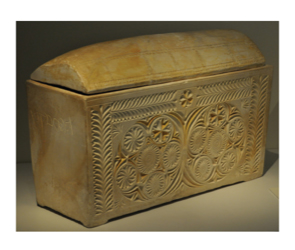
Caiaphas Ossuary. Image by Titus Kennedy.
CAIAPHAS THE HIGH PRIEST (Caiaphas Ossuary). Date: AD 0-100. Bible Period: Jesus and the Gospels. Bible Passages: Matthew 26:3-68; Luke 3:1-2; John 18:12-28; Acts 4:5-6. From about AD 18 to 36, Joseph Caiaphas was the high priest in Jerusalem that was involved in the plot to kill Jesus, conducted the trial of Jesus, issued charges of blasphemy and treason, and requested that Jesus be executed by the Romans according to the New Testament and Josephus. An ossuary (stone box placed in a tomb that stores human bones) of Mariam, the daughter of the son of Caiaphas found in Elah Valley, Jerusalem, Israel has an inscription stating that the Caiaphas family was a priestly family in the line of Ma’aziah, a priest from the tribe of Levi who was appointed during King David’s reign. Another ossuary found in a first century AD tomb outside Jerusalem dating to before AD 70 contains an inscription, “Yehosef bar Qayafa” (“Joseph, son of Caiaphas”). This inscription corresponds with the New Testament Greek spelling of the Caiaphas family name Kaiafa. The bones of a 60 year old man and five other individuals were inside the ossuary. The name, location, and decorative details of the ossuary indicate it was a burial box of a wealthy and prominent Jerusalem citizen with a family name of Caiaphas. This ossuary most likely contained the bones of Caiaphas, who served as the high priest in AD 35 with Jonathan the son of Ananus. Kennedy, Unearthing the Bible, 164-165; Kennedy, Excavating the Evidence for Jesus, chapter 7.
PONTIUS PILATE THE GOVERNOR/PREFECT (The Pilate Stone & Ring). Date: AD 26-36. Pilate Stone Discovered: Caesarea, Israel. Pilate Ring Discovered: Herodium, Israel. Bible Period: Jesus and the Gospels. Bible Passages: Mark 15:1; Matthew 27:1-26; Luke 3:1-2; John 18:28, 19:1-15. In AD 26, Tiberius was the emperor of Rome and Sejanus was a commander of the Praetorian Guard. Sejanus accumulated so much power and influence that he effectively ruled the Roman Empire and most likely appointed Pontius Pilate as the fifth governor/prefect of the Judea Province in AD 26. Pilate had at least 6 significant conflicts with the local people, with the last conflict resulting in Pilate’s recall from the province. One of these conflicts was the trial of Jesus in AD 33. Since Pilate as the prefect had the power to sentence to death or acquit, his approval was necessary to execute Jesus. He did not want to cause another conflict, so he agreed to sentence Jesus to death at the request of the Jews. There are two artifacts that confirm that Pilate was the prefect of Judah. The first is the monument stone called the Pilate Stone that had an inscription that dated between AD 26-36. It is a two-by-three foot limestone block that has the Latin inscription, “Tiberium, Pontius Pilatus, Prefect of Judea … dedicated.”

The Pilate Stone. Image by Titus Kennedy.
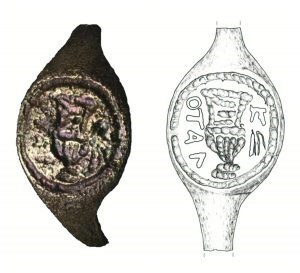
View and cross section of the Pilate ring discovered at
Herodium, Israel. Drawing by Rodman. Photo by
C. Amit, IAA Photographic Department.
The second artifact is a copper-alloy Roman-type ring that had the Greek inscription, “Pilato” (Pilatus in Latin). The ring could be used as a stamp on behalf of Pilate. The ring dates from AD 71 or earlier and was found in 1969 in Herodium near Jerusalem in an archaeological layer in a room with other first century AD artifacts and coins of the First Judean Revolt against Rome.
The Pilate Stone and the Pilate ring are very important artifacts that confirm the New Testament. First, they corroborate the biblical account that Pilate was the Roman authority in Judea at the time Jesus was crucified (Mark 15:1; John 18:28). Second, they confirm that Luke accurately recorded that Pilate ruled Judea during the reign of Tiberius Caesar when Herod was tetrarch of Galilee and Caiaphas followed Annas as the high priest in Jerusalem (Luke 3:1-2). Third, prior to the discovery of the Pilate Stone and Pilate ring, Pilate was only known from manuscript copies of Josephus, Philo, Tacitus, the gospels, Acts, and 1 Timothy. Hanegraaff, Has God Spoken?, 68-70; Kennedy, Unearthing the Bible, 164-165; Kennedy, Excavating the Evidence for Jesus, chapter 7.
CRUCIFIXION IN JUDEA (Crucified Man Remains). Date: AD 0-100 AD. Discovered. Givat Ha Mivtar, Jerulaelm, Israel. Bible Period: Jesus and the Gospels. Bible Passages: Luke 24:36-40; John 19:45, 20:20-29. The remains of two men have been recovered that show the use of nails in crucifixion from AD 0-100 in Judea, Israel. These artifacts indicate that the men had been attached to a wooden cross by placing nails in the wrists and feet, just as Jesus was. An iron nail about 4.5 inches long (11.5 cm) with wood remnants was still in the heel bone of one of the men. In another more recent find, a nail was found inserted between the bones of the wrist in another crucified man from Judea. Kennedy, Unearthing the Bible, 194-195; Kennedy, Excavating the Evidence for Jesus, chapter 7.
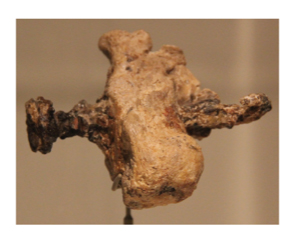
Crucified man remains. Image by Titus Kennedy.
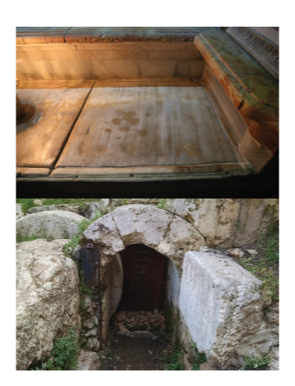
Burial bench and tomb of Jesus at the Church of Holy
Sepulchre. Image by Titus Kennedy.
THE TOMB OF JESUS (Burial Bench in the Holy Sepulchre). Date: AD 300-400. Discovered: Church of the Holy Sepulchre, Jerusalem, Israel. Bible Period: Jesus and the Gospels. Bible Passages: Matthew 27:57-28:7; Mark 15:42-16:8; Luke 23:50-24:12; John 19:38-20:7. The New Testament account of the burial and tomb of Jesus states that Jesus was buried in new tomb just outside the walls of Jerusalem, cut out of rock, a single chamber, with a bench on which to place the body, and large stone seal.
Christians in Jerusalem passed down to subsequent generations the location of the tomb from Jesus’ burial and resurrection in AD 33 until the start of the construction of a church on that site in about AD 326, the Church of the Holy Sepulchre. In 2016 to 2017, there was restoration work at this church to the edicule (small structure or chapel around the tomb) containing Jesus’s tomb that confirmed the single chamber tomb was carved into a limestone hill during the first century. It contains a stone bench consistent with an acrosolium tomb (carved out rock section, usually an arched recess and flat stone bench to lay the body on) from the Roman period, the tomb was originally sealed with a large circular stone, and the Romans built a temple over the site prior to the building of the church. Therefore, there is evidence of the location and type of Jesus’s burial and tomb that dates back to the time of the crucifixion, death and resurrection of Jesus. There is no other location of the burial and tomb with as much evidence. Kennedy, Excavating the Evidence for Jesus, chapter 7.
JESUS’ RESURRECTION SHROUD CONTOVERSY (The Shroud of Turin): Date: AD 33 versus forgery. Discovered: France in the 1350s. Bible Period: Jesus and the Gospels. Bible Passages: Matthew 27:57-28:7; Mark 15:42-16:8; Luke 23:50-24:12; John 19:38-20:7. The controversy over the Shroud of Turin is whether it is the actual burial cloth of Jesus with imprints of the front and rear images of his body caused by the radiation of his body at the moment of his resurrection versus one of the most ingenious forgeries in history. The shroud made its first appearance in the 1350s in France. In 1356, the original owner died without revealing where or how he acquired the cloth. In 1532, a fire damaged the cloth and patches were added. Since 1578, the shroud has been kept in Turin, Italy.
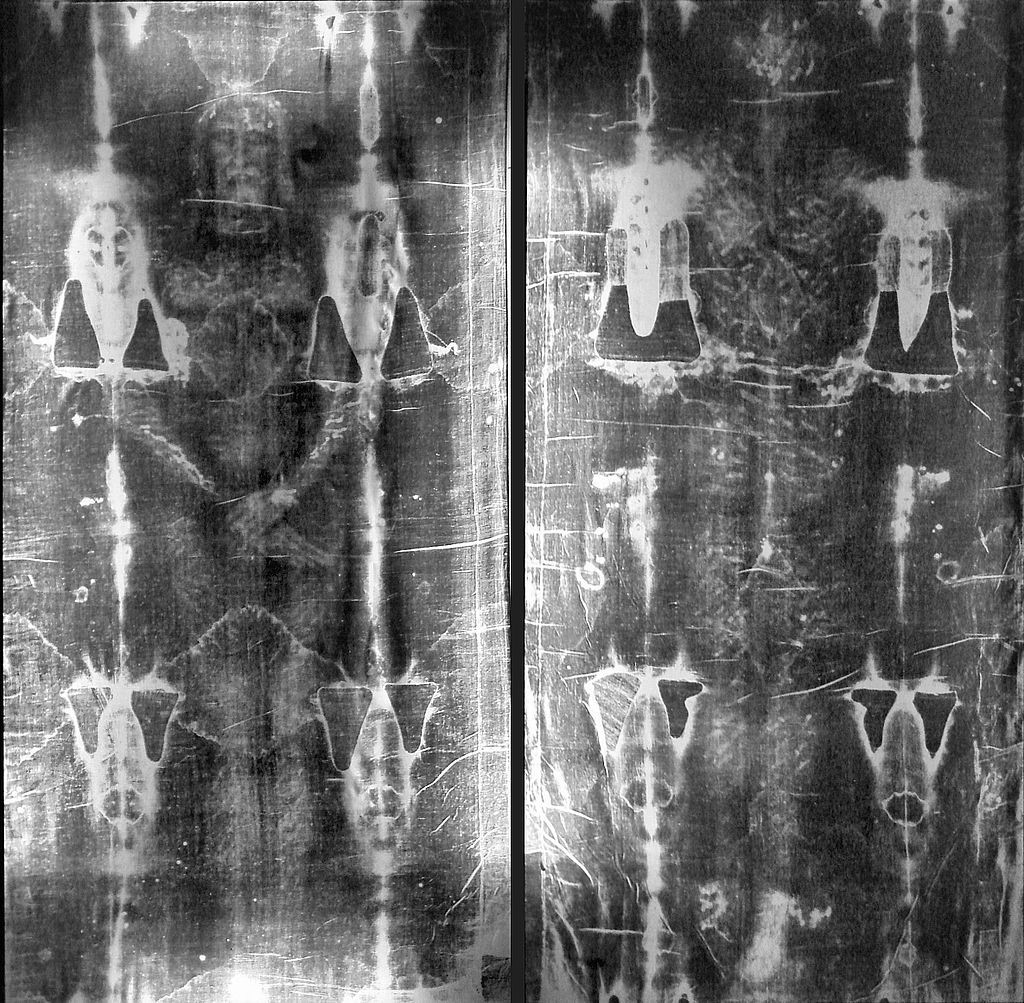
Full-length negatives of the Shroud of Turin. Images from
Wikimedia Commons.
The evidence supporting the authenticity of the shroud includes:
- The injuries of the man in the shroud are consistent with a man that was crucified in Roman fashion and correspond to injuries that Jesus suffered to his head, hands/wrists/thumbs collapsed into the palms (and possibly feet) pierced, a wound in his side, legs not broken, purple stains that appear to be blood all over the linen shroud, traces of flogging on the front and back of the body by Roman scourging with a flagrum with two or three leather thongs with a pair of barbed lead balls or sheep bones at the end of each that caused over 100 lash marks in dumbbell shape, and abrasions on the body that could be the result of carrying a heavy wooden cross-bar of a cross.
- The dirt soil at the feet image section of the shroud is from limestone dirt soil found in or near Jerusalem. This dirt soil is not found in western Europe where critics claim the shroud was created. The pollen preserved in the fibers suggest the cloth originated at or near Jerusalem.
- The image is barely visible to the eye, and only a rough outline can be seen by standing farther away. However, when photographed and viewed in negative, a clear image appears on the shroud that allows a three-dimensional reconstruction of the man’s appearance. The image even reveals body parts/organs inside the body such as the teeth similar to an x-ray or MRI. The image on the surface of the cloth is no more than two fibrils (filaments or fibers) deep. The image was not painted. Instead, some of the threads were changed to produce the image by some type of radiated energy according to modern scientific tests on the shroud. This radiated image technology was not available at the time the image was made on the shroud either in AD 30 or AD 1260-1390 when critics claim the shroud was created based on carbon 14 testing as stated below. Modern scientists cannot reproduce the same image on a similar shroud type cloth.
- Potsherds or coins may have covered the eyes that state Pontius Pilate (although misspelled), but the fabric is so coarse and the image is not clear enough so that many sceptics of the shroud doubt this claim can be substantiated.
The evidence against the authenticity of the shroud includes:
- In 1988, British scientists conducted carbon 14 testing on a piece from the edge of the shroud that dated the shroud to between AD 1260-1390. However, subsequent researchers argue that the sample of the shroud for the carbon 14 test was taken from a part of the shroud that was repaired and not from the original fabric, because there were cotton fibers in the sample that are not in the parts of the shroud that were not repaired and patched.
- In 2002, the shroud underwent substantial restoration, which included the removal of the repair patches from 1532. Some researchers claim that this process will limit or invalidate any further testing.
Based on the evidence, it is more likely that the shroud is authentic artifact shroud of the crucified Jesus or at least of another crucified man. Walter C, Kaiser, Jr. Editor and Gordon-Conwell Theological Seminary, NIV Archaeological Study Bible. An Illustrated WalkThrough Biblical History and Culture (Grand Rapids, MI: Zondervan, 2005), 4408-4410; Dr. John H. Walton PhD and Dr. Craig S. Keener PhD Editors and Authors, NIV Cultural Backgrounds Study Bible. Bringing to Life the Ancient World of Scripture (Grand Rapids, MI: Zondervan, 2016), 6603-6036; Doug Powell “Ancient Art of Facts” podcast interview of Gary Habermas, Is the Shroud of Turin Authentic? presented on the Tactical Faith YouTube program, March 16, 2021, https://www.youtube.com/watch?v=b4a4YmAhbsY; www.shroud.com. See also Shroud of Turin Website www.shroud.com and Turin Shroud Center of Colorado www.shroudofturin.com.
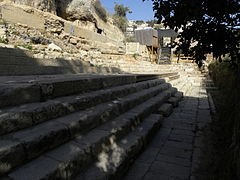
The steps of the Pool of Siloam. Image by Ian Scott
contributed to Wikimedia Commons.
JESUS HEALS BLIND MAN (The Pool of Siloam): Date: AD 30-33. Discovered: Jerusalem, Israel. Bible Period: Jesus and the Gospels Bible Passages: (John 9:1-7). The apostle John wrote accounts of Jesus healing a man by spitting on the ground and rubbing the clay in eyes of a blind man and telling him to wash his eyes in the Pool of Siloam in Jerusalem (John 9:1-7) and healing of a lame man on the Sabbath by telling him to pick up his mat and walk at the Pool of Bethesda in Jerusalem (John 5:2-14). Until modern times, skeptics claimed there was no archeological evidence of these pools. However, in June 2004, workers in the Old City of Jerusalem discovered the remains of steps on one side of the Pool of Siloam. Archeologists excavated three sets of stairs, each containing five steps, and a pool in the shape of a trapezoid 225 feet wide overlooking the Kidron Valley. Encased in the plaster were four coins of Alexander Jannaeus, the king and high priest of Judea (103 to 76 BC), strongly indicating that the Pool of Siloam was constructed during the reign of the Hasmonean kings’ independent rule of Israel (140 to 37 BC). This pool was supplied water from the Siloam Tunnel built by King Hezekiah of Judah in the eighth century BC (to supply water and withstand a siege from Assyria) from the Gihon Spring in the Kidron Valley to the Pool of Siloam near the King’s Garden (2 Kings 20; 2 Chronicles 32, Isaiah 37). In 1837, the Siloam Tunnel was discovered. Hanegraaff, Has God Spoken?, 72-75.
JESUS HEALS LAME MAN (The Pool of Siloam): Date: AD 30-33. Discovered: Jerusalem, Israel. Bible Period: Jesus and the Gospels Bible Passages: (John 5:2-4). The apostle John’s account of the Pool of Bethesda stated the pool was near the Sheep Gate which was surrounded by five covered colonades (John 5:2). In 1956, excavations of the Pool of Bethesda revealed it was a twin basin pool located where John indicated and was bounded on the sides with four colonades and spanned across the middle by a fifth. One of the basins must have had broad steps with landings at intervals, which would allow the lame man and his bed access to the the pool before Jesus healed him. Hanegraaff, Has God Spoken?, 75-78.
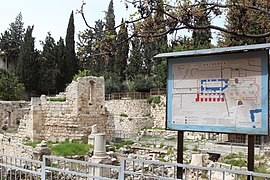
The Pool of Bethesda. Image by Fallaner from Creative Commons.
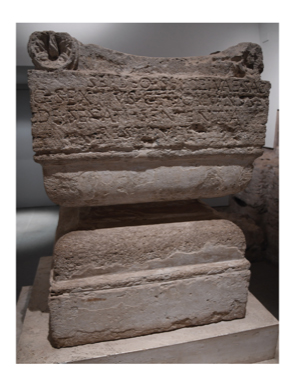
Altar to a god or goddess sacred.
Image by Titus Kennedy.
ALTAR TO THE UNKNOWN GOD (Unknown Gods Altars). Date: 100-0 BC. Discovered: Palatine Hill, Rome, Italy. Bible Period: Apostles and the Early Church. Bible Passage: Acts 17:22-34. In about AD 50, the apostle Paul went to Athens, Greece and reasoned with the Jews, other devout persons, philosophers, and anyone who happened to be present at the synagogue, various marketplace locations, and the Areopagus (a place where people spend time telling or hearing something new). While Paul was at the Areopagus addressing Athenians and foreigners who lived in Athens, he stated, “Men of Athens, I perceive that in every way you are very religious. For as I passed along and observed objects of your worship, I found also an altar with this inscription, ‘To the unknown god. What therefore you worship as unknown, this I proclaim to you” (Acts 17:22-24 ESV). Paul then went on to proclaim that the unknown god was the God of the Bible, they should seek and find God, and that God was not far from them. Roman alters have been discovered with Greek inscriptions stating dedication to “unknown gods” in the Greek cities (currently located in Turkey) of Pergamum, Miletus, and Phrygia. A first century BC altar was discovered in Palatine Hill in Rome, Italy, which has the Latin inscription, ”whether to a god or goddess sacred” is similar to “unknown god” altar of Athens. Ancient sources and these recently discovered altars confirm that the Paul’s reference to the “unknown god” in Athens was an actual monument and not a made-up hypothetical figure of speech.
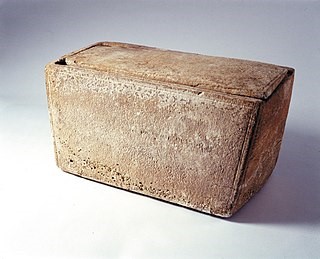
The James ossuary was on display at the Royal Ontario
Museum from November 15, 2002 to January 5, 2003.
Image by Paradiso.
JAMES, BROTHER OF JESUS (James Ossuary). Date: AD 62. Discovered: Unspecified tomb, Jerusalem, Israel. Bible Period: Apostles and the Early Church. Bible Passages: Matthew. In 2002, an ossuary called the “James Ossuary” was revealed after an epigraphy (study and interpretation of ancient inscriptions) expert examined and interpreted the Aramaic inscription on the side of the ossuary and translated it as “James son of Joseph brother of Jesus.” The ossuary became famous because it could possibly be referring to the New Testament James, Jesus’ brother. The Israeli government confiscated it under charges of forgery and illegal dealing in antiquities. It underwent an eight year antiquities trial and ultimately the forgery charges were dropped and it was returned to the owner. The ossuary and the inscription were authenticated by many scholars as a first century AD (before AD 70) limestone ossuary and inscription from Jerusalem that mentioned a James, Joseph, and Jesus, but some scholars did not agree it was authentic. A statistical name analysis found that it was probable that the inscription refers to James the apostle and leader of the Jerusalem church, and to his brother Jesus Christ, which makes it the only known first century AD inscription mentioning either James or Jesus.
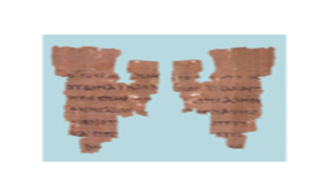
P52 John Rylands Manuscript fragment.
Image from Wikimedia.
EARLIEST NEW TESTAMENT MANUSCRIPT (P52 John Rylands Manuscript). Date: Around AD 130. Discovered: Egypt. Bible Period: Apostles and the Early Church. Bible Passages: John 18:31-33, 37-38; 1 Peter 1:22-25. The P52 John Rylands Manuscript is a fragment of 5 verses of the John 18 that is about the size of a credit card with writing on both sides. It is the oldest extant fragment of the New Testament dating to about AD 130. Since John was written in Asia Minor before AD 100 and P52 was found in Egypt, it most likely is a first generation manuscript of the Gospel of John. P52 is located in the John Rylands Library of Manchester, England. Josh McDowell and Sean McDowell, Evidence That Demands a Verdict, 60-63; Kennedy, Unearthing the Bible, 234-236.
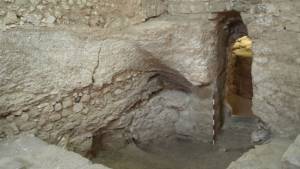 The doorway to the Jesus’ childhood home that was carved out of the rock in a cave in Nazareth. Photo by Ken Dark. https”//www.bbc.com/news/uk-england-berkshire-55061233.
JESUS’ CHIILDHOOD HOME. Date: 4 BC-AD 22. Discovered in Nazareth, Israel. Bible Period: Jesus and the Gospels. Bible Passages: Matthew 2:23, 4:13, 21:11; Mark 1:9; Luke 2:39, 4:16 ; John 1:45-46, 18:5, 19:19. Since 2006, professor and archeologist, Ken Dark, from the University of Reading, has been studying the ruins and remains of the first century dwelling beneath the modern-day Sisters of Nazareth Convent in Nazareth, Israel. He concluded that the dwelling is the home of Jesus, Mary and Joseph. The house dates back to the first century and reveals the building was carved into a rocky hillside. Dark stated that when he started his investigation, “I didn’t go to Nazareth to find the house of Jesus, I was actually doing a study of the city’s history as a Byzantine Christian pilgrimage centre. Nobody could have been more surprised than me.” Dark’s investigation found that the builder of the house had excellent knowledge of stone-working, which would be expected of someone who would have been called a tekton, the ancient word for craftsman that was used to refer to Joseph in the Bible. Dark concluded that while all these factors do not prove it was Jesus’ home, “this is about as close as we will probably ever get to being able to say it was” Jesus’ home. See Ken Dark’s article, Has Jesus’ Nazareth House Been Found?” in the March/April 2015 issue of Biblical Archaeology Review, 54-63. https://www.baslibrary.org/biblical-archaeology-review/41/2/7. See also see the BBC News Online article by Jo Couzens, ‘Strong Case’ house in crypt was home to Jesus, says archaeologist, November 25, 2020. https://www.bbc.com/news/uk-england-berkshire-55061233.
CONCLUSION REGARDING ARCHEOLOGICAL CORROBORATION OF THE BIBLE
In conclusion, although archeological artifacts cannot prove that all the biblical supernatural events, miracles, signs, and wonders occurred, they do corroborate many of the historical biblical accounts. No artifacts have refuted any of the biblical accounts. Since new artifacts are being discovered, we can be confident that they will continue to present cumulative clear and convincing evidence that the biblical accounts are historically true and accurate. In Part 2 of Hank Hanegraff’s book, Has God Spoken?, he utilizes the subacronym SPADE, meaning the archeologist’s spade, and demonstrates that archeology “documents time and time again, … the people, places, and particulars found in sacred Scripture have their roots in history and evidence. As such, what was concealed in soil corresponds to what is revealed in the Scriptures. From steles to stones to the Epic of Gilgamesh, archaeological artifacts cry forth from antiquity: God has spoken-“Scripture cannot be broken” (John 10:35 NASB). Hanegraaff, Has God Spoken?, Kindle location 252-257.